

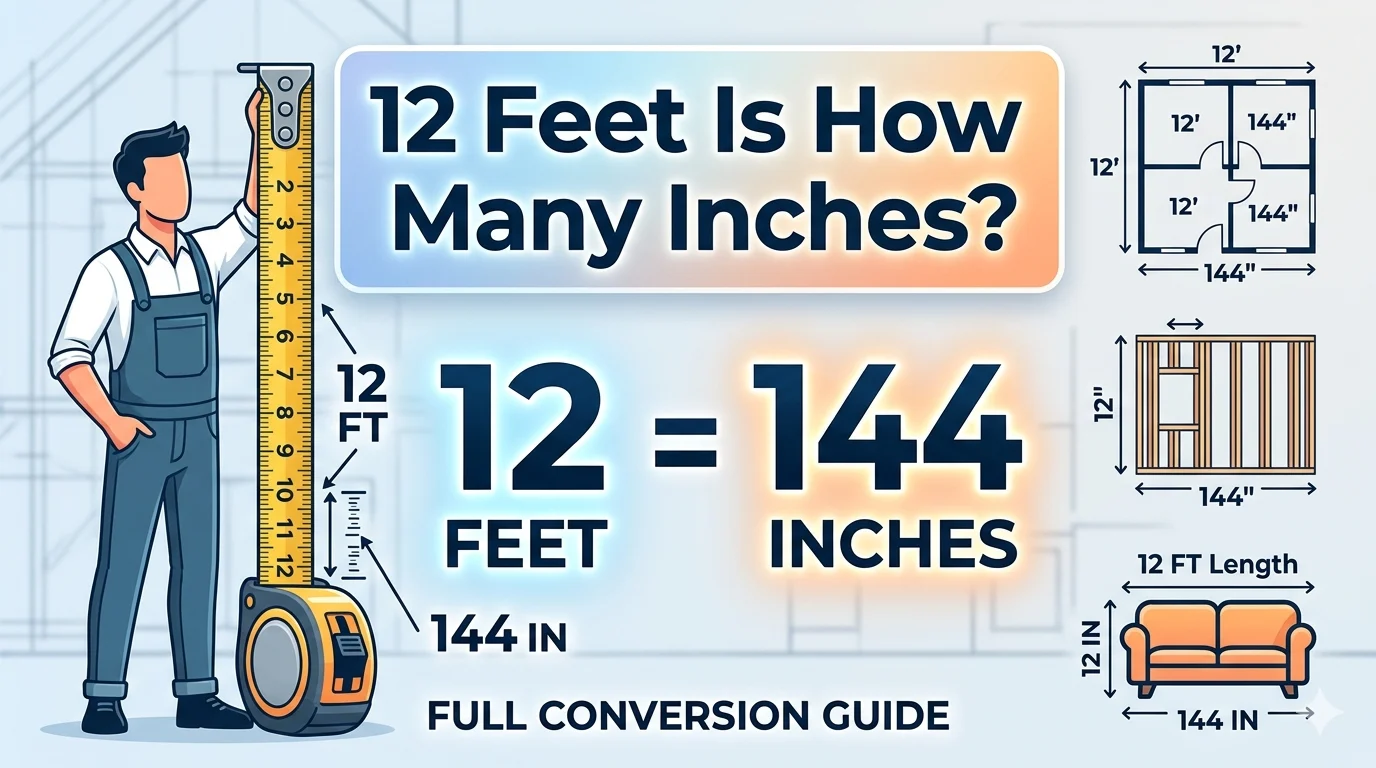
When you come across the question “12 feet is how many inches”, it usually comes from everyday needs like measuring a room, working on a DIY project, or solving a math problem. This is one of the most common unit conversion questions in the imperial system.
Understanding how feet convert into inches is not only useful for students but also for builders, designers, and anyone dealing with measurements in daily life. In this guide, you will learn the exact answer, the simple formula behind it, and practical ways to use this knowledge.
Understanding the Basics of Feet and Inches
Before solving 12 feet is how many inches, it is important to understand what these units mean.
What is a foot?
A foot is a unit of length used in the imperial system. It is commonly used to measure height, room dimensions, and distances in countries like the United States.
What is an inch?
An inch is a smaller unit of length used for more precise measurements like screen sizes, fabric length, or small objects.
Relationship between feet and inches
The standard relationship is:
- 1 foot = 12 inches
This simple rule is the foundation of all conversions.
12 Feet Is How Many Inches? Step-by-Step Explanation
Now let’s directly answer the main question: 12 feet is how many inches.
Conversion formula
To convert feet into inches, use this formula:
- Feet × 12 = Inches
Apply the formula
Now multiply:
- 12 × 12 = 144
Final answer
So,
👉 12 feet = 144 inches
This means a length of 12 feet is equal to 144 inches in total.
Quick Feet to Inches Conversion Table
Here is a simple reference chart to make conversions easier:
| Feet | Inches |
|---|---|
| 1 ft | 12 in |
| 2 ft | 24 in |
| 5 ft | 60 in |
| 10 ft | 120 in |
| 12 ft | 144 in |
| 15 ft | 180 in |
| 20 ft | 240 in |
This table helps you quickly estimate measurements without calculation.
Real-Life Uses of 12 Feet to Inches Conversion
Knowing 12 feet is how many inches is useful in many practical situations.
Construction work
Builders often convert feet into inches for:
- Wall height measurements
- Cutting materials accurately
- Planning room dimensions
Interior design
Designers use conversions for:
- Furniture placement
- Curtain and carpet sizing
- Space planning
DIY home projects
For home projects, this conversion helps with:
- Building shelves
- Measuring tables
- Installing fixtures
Common Mistakes People Make
Even though the conversion is simple, mistakes are common.
Forgetting the multiplier
Many people forget that:
- 1 foot = 12 inches
So they don’t multiply correctly.
Mixing measurement systems
Confusion happens when mixing:
- Feet and inches (imperial)
- Meters and centimeters (metric)
Incorrect rounding
Small rounding errors can lead to incorrect final measurements.
Expert Tips for Fast Conversion
Here are some easy tricks to improve your speed:
Mental math shortcut
Break it down:
- 12 × 10 = 120
- 12 × 2 = 24
- Total = 144
Memorize key values
Keep these in mind:
- 1 ft = 12 in
- 10 ft = 120 in
- 12 ft = 144 in
Practice regularly
The more you practice conversions like 12 feet is how many inches, the faster and more accurate you become.
Why Accurate Conversion Matters
Accurate measurement is important in many areas.
Construction accuracy
Even small mistakes can affect:
- Wall alignment
- Door fitting
- Material cutting
Everyday use
Accurate conversions help in:
- Buying furniture
- Planning room space
- Home renovation projects
FAQs
1. What is 12 feet in inches?
12 feet equals 144 inches.
2. How do you convert feet to inches?
Multiply the number of feet by 12.
3. Why is 1 foot equal to 12 inches?
It is a standard measurement in the imperial system.
4. Is 12 feet a large measurement?
Yes, it is commonly used for room dimensions and large objects.
5. Where is this conversion used?
It is used in construction, interior design, and daily measurements.
Conclusion
The answer to 12 feet is how many inches is simple:
👉 12 feet = 144 inches
By remembering the basic rule that 1 foot equals 12 inches, you can easily convert any measurement. This small skill is extremely useful in construction, design, and everyday life, helping you avoid mistakes and improve accuracy in all types of projects.