
If you’re planning a concrete project, one of the first questions you’ll likely ask is how many cubic feet is an 80 lb bag of concrete. Whether you’re setting fence posts, pouring a small patio, building steps, or installing deck footings, knowing the volume an 80-pound bag produces helps you buy the right amount of material and avoid costly waste.
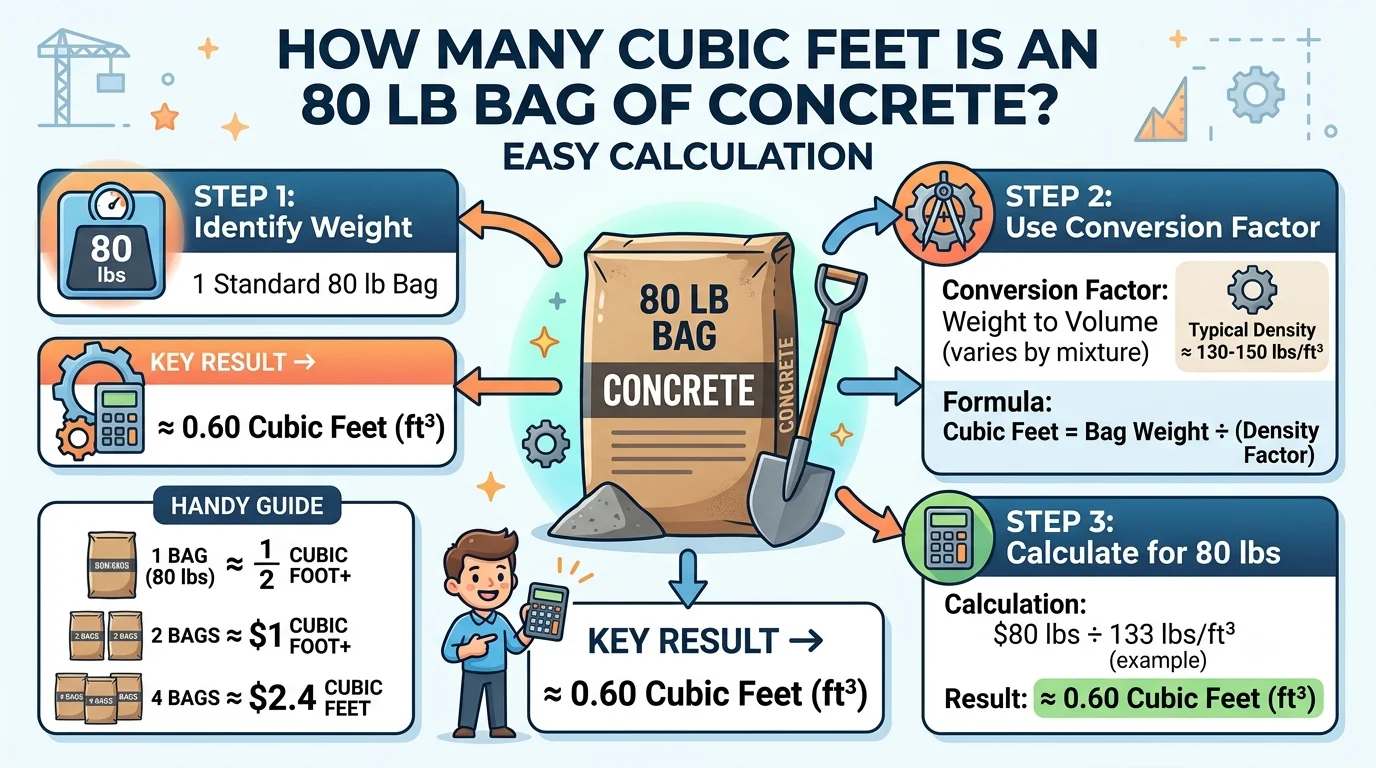
An 80 lb bag of premixed concrete typically yields about 0.60 cubic feet of cured concrete when mixed according to the manufacturer’s instructions. While this is the standard estimate, slight variations may occur depending on the brand, mixing method, and water added.
This guide explains everything you need to know, including yield charts, calculations, examples, practical applications, and tips for estimating concrete accurately.
What Is the Volume of an 80 lb Bag of Concrete?
An 80 lb bag of concrete yields approximately 0.60 cubic feet of finished concrete.
This means one bag fills a space measuring about:
- 0.60 cubic feet
- 17 liters (approximately)
- 0.022 cubic yards
Most major concrete brands, including ready-mix products sold at home improvement stores, produce a similar yield.
Quick Answer
| Bag Size | Approximate Yield |
|---|---|
| 40 lb | 0.30 cubic feet |
| 50 lb | 0.375 cubic feet |
| 60 lb | 0.45 cubic feet |
| 80 lb | 0.60 cubic feet |
Why Concrete Yield Matters
Understanding concrete yield helps you:
- Estimate project costs
- Buy enough material
- Reduce waste
- Avoid multiple trips to the store
- Finish projects without running out of concrete
Even being one or two bags short can delay your work.
How Many Cubic Feet Is an 80 lb Bag of Concrete Exactly?
Most manufacturers list the yield as:
1 bag = approximately 0.60 cubic feet
Some brands may advertise:
- 0.59 cubic feet
- 0.60 cubic feet
- 0.61 cubic feet
The difference is very small and usually doesn’t affect residential projects.
For planning purposes:
Use 0.60 cubic feet per bag.
How to Calculate the Number of Bags Needed
The formula is simple.
Number of Bags = Total Concrete Volume ÷ 0.60
Example
Suppose you need:
6 cubic feet of concrete.
Calculation:
6 ÷ 0.60 = 10 bags
You’ll need approximately 10 bags of 80 lb concrete.
Concrete Volume Formula
To find the total volume of a slab:
Length × Width × Thickness = Cubic Feet
Example:
Length = 8 feet
Width = 4 feet
Thickness = 4 inches
Convert inches to feet:
4 inches = 0.333 feet
Calculation:
8 × 4 × 0.333
= 10.66 cubic feet
Now divide by the yield:
10.66 ÷ 0.60
= 17.8
Round up.
You’ll need 18 bags.
Cubic Feet Yield Chart
| Bags | Cubic Feet Produced |
|---|---|
| 1 | 0.60 |
| 2 | 1.20 |
| 3 | 1.80 |
| 4 | 2.40 |
| 5 | 3.00 |
| 10 | 6.00 |
| 15 | 9.00 |
| 20 | 12.00 |
| 25 | 15.00 |
| 30 | 18.00 |
| 40 | 24.00 |
| 50 | 30.00 |
How Many Bags Are Needed Per Cubic Yard?
One cubic yard equals:
27 cubic feet
Since each bag produces:
0.60 cubic feet
Calculation:
27 ÷ 0.60 = 45 bags
You’ll need approximately:
45 bags of 80 lb concrete for one cubic yard.
Common Projects and Bag Estimates
Fence Post
Typical hole:
- Diameter: 12 inches
- Depth: 24 inches
Concrete needed:
About 1.5 cubic feet
Bags required:
Approximately 3 bags
Deck Footing
Typical footing:
- Diameter: 18 inches
- Depth: 36 inches
Concrete needed:
About 4 cubic feet
Bags:
Around 7 bags
Mailbox Post
Usually requires:
About 1 cubic foot
You’ll need:
2 bags
Small Sidewalk
Dimensions:
10 ft × 3 ft × 4 inches
Volume:
10 cubic feet
Required bags:
10 ÷ 0.60
≈ 17 bags
How Thick Should Concrete Be?
| Project | Recommended Thickness |
|---|---|
| Patio | 4 inches |
| Walkway | 4 inches |
| Driveway | 5–6 inches |
| Garage Floor | 6 inches |
| Shed Base | 4–6 inches |
Thicker slabs require more concrete.
Does Adding More Water Increase Yield?
No.
Adding excess water:
- Weakens the concrete
- Reduces strength
- Causes cracking
- Increases shrinkage
Always follow the manufacturer’s recommended water amount.
Wet Concrete vs Dry Mix
An 80 lb bag weighs:
80 pounds before mixing.
After adding water:
The weight increases.
However:
The finished volume remains close to 0.60 cubic feet.
Difference Between Cubic Feet and Cubic Yards
| Unit | Equivalent |
|---|---|
| 1 Cubic Yard | 27 Cubic Feet |
| 1 Cubic Foot | 0.037 Cubic Yard |
| 80 lb Bag | 0.60 Cubic Feet |
Understanding these units helps when ordering ready-mix concrete.
Practical Example 1: Backyard Patio
Patio dimensions:
- 12 ft
- 10 ft
- 4 inches thick
Volume:
12 × 10 × 0.333
= 39.96 cubic feet
Required bags:
39.96 ÷ 0.60
≈ 66.6
Round up:
67 bags
Practical Example 2: Concrete Steps
Three steps require:
8 cubic feet.
Calculation:
8 ÷ 0.60
= 13.3
You’ll need:
14 bags
Practical Example 3: Basketball Pole
Hole dimensions:
18-inch diameter
30-inch depth
Concrete needed:
About 2.8 cubic feet
Required:
Approximately 5 bags
Common Mistakes When Estimating Concrete
Many DIY homeowners make these errors:
- Forgetting to convert inches into feet
- Buying too little concrete
- Ignoring waste
- Adding too much water
- Forgetting irregular shapes
- Not rounding up
Always purchase one or two extra bags for unexpected needs.
Tips for Accurate Concrete Estimates
Measure Carefully
Double-check all dimensions before calculating.
Convert Thickness Correctly
Remember:
- 2 inches = 0.167 feet
- 4 inches = 0.333 feet
- 6 inches = 0.50 feet
Add Extra Material
Plan for:
- Uneven ground
- Minor spills
- Over-excavation
Most professionals recommend buying 5–10% extra.
80 lb Concrete Bag Compared With Other Sizes
| Bag Weight | Yield |
|---|---|
| 40 lb | 0.30 cu ft |
| 50 lb | 0.375 cu ft |
| 60 lb | 0.45 cu ft |
| 80 lb | 0.60 cu ft |
The 80 lb bag offers the highest yield among common retail bag sizes, making it a popular choice for medium-sized DIY and construction projects.
When Should You Use Bagged Concrete?
Bagged concrete is ideal for:
- Fence posts
- Deck footings
- Mailbox installations
- Sidewalk repairs
- Small patios
- Garden edging
- Concrete steps
- Shed foundations
For large pours requiring several cubic yards, ordering ready-mix concrete is often more efficient and economical.
Expert Tips
- Measure twice before purchasing materials.
- Always round up the number of bags.
- Mix only what you can place within the recommended working time.
- Use clean water for mixing.
- Allow adequate curing time for maximum strength.
- Wear gloves and safety glasses when handling concrete.
Frequently Asked Questions
How many cubic feet does an 80 lb bag of concrete make?
An 80 lb bag of premixed concrete produces approximately 0.60 cubic feet of finished concrete.
How many 80 lb bags equal one cubic yard?
Since one cubic yard equals 27 cubic feet, you’ll need about 45 bags of 80 lb concrete.
Is 0.60 cubic feet the same for every brand?
Most brands produce around 0.60 cubic feet, although the exact yield may range from 0.59 to 0.61 cubic feet.
How much area does one 80 lb bag cover?
At a thickness of 4 inches, one 80 lb bag covers approximately 1.8 square feet.
Should I buy extra concrete?
Yes. Purchasing an additional 5–10% helps account for waste, uneven ground, and small measuring errors.
Conclusion
So, how many cubic feet is an 80 lb bag of concrete? The standard answer is about 0.60 cubic feet of finished concrete. This measurement is essential for planning concrete projects, estimating material costs, and ensuring you purchase the correct number of bags.
By understanding concrete yield, using the proper volume formulas, and allowing a small margin for waste, you can complete your project with confidence and avoid unnecessary delays. Whether you’re installing fence posts, pouring a patio, or building footings, knowing that one 80 lb bag yields approximately 0.60 cubic feet makes concrete estimation much simpler.