
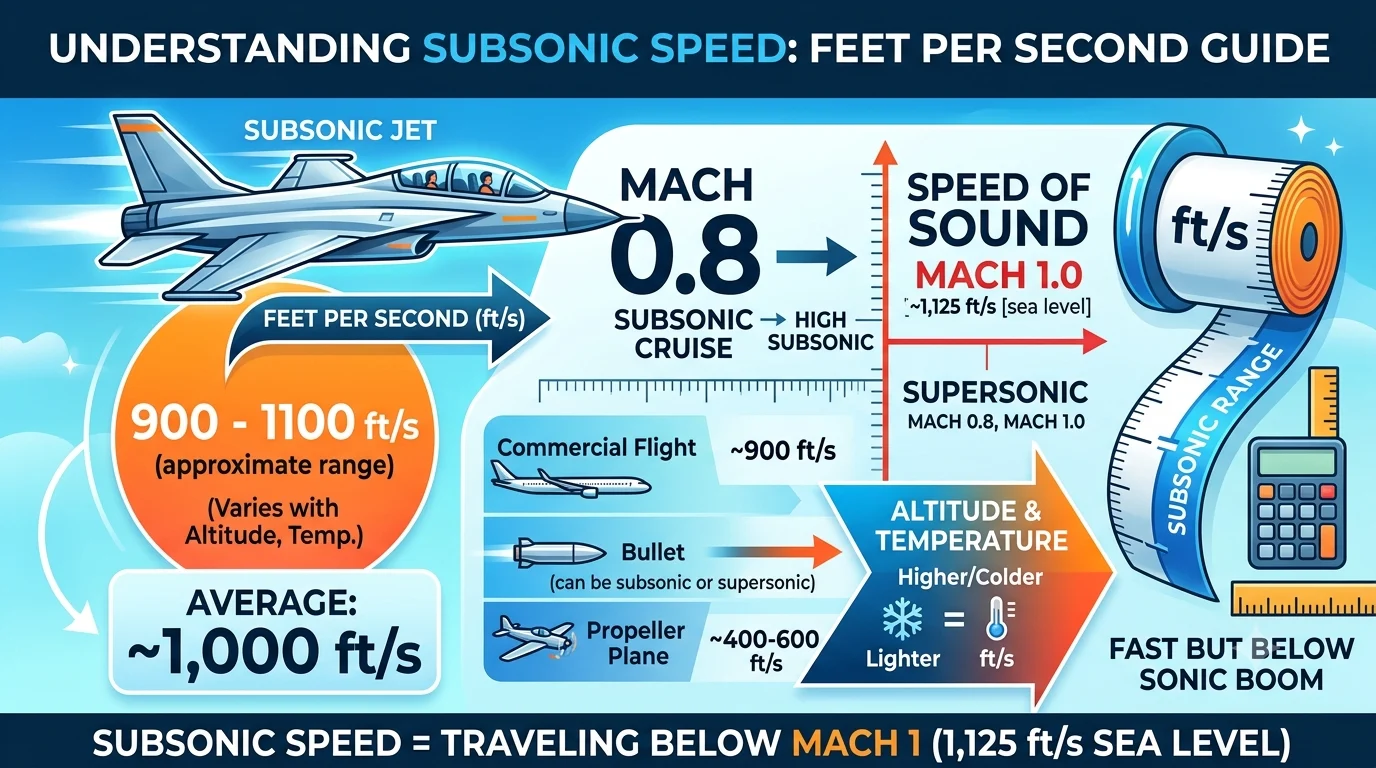
Subsonic speed is any speed that is below the speed of sound. If you are asking how many feet per second is subsonic, the general answer is that anything below approximately 1,125 feet per second (fps) is considered subsonic under normal sea-level conditions.
The exact value can change because the speed of sound depends on factors such as temperature, altitude, and air conditions. However, 1,125 feet per second is a commonly used reference point for understanding subsonic speed.
What Does Subsonic Mean?
The term “subsonic” means “below sound.” It describes the movement of an object that travels slower than sound waves move through the air.
When an object moves through the atmosphere, it creates pressure waves. At subsonic speeds, these waves move away from the object smoothly. The airflow remains relatively stable, which makes subsonic travel easier to control.
When an object reaches the speed of sound, it enters the transonic range. If it goes faster than sound, it becomes supersonic.
Understanding the Speed of Sound
Sound does not always travel at the same speed. In dry air at sea level and around 59°F (15°C), sound travels at approximately:
1,125 feet per second
This means:
- Below 1,125 feet per second = subsonic
- Around 1,125 feet per second = transonic
- Above 1,125 feet per second = supersonic
Because temperature and altitude affect sound speed, the exact boundary can change.
How Many Feet Per Second Is Subsonic?
In simple terms:
Any speed below about 1,125 feet per second is subsonic.
Examples:
| Speed | Feet Per Second | Subsonic? |
|---|---|---|
| Walking | 5 fps | Yes |
| Running | 30 fps | Yes |
| Highway car | 88 fps | Yes |
| Fast train | 400 fps | Yes |
| Commercial aircraft | 800 fps | Yes |
| Speed of sound | 1,125 fps | Boundary |
Most vehicles humans use every day operate far below the speed of sound.
Subsonic Speed and Mach Numbers
Scientists use Mach numbers to compare an object’s speed with the speed of sound.
Mach 1 equals the speed of sound.
Examples:
- Mach 0.5 = half the speed of sound
- Mach 0.8 = 80% of the speed of sound
- Mach 1 = speed of sound
- Mach 2 = twice the speed of sound
A commercial airplane traveling at Mach 0.8 is moving very fast, but it is still subsonic.
Why Most Aircraft Fly at Subsonic Speeds
Most passenger airplanes are designed to fly below Mach 1. Typical commercial aircraft travel around Mach 0.75 to Mach 0.85.
Flying at subsonic speeds provides several advantages:
- Better fuel efficiency
- Lower operating costs
- Reduced noise
- Improved passenger comfort
- Easier aircraft control
Supersonic flight requires stronger materials, special designs, and much more energy.
Factors That Change Subsonic Speed
Temperature
Warmer air increases the speed of sound, while colder air decreases it.
For example, an aircraft flying at a certain speed may be farther from Mach 1 in warm conditions compared with colder conditions.
Altitude
At higher altitudes, air temperature changes, which affects the speed of sound. Aircraft engineers consider this when calculating flight speeds.
Air Pressure and Density
Air density affects how objects move. Lower-density air can change aerodynamic performance and influence how close an object is to the sound barrier.
Real-World Examples of Subsonic Speeds
Cars
A car traveling at 60 miles per hour moves at about 88 feet per second. This is extremely fast compared with human movement but still much slower than sound.
Commercial Jets
Passenger jets often travel between 750 and 950 feet per second. Although they cover large distances quickly, they remain below the speed of sound.
Animals
Even the fastest animals move at subsonic speeds.
A cheetah can reach around 95 feet per second, which is impressive but still far below 1,125 feet per second.
Benefits of Subsonic Travel
Subsonic speeds provide many practical benefits.
Efficiency
Moving below the speed of sound requires less energy compared with supersonic travel.
Safety
Subsonic aircraft experience predictable airflow, making them easier to design and operate.
Lower Noise
Supersonic objects create powerful shock waves known as sonic booms. Subsonic vehicles avoid this problem.
Common Misunderstandings About Subsonic Speed
Subsonic Does Not Mean Slow
A speed can be extremely fast and still be subsonic. A passenger airplane traveling hundreds of miles per hour is a good example.
The Speed of Sound Is Not Always 1,125 FPS
The commonly used number applies to specific conditions. Temperature and altitude can change the actual speed.
Subsonic and Supersonic Are Not Fixed Speeds
They are relative terms based on the speed of sound in the surrounding environment.
Frequently Asked Questions
What is the exact subsonic speed in feet per second?
Subsonic speed is any speed below the speed of sound. At sea level, this is approximately below 1,125 feet per second.
Is 1,000 feet per second subsonic?
Yes. Under normal conditions, 1,000 feet per second is below the speed of sound and is considered subsonic.
Is Mach 0.9 subsonic?
Yes. Mach 0.9 is 90% of the speed of sound, so it is still considered subsonic, although it is close to the transonic range.
Are commercial airplanes subsonic?
Yes. Most commercial passenger aircraft fly at subsonic speeds, usually below Mach 1.
What happens at the speed of sound?
When an object reaches Mach 1, pressure waves combine and create shock waves. This marks the transition from subsonic to supersonic flight.
Conclusion
The answer to how many feet per second is subsonic is that any speed below approximately 1,125 feet per second is subsonic under normal sea-level conditions.
Subsonic speeds are important in aviation, engineering, and everyday transportation. From cars and trains to commercial aircraft, many fast-moving objects operate below the speed of sound because it provides better efficiency, stability, and control.
Understanding subsonic speed helps explain how objects move through air and why reaching faster-than-sound speeds requires advanced technology and engineering.