

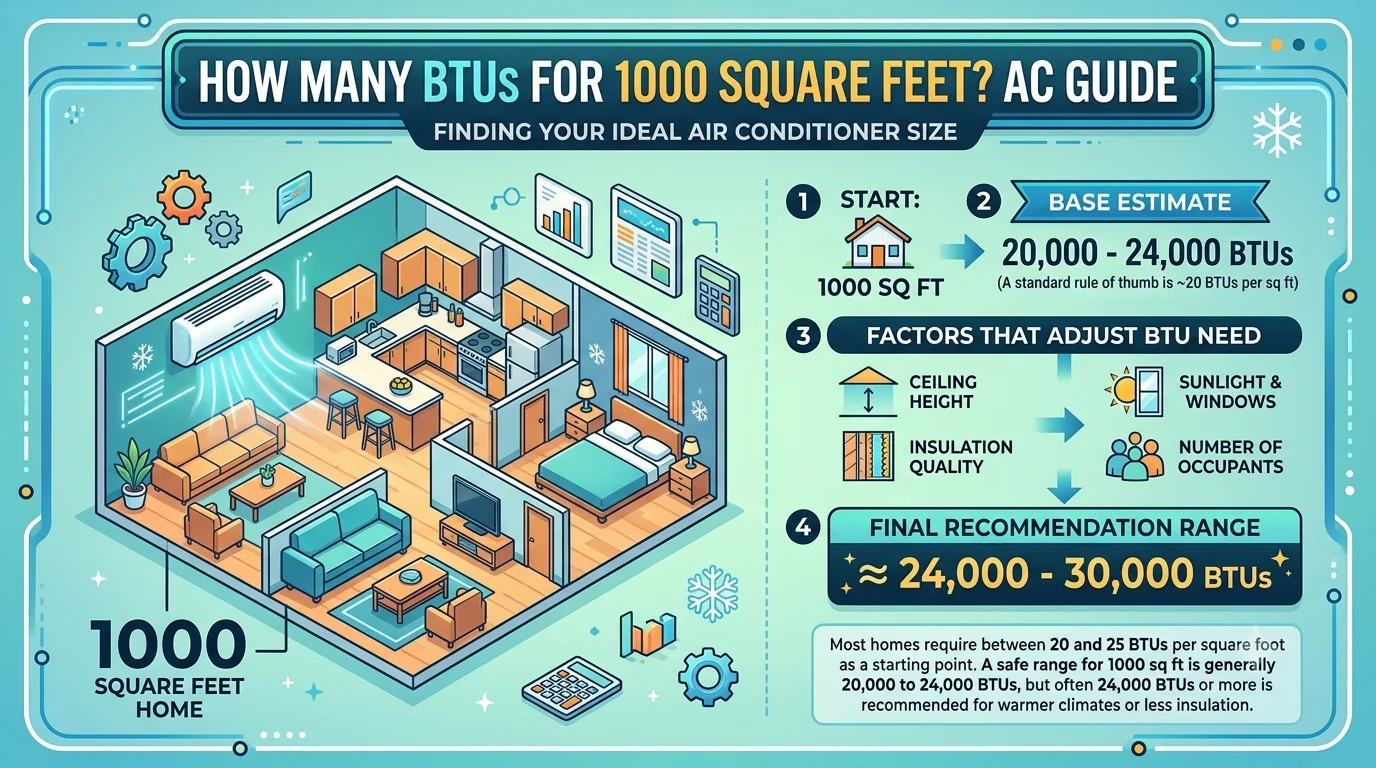
Choosing the right air conditioner size is one of the most important decisions for home comfort and energy savings. If you are wondering how many BTUs for 1000 square feet, the answer is not a single fixed number because cooling needs depend on climate, insulation, ceiling height, sunlight exposure, and occupancy.
In general, a 1000 square foot space typically requires around 18,000 to 24,000 BTUs for effective cooling. However, this range can shift based on real-world conditions. Understanding this properly helps you avoid undersized or oversized AC units that waste energy or fail to cool efficiently.
This guide explains everything in simple terms so you can confidently choose the right AC size for a 1000 sq ft home or apartment.
What Is a BTU in Air Conditioning?
A BTU (British Thermal Unit) is a measurement of cooling power. It shows how much heat an air conditioner can remove from a room in one hour.
In simple terms:
- Higher BTU = stronger cooling power
- Lower BTU = weaker cooling capacity
For example:
- 6,000 BTU → small bedroom
- 12,000 BTU → medium-sized room
- 24,000 BTU → large open space or apartment
BTU is the foundation of AC sizing, and choosing correctly directly impacts comfort and electricity bills.
How Many BTUs for 1000 Square Feet?
The most commonly used rule is:
20 BTU per square foot
So for 1000 square feet:
1000 × 20 = 20,000 BTUs
Practical Range:
- 18,000 BTU → Cool climate, good insulation
- 20,000 BTU → Average conditions
- 22,000–24,000 BTU → Hot climate or poor insulation
This means the ideal AC size for 1000 sq ft is usually around 20,000 BTUs, with adjustments based on environment.
Simple BTU Calculation Method
You can estimate quickly using this formula:
Square footage × 20 = Required BTU
Example:
- 1000 × 20 = 20,000 BTU
This is a baseline method used widely in HVAC planning, but it does not account for heat load variations.
Factors That Affect BTU Requirements
1. Climate Conditions
Hot climates require more cooling power.
- Hot & humid: increase BTU by 10–20%
- Moderate climate: standard calculation
- Cool regions: slightly lower BTU needed
2. Ceiling Height
More air volume requires more cooling.
- Standard 8 ft ceiling: no change
- High ceilings: +10–15% BTU
3. Insulation Quality
Insulation directly affects cooling efficiency.
- Poor insulation: +10–20% BTU
- Good insulation: lower energy requirement
4. Sunlight Exposure
Rooms with direct sunlight heat faster.
- Sunny rooms: increase BTU
- Shaded rooms: standard BTU
5. Number of People
Human body heat adds load.
- Add ~600 BTU per extra person (beyond two occupants)
Recommended BTU for 1000 Sq Ft
| Condition | Recommended BTU |
|---|---|
| Cool climate, strong insulation | 18,000 BTU |
| Normal residential use | 20,000 BTU |
| Hot climate, weak insulation | 22,000–24,000 BTU |
| Top floor or heavy sunlight | 24,000 BTU |
Split AC vs Central AC for 1000 Sq Ft
Split AC
Best for most 1000 sq ft homes.
Advantages:
- Energy efficient
- Lower installation cost
- Easy maintenance
Limitations:
- Better for single-zone cooling
Central AC
Better for multi-room houses.
Advantages:
- Even cooling across rooms
- Clean and hidden installation
Limitations:
- Higher cost
- Complex setup
For most users, split AC systems are more practical and cost-effective.
Energy Efficiency Matters (SEER Rating)
BTU is important, but efficiency matters just as much.
SEER rating measures energy efficiency:
- Higher SEER = lower electricity bills
- Lower SEER = higher power usage
Recommended:
- SEER 14–16 → Standard efficiency
- SEER 18+ → High efficiency and savings
An energy-efficient AC saves more money long-term than a cheaper low-SEER unit.
Common Mistakes to Avoid
Oversizing AC
- Wastes electricity
- Poor humidity control
- Higher upfront cost
Undersizing AC
- Constant running
- Poor cooling performance
- Shorter compressor life
Ignoring insulation
Even a high BTU AC will struggle in poorly insulated spaces.
Not considering sunlight
Sun-facing rooms always require more cooling power.
Expert Tips for Best Results
- Always choose slightly higher BTU if unsure
- Prefer inverter AC for energy savings
- Consider top-floor heat load separately
- Maintain filters for better efficiency
- Don’t rely only on square footage
Real-Life Example
A 1000 sq ft apartment with:
- Moderate climate
- 3 occupants
- Standard insulation
- Medium sunlight exposure
Calculation:
- Base: 20,000 BTU
- Adjustment: +10% heat load
Final recommendation: 22,000 BTU inverter AC
This ensures stable cooling without overloading electricity usage.
BTU vs Square Footage Chart
| Area (sq ft) | BTU Range |
|---|---|
| 500 sq ft | 10,000–12,000 BTU |
| 800 sq ft | 14,000–18,000 BTU |
| 1000 sq ft | 18,000–24,000 BTU |
| 1200 sq ft | 22,000–28,000 BTU |
Benefits of Correct BTU Selection
Choosing the right AC size gives you:
- Faster cooling
- Lower electricity bills
- Better comfort level
- Longer AC lifespan
- Reduced maintenance issues
Proper sizing is essential for long-term efficiency.
Conclusion
Understanding how many BTUs for 1000 square feet helps you choose the right air conditioner without wasting money or energy. In most cases, a 1000 sq ft space requires around 20,000 BTUs, with adjustments between 18,000 and 24,000 BTUs depending on real-world conditions.
Instead of focusing only on square footage, always consider climate, insulation, and usage patterns. This ensures better cooling performance, lower energy costs, and long-lasting comfort.