

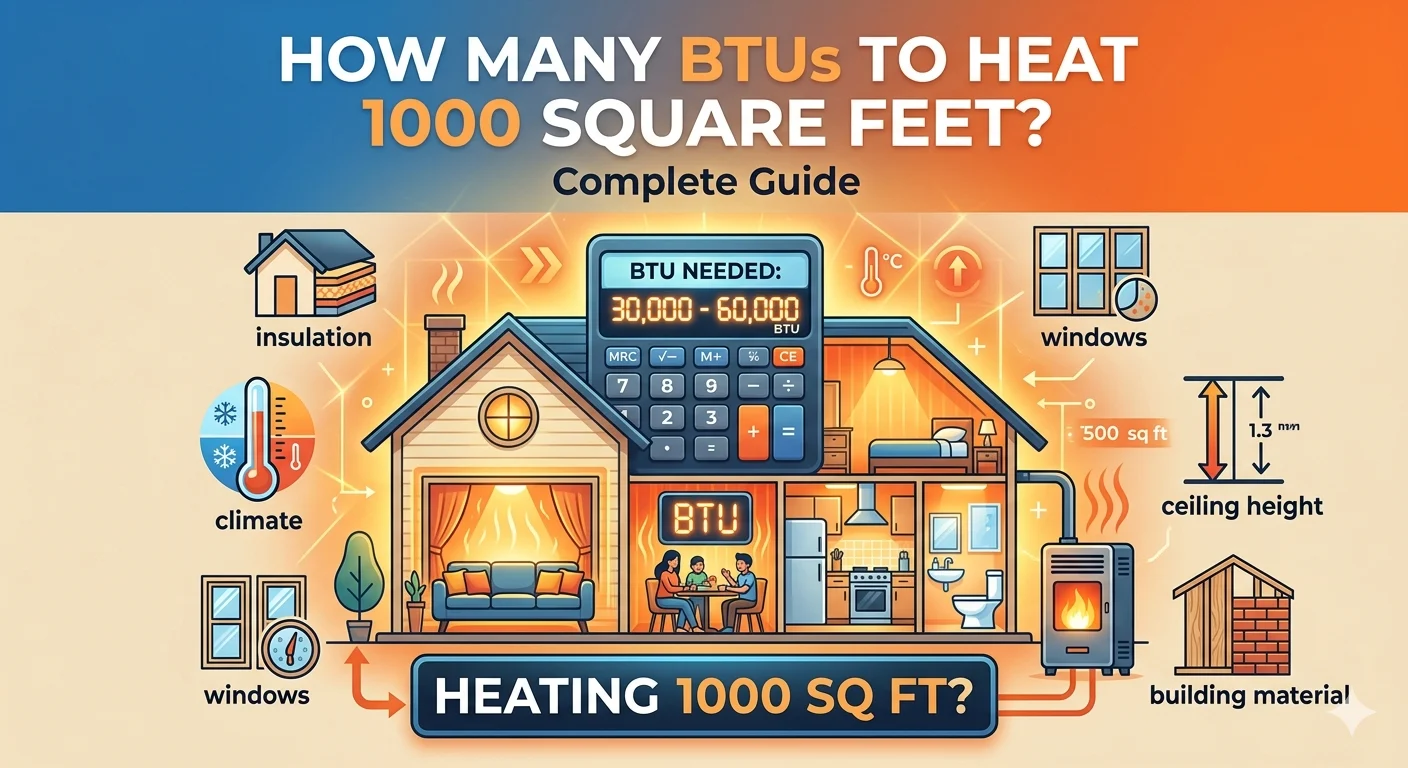
Choosing the right heating system for your home starts with understanding BTUs. If you’re wondering how many BTUs to heat 1000 square feet, the answer depends on more than just the size of the space. Climate, insulation, ceiling height, and the overall energy efficiency of your home all play a role in determining the ideal heating capacity.
A heater that is too small may struggle to keep your home warm during winter, while one that is too large can waste energy and increase your utility bills. Knowing the right BTU range helps you select a furnace, heat pump, or space heater that delivers reliable comfort without unnecessary costs.
In this guide, you’ll learn what BTUs are, how many you need to heat a 1,000-square-foot home, and the factors that can affect your heating requirements.
What Is a BTU?
BTU stands for British Thermal Unit, which is the standard measurement used to describe the amount of heat energy a heating or cooling system can produce. One BTU is the amount of energy required to raise the temperature of one pound of water by one degree Fahrenheit.
When shopping for a furnace, heat pump, or heater, the BTU rating tells you how much heating power the unit can provide. The higher the BTU rating, the larger the area it can effectively heat.
How Many BTUs to Heat 1000 Square Feet?
As a general guideline, homes typically require 30 to 60 BTUs per square foot, depending on the climate and insulation quality.
For a 1,000-square-foot home, the estimated heating requirements are:
| Climate Type | BTUs Per Square Foot | Estimated BTUs Needed |
|---|---|---|
| Warm Climate | 30–35 BTUs | 30,000–35,000 BTUs |
| Moderate Climate | 35–45 BTUs | 35,000–45,000 BTUs |
| Cold Climate | 50–60 BTUs | 50,000–60,000 BTUs |
For most average homes in moderate climates, 35,000 to 45,000 BTUs is sufficient to heat 1,000 square feet comfortably. However, homes in colder regions or with poor insulation may require a larger heating system.
Why BTU Requirements Vary
Many people assume that square footage alone determines the correct heater size, but several factors can change the amount of heat your home needs.
Climate Zone
Your local weather conditions have the biggest impact on heating requirements.
- Warm climates: Require fewer BTUs because winters are mild.
- Moderate climates: Need a balanced heating capacity for seasonal temperature changes.
- Cold climates: Demand significantly more BTUs to maintain comfortable indoor temperatures.
If you live in an area with long, freezing winters, choosing a heating system based only on square footage could leave your home underheated.
Insulation Quality
A well-insulated home retains heat more effectively, reducing the amount of energy required to stay warm. Older homes with poor insulation lose heat quickly, increasing BTU requirements.
You may need to adjust your estimate based on insulation:
- Excellent insulation: Reduce BTU needs by 10–15%.
- Poor insulation: Increase BTU needs by 10–20%.
Ceiling Height
Most BTU estimates assume a standard 8-foot ceiling. If your ceilings are 9, 10, or even 12 feet high, there is more air volume to heat.
Homes with taller ceilings generally require additional BTUs to maintain the same level of comfort.
Windows and Doors
Large windows, single-pane glass, and drafty doors can allow heat to escape. Energy-efficient windows and properly sealed doors help reduce heat loss and improve heating performance.
Home Layout
Open-concept homes, multi-story houses, and rooms with large open spaces may distribute heat differently than smaller, enclosed floor plans. These design features can affect how efficiently your heating system works.
How to Calculate Heating BTUs
If you want a rough estimate of your home’s heating needs, you can use a simple formula:
Square Footage × BTUs Per Square Foot = Required Heating BTUs
For example:
- 1,000 sq ft × 35 BTUs = 35,000 BTUs
- 1,000 sq ft × 45 BTUs = 45,000 BTUs
This quick calculation works well for general planning. However, HVAC professionals often perform a more detailed heat load calculation that takes insulation, windows, climate, and air leakage into account.
BTU Heating Chart by Home Size
The following chart provides estimated heating requirements for different home sizes.
| Home Size | Mild Climate | Moderate Climate | Cold Climate |
|---|---|---|---|
| 500 sq ft | 15,000–18,000 BTUs | 18,000–22,000 BTUs | 25,000–30,000 BTUs |
| 750 sq ft | 22,000–26,000 BTUs | 26,000–34,000 BTUs | 38,000–45,000 BTUs |
| 1,000 sq ft | 30,000–35,000 BTUs | 35,000–45,000 BTUs | 50,000–60,000 BTUs |
| 1,250 sq ft | 38,000–44,000 BTUs | 44,000–56,000 BTUs | 62,000–75,000 BTUs |
| 1,500 sq ft | 45,000–53,000 BTUs | 53,000–67,000 BTUs | 75,000–90,000 BTUs |
Keep in mind that these are estimates. Actual heating requirements can vary based on your home’s design and energy efficiency.
Choosing the Right Heating System
Understanding how many BTUs to heat 1000 square feet is only part of the process. You also need to choose the right type of heating equipment.
Gas Furnace
Gas furnaces are one of the most common home heating systems. They are available in a range of capacities, including 40,000, 60,000, and 80,000 BTUs. For many 1,000-square-foot homes, a 40,000- to 60,000-BTU furnace provides adequate heating.
Heat Pump
Heat pumps are energy-efficient systems that provide both heating and cooling. They work well in moderate climates and can significantly reduce energy costs compared to traditional heating methods.
Electric Heater
Electric heaters are often used for smaller spaces or supplemental heating. While they can effectively warm individual rooms, multiple units may be needed to heat an entire 1,000-square-foot home.
Benefits of Choosing the Correct BTU Size
Selecting a properly sized heating system offers several important benefits:
- Improved indoor comfort.
- Lower monthly energy bills.
- More even temperature distribution.
- Longer lifespan for HVAC equipment.
- Reduced maintenance and repair costs.
- Better overall energy efficiency.
A correctly sized heater works efficiently without constantly running or cycling on and off.
Problems with an Oversized or Undersized Heater
Installing the wrong size heating system can create several issues.
Heater Is Too Small
If the unit does not produce enough BTUs:
- The home may never reach the desired temperature.
- The system will run almost continuously.
- Energy costs may increase because of longer operating times.
- Excessive wear can shorten the equipment’s lifespan.
Heater Is Too Large
An oversized heater can also create problems:
- Frequent on-and-off cycling.
- Uneven room temperatures.
- Higher energy consumption.
- Increased wear on components due to repeated starts and stops.
Proper BTU sizing helps avoid these issues while maximizing comfort and efficiency.
Common Mistakes When Estimating BTUs
Homeowners often make a few common mistakes when selecting a heating system:
- Choosing a heater based only on square footage.
- Ignoring local climate conditions.
- Overlooking insulation quality.
- Forgetting to account for high ceilings.
- Buying the largest unit available, assuming bigger is better.
- Failing to seal drafts around windows and doors.
Avoiding these mistakes can save money and improve your home’s heating performance.
Expert Tips for Better Heating Efficiency
Even with the right BTU capacity, you can reduce heating costs and improve comfort by making your home more energy efficient.
Here are some practical tips:
- Upgrade attic and wall insulation.
- Seal air leaks around windows and doors.
- Replace old HVAC filters regularly.
- Schedule annual furnace maintenance.
- Install a programmable or smart thermostat.
- Keep vents and registers clear of furniture or curtains.
- Use weatherstripping to prevent drafts.
Small improvements like these can significantly reduce the amount of energy your home requires during the winter months.
Frequently Asked Questions
Is 30,000 BTUs enough to heat 1,000 square feet?
Yes, 30,000 BTUs may be enough for a well-insulated home in a mild climate. However, colder climates often require 40,000 BTUs or more.
What size furnace is recommended for a 1,000-square-foot house?
Most 1,000-square-foot homes perform well with a furnace rated between 40,000 and 60,000 BTUs, depending on insulation and local weather conditions.
Does ceiling height affect BTU calculations?
Yes. Higher ceilings increase the total air volume inside your home, meaning more heat is required to maintain a comfortable temperature.
How do I know if my heater is oversized?
Frequent short cycling, uneven heating, and higher-than-expected energy bills are common signs that a heater may be too large for the space.
Can insulation reduce the BTUs I need?
Absolutely. Better insulation keeps warm air inside your home, reducing heat loss and lowering the overall BTU requirement.
Conclusion
If you’re trying to determine how many BTUs to heat 1000 square feet, the ideal range for most homes falls between 35,000 and 45,000 BTUs, while homes in colder climates may require 50,000 to 60,000 BTUs. The exact amount depends on factors such as insulation, climate, ceiling height, windows, and the overall energy efficiency of the building.
Instead of simply choosing the largest heating system available, focus on selecting one that matches your home’s actual heating needs. A properly sized furnace or heater provides consistent comfort, lowers utility bills, and extends the life of your HVAC equipment.
By understanding BTU ratings and using the guidelines in this article, you can make a more informed decision and ensure your 1,000-square-foot home stays warm and energy efficient throughout the heating season.