

Have you ever wondered just how long your intestines are? It may be surprising to learn that the human intestines are much longer than most people imagine. Even though they fit neatly inside your abdomen, if they were stretched out completely, they would measure around 25 to 30 feet in length. This incredible design allows your body to digest food efficiently and absorb the nutrients it needs to stay healthy.
Understanding how many feet are your intestines is not only an interesting anatomy fact but also helps explain how the digestive system works. In this guide, we’ll explore the length of the small and large intestines, why they are so long, and some fascinating facts about the human digestive tract.
How Many Feet Are Your Intestines?
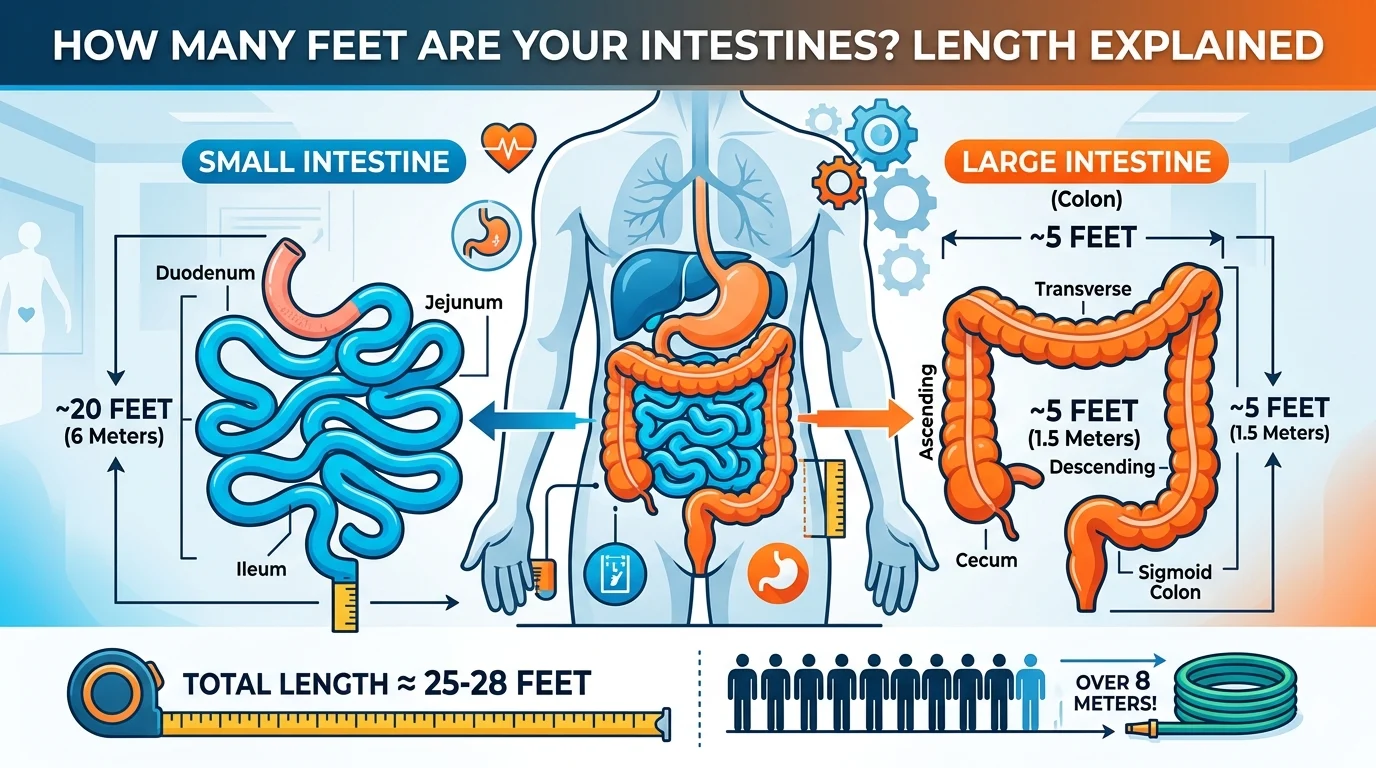
The average adult human has approximately 25 to 30 feet of intestines. This total includes both the small intestine and the large intestine.
- Small intestine: About 20 to 22 feet long
- Large intestine: About 5 feet long
- Total intestinal length: Around 25 to 27 feet on average, though some people may have intestines approaching 30 feet.
The exact length varies slightly from person to person based on genetics, body size, age, and the method used to measure the intestines.
How Long Is the Small Intestine?
The small intestine is the longest section of the digestive system. Despite being called “small,” it is actually much longer than the large intestine. The name comes from its smaller diameter, not its length.
An average adult’s small intestine measures between 20 and 22 feet (6 to 6.7 meters). It consists of three main sections:
Duodenum
The duodenum is the first part of the small intestine. It receives partially digested food from the stomach and mixes it with digestive enzymes and bile from the liver and pancreas.
Jejunum
The jejunum is the middle portion and is responsible for absorbing the majority of nutrients from the food you eat. Carbohydrates, proteins, fats, vitamins, and minerals are processed here.
Ileum
The ileum is the final section of the small intestine. It absorbs vitamin B12, bile salts, and any remaining nutrients before passing waste material into the large intestine.
How Long Is the Large Intestine?
The large intestine, also known as the colon, is much shorter but wider than the small intestine. It measures approximately 5 feet (1.5 meters) in length.
The large intestine is divided into several parts:
- Cecum
- Ascending colon
- Transverse colon
- Descending colon
- Sigmoid colon
- Rectum
Its main job is to absorb water and electrolytes from undigested food, helping to form and store stool before it leaves the body.
Why Are Human Intestines So Long?
The impressive length of the intestines serves a very important purpose. Digestion and nutrient absorption take time, and the body needs a large surface area to absorb all the essential nutrients from food.
The walls of the small intestine are covered with millions of tiny finger-like structures called villi, along with even smaller structures known as microvilli. Together, these create a massive surface area that helps the body efficiently absorb nutrients into the bloodstream.
Without such a long and highly folded digestive tract, humans would struggle to obtain enough nutrition from the foods they eat.
How Do 25 Feet of Intestines Fit Inside the Body?
A common question is how such a long organ can fit inside the abdomen. The answer lies in the way the intestines are arranged.
Rather than lying in a straight line, the intestines are tightly folded and coiled into loops. These loops are supported by a tissue called the mesentery, which anchors them in place while still allowing movement.
Think of it like a long garden hose carefully wound into a compact container. This efficient arrangement allows the digestive system to maximize its function without taking up too much space.
Small Intestine vs. Large Intestine
Although they work together, the small and large intestines have different roles.
| Feature | Small Intestine | Large Intestine |
|---|---|---|
| Average Length | 20–22 feet | About 5 feet |
| Width | Narrow | Wider |
| Main Function | Nutrient absorption | Water absorption and waste formation |
| Major Sections | Duodenum, jejunum, ileum | Colon and rectum |
| Digestive Role | Digests and absorbs food | Stores and eliminates waste |
The small intestine handles most of the digestion, while the large intestine completes the process by recovering water and preparing waste for elimination.
Interesting Facts About Your Intestines
The human intestines are among the most fascinating organs in the body. Here are a few surprising facts:
- The average adult has around 25 to 30 feet of intestines.
- The small intestine is roughly four times longer than the large intestine.
- The inner lining of the small intestine has millions of villi that increase its surface area dramatically.
- Trillions of beneficial bacteria live inside the intestines and help with digestion and immune function.
- The intestines move food using rhythmic muscle contractions called peristalsis.
- Most nutrient absorption takes place in the small intestine rather than the stomach.
Why Intestinal Length Can Vary
Not everyone has intestines of exactly the same length. Several factors can influence the measurement, including:
- Age
- Height and body size
- Genetics
- Biological differences between individuals
- Whether the intestines are measured during life or after death
Researchers have found that intestines often appear longer after death because the muscles relax, allowing the tissues to stretch naturally.
Common Myths About Intestinal Length
Myth 1: The Large Intestine Is the Longest Part
This is false. The small intestine accounts for the majority of the digestive tract’s length.
Myth 2: Digestion Happens Mainly in the Stomach
The stomach starts the digestive process, but most digestion and nutrient absorption occur in the small intestine.
Myth 3: Taller People Always Have Longer Intestines
While body size may play a role, intestinal length varies naturally and does not always correspond directly to a person’s height.
Myth 4: Intestinal Length Has No Purpose
Every foot of the intestine contributes to digestion and nutrient absorption. The long, folded structure is essential for maintaining health.
Why Understanding Intestinal Length Matters
Learning about the digestive system can help students, healthcare professionals, and curious readers better understand how the human body functions. The intestines are responsible for absorbing nutrients, balancing fluids, supporting beneficial gut bacteria, and eliminating waste.
A healthy digestive tract contributes to overall wellness, energy levels, immune function, and proper nutrition. Eating a balanced diet rich in fiber, drinking enough water, and staying physically active all help support intestinal health.
Frequently Asked Questions
How many feet are your intestines altogether?
The average adult has approximately 25 to 30 feet of intestines, including both the small and large intestines.
How long is the small intestine?
The small intestine is usually 20 to 22 feet long, making it the longest section of the digestive tract.
How long is the large intestine?
The large intestine measures about 5 feet in length.
Why are the intestines so long?
They are long to provide enough surface area for efficient digestion and nutrient absorption.
Do all people have the same length of intestines?
No. Intestinal length can vary depending on genetics, body size, age, and other natural factors.
Conclusion
If you’ve ever asked yourself, “How many feet are your intestines?”, the answer is truly remarkable. The average adult has around 25 to 30 feet of intestines, with the small intestine accounting for about 20 to 22 feet and the large intestine adding another 5 feet.
This extraordinary length allows the digestive system to efficiently process food, absorb nutrients, and maintain overall health. Despite their size, the intestines fit comfortably inside the abdomen thanks to their tightly coiled structure. Understanding how your intestines work offers a fascinating glimpse into one of the most important systems in the human body. :::