

Darts is one of the easiest games to enjoy at home, in a club, or in a local pub. However, one small mistake during setup can make every throw feel different. The most common question beginners ask is how many feet away from dart board should they stand.
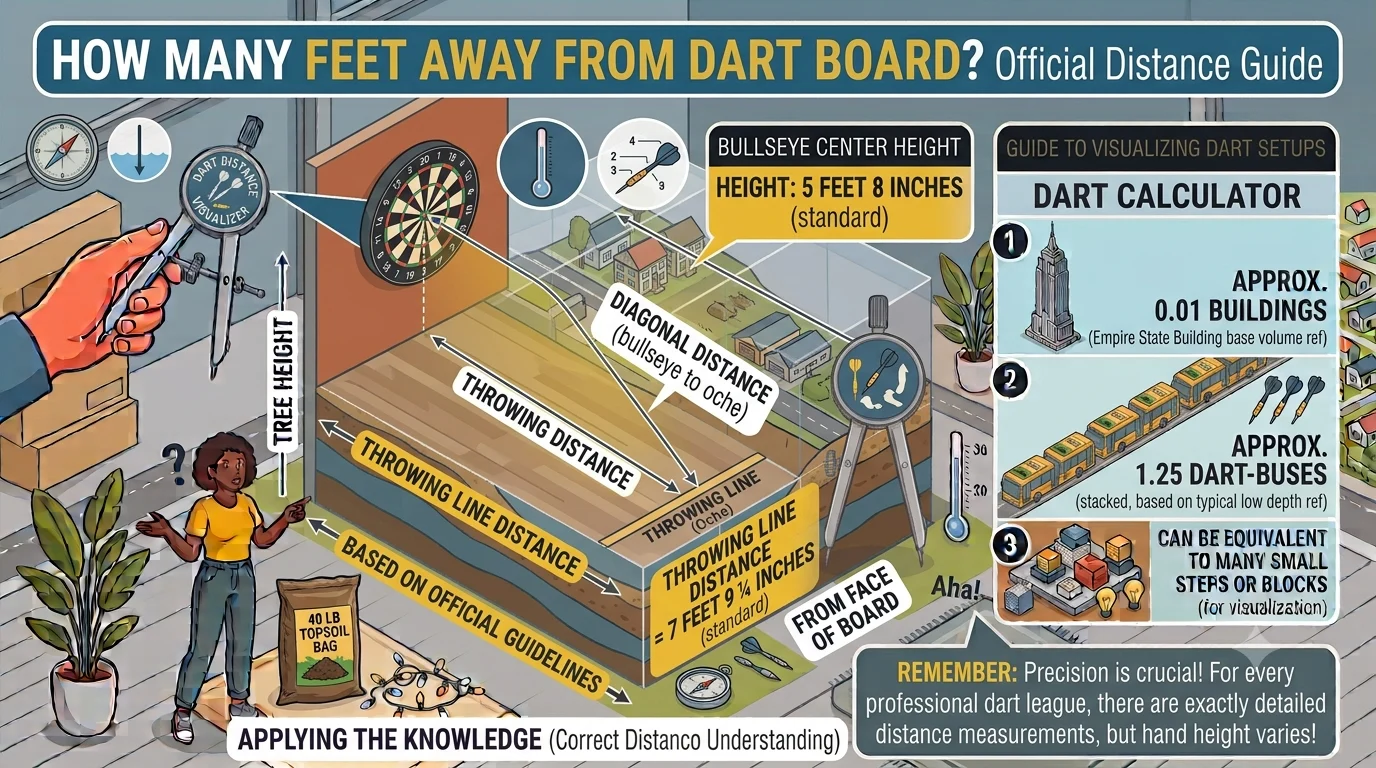
The official answer is 7 feet 9¼ inches (93.25 inches or approximately 2.37 meters) from the front face of the dartboard to the throwing line, also called the oche. This measurement is used in professional tournaments and is recommended for home setups as well.
Using the correct distance improves accuracy, builds consistent throwing habits, and ensures everyone plays by the same rules. This guide explains official measurements, setup tips, conversion charts, common mistakes, and everything else you need to know.
Official Distance: How Many Feet Away From Dart Board?
The official throwing distance is:
| Measurement | Distance |
|---|---|
| Feet | 7 feet 9¼ inches |
| Inches | 93.25 inches |
| Meters | 2.37 meters |
| Centimeters | 237 centimeters |
Measure from the front surface of the dartboard to the throwing line—not from the wall behind it.
Standing even a few inches closer or farther away can noticeably affect your accuracy. Whether you’re practicing casually or preparing for league play, using the regulation distance helps you build consistent throwing mechanics and better scoring habits.
Why the Official Distance Matters
Many players assume that standing a little closer or farther away won’t make much difference. In reality, even a one-inch difference can change your throwing angle and affect where the dart lands.
The official distance helps:
- Improve consistency
- Develop muscle memory
- Ensure fair competition
- Prepare players for tournaments
- Make practice sessions more effective
Once you become accustomed to the correct distance, your throws become more repeatable, making it easier to improve over time.
Understanding the Oche
The oche is the official throwing line in darts. Every player must throw from behind this line during a match.
The oche can be made using:
- A raised wooden strip
- A rubber oche
- Floor tape
- A dart mat with built-in markings
Professional tournaments typically use a raised oche because it gives players a clear physical boundary that prevents accidental foot faults.
Official Dartboard Height
Correct distance alone isn’t enough. The dartboard also needs to be mounted at the proper height.
The official measurement is:
| Measurement | Height |
|---|---|
| Bullseye from floor | 5 feet 8 inches |
| Inches | 68 inches |
| Meters | 1.73 meters |
Always measure to the exact center of the bullseye. If the board is mounted too high or too low, players may develop poor throwing habits that become difficult to correct later.
Complete Regulation Dartboard Measurements
For a tournament-style setup, use these official dimensions.
| Measurement | Official Size |
|---|---|
| Bullseye height | 5 ft 8 in |
| Throwing distance | 7 ft 9¼ in |
| Diagonal measurement | 9 ft 7½ in |
| Metric throwing distance | 2.37 meters |
Following these measurements ensures your playing area matches the standards used in professional competitions.
How to Measure the Correct Throwing Distance
Setting up a dartboard correctly takes only a few minutes.
Step 1: Mount the Dartboard
Secure the dartboard firmly to a wall so it doesn’t move during play.
Step 2: Measure the Height
Measure from the floor to the center of the bullseye.
Adjust until the bullseye sits exactly 5 feet 8 inches above the floor.
Step 3: Measure the Throwing Distance
From the front surface of the dartboard, measure 7 feet 9¼ inches straight out.
Mark this location carefully.
Step 4: Install the Oche
Place a rubber oche, dart mat, or tape at the marked location.
Your dartboard is now ready for regulation play.
Steel Tip vs. Soft Tip Dart Board Distance
Different types of dartboards sometimes use different measurements.
Steel Tip Darts
Official throwing distance:
- 7 feet 9¼ inches (2.37 meters)
Soft Tip Darts
Many electronic dart leagues use:
- 8 feet (2.44 meters)
However, some organizations still use the steel-tip measurement. Always check your local league’s rules if you plan to compete.
Why Professionals Follow Exact Measurements
Professional dart players spend thousands of hours practicing.
A small difference in distance can affect:
- Release angle
- Dart trajectory
- Accuracy
- Scoring consistency
- Muscle memory
Because of this, tournaments around the world follow strict regulation measurements to ensure fairness for every player.
Common Mistakes When Setting Up a Dartboard
Many home setups contain simple errors that affect gameplay.
Measuring from the Wall
The throwing distance must always be measured from the front face of the dartboard, not from the wall behind it.
Incorrect Bull Height
The center of the bull should always be 68 inches above the floor.
Uneven Flooring
If the floor slopes, measurements may become inaccurate.
No Permanent Throw Line
Without a clearly marked oche, players often step forward without realizing it.
How Much Space Do You Need?
Besides the official throwing distance, you’ll need enough room for players to stand comfortably.
Recommended room dimensions include:
| Area | Suggested Space |
|---|---|
| Width | 5–6 feet |
| Length | 11–13 feet |
| Ceiling Height | At least 8 feet |
Having additional space makes the playing area safer and more enjoyable.
Safety Tips for Home Dartboard Setups
A properly installed dartboard is generally safe, but it’s important to take a few precautions.
- Keep children away while games are in progress.
- Protect surrounding walls with a dartboard surround.
- Ensure the playing area has good lighting.
- Avoid placing the board near windows or fragile objects.
- Leave enough room behind players.
- Replace damaged darts immediately.
These simple safety measures reduce accidents and protect your home.
Choosing the Best Lighting
Lighting plays an important role in dart accuracy.
Good dartboard lighting should:
- Eliminate shadows
- Brightly illuminate the entire board
- Avoid glare
- Keep numbers clearly visible
LED dartboard lighting systems are a popular choice because they provide even illumination without creating shadows.
Practical Example
Imagine you’re turning your garage into a game room.
First, you mount the dartboard securely.
You measure 68 inches from the floor to the center of the bullseye.
Next, you measure 93.25 inches from the front face of the board and place a rubber oche at that point.
Now your setup matches professional standards, allowing everyone to practice under tournament conditions without needing future adjustments.
Quick Conversion Chart
| Measurement | Equivalent |
|---|---|
| 7 ft 9¼ in | 93.25 inches |
| 93.25 inches | 2.37 meters |
| 2.37 meters | 237 centimeters |
| Bull height | 5 ft 8 in |
| Bull height | 68 inches |
| Bull height | 1.73 meters |
This chart is useful whether you’re measuring in imperial or metric units.
Benefits of Using Regulation Measurements
Setting up your dartboard correctly provides several long-term advantages.
Better Accuracy
Consistent distance improves throwing precision over time.
Easier Tournament Transition
Players who practice using official measurements won’t need to adjust when competing.
Fair Competition
Everyone throws under the same conditions.
Stronger Muscle Memory
Repeated practice from the correct distance builds reliable throwing mechanics.
Expert Tips to Improve Your Dart Game
Even with a perfect setup, technique matters.
Professional players recommend:
- Stand with a balanced stance.
- Keep one foot behind the oche.
- Hold the dart with a relaxed grip.
- Aim before lifting your arm.
- Keep your elbow steady.
- Release smoothly.
- Follow through naturally.
- Practice consistently instead of throwing too hard.
Improvement comes from good habits repeated over time rather than relying on expensive equipment.
Frequently Asked Questions
How many feet away from dart board should you stand?
The official throwing distance is 7 feet 9¼ inches (93.25 inches or 2.37 meters) measured from the front of the dartboard.
What is the official dartboard height?
The center of the bullseye should be 5 feet 8 inches (68 inches or 1.73 meters) above the floor.
Is the throwing distance the same for soft tip darts?
Not always. Many soft-tip leagues use 8 feet, while others follow the standard steel-tip measurement of 7 feet 9¼ inches.
Can beginners stand closer?
Yes. Beginners and children can start at a shorter distance while learning. However, practicing at the official distance helps develop proper technique more quickly.
Why is the throwing line called the oche?
The oche is simply the official name for the line behind which players must stand when throwing darts.
Conclusion
Knowing how many feet away from dart board you should stand is essential for accurate and enjoyable play. The official distance is 7 feet 9¼ inches (93.25 inches or 2.37 meters) from the front of the dartboard to the oche, while the bullseye should be mounted 5 feet 8 inches above the floor.
Following these regulation measurements helps improve accuracy, develop consistent technique, and prepare you for league or tournament play. Whether you’re creating a home game room or practicing to improve your skills, taking a few extra minutes to measure everything correctly ensures a better playing experience for years to come.
Try