
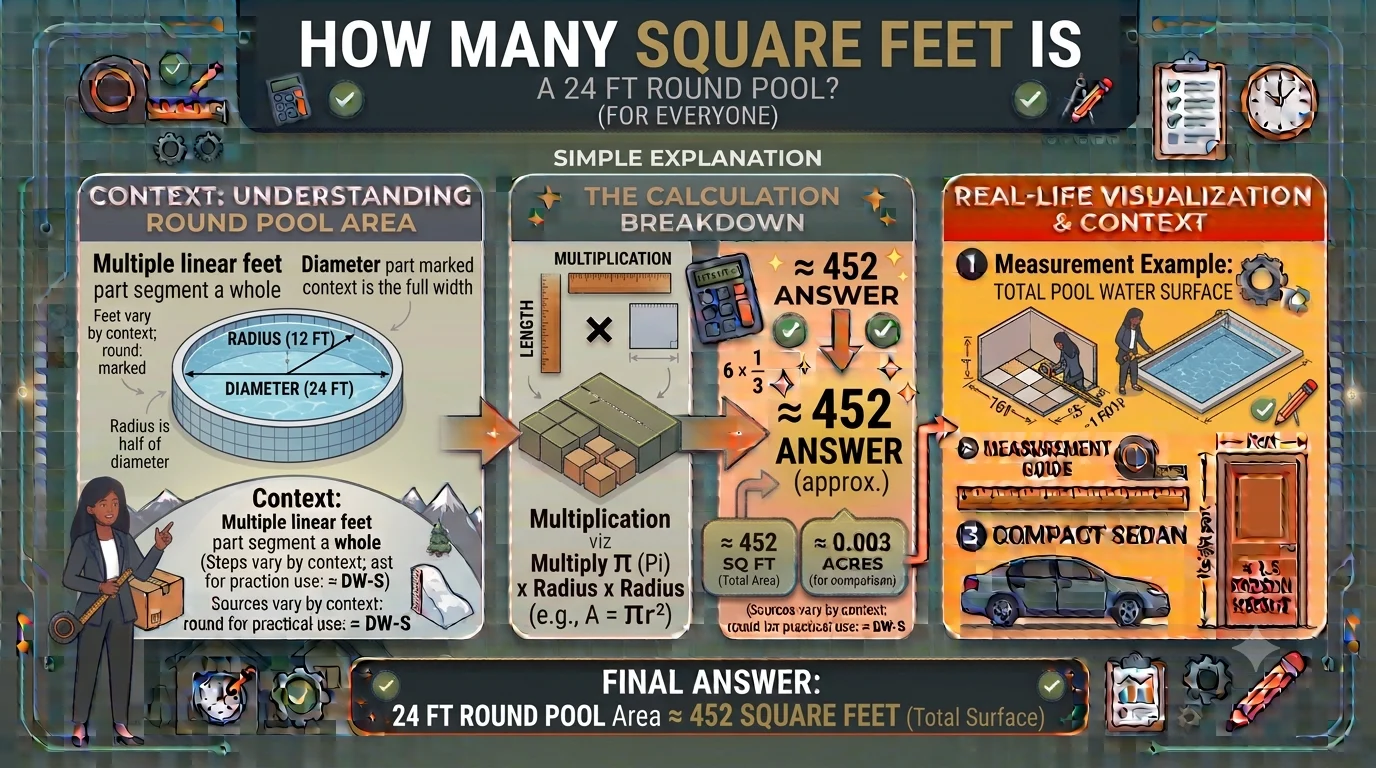
If you’re wondering how many square feet is a 24 ft round pool, the answer is approximately 452 square feet. This measurement represents the pool’s surface area and is useful when planning installation, purchasing a pool cover, designing a deck, estimating landscaping materials, or preparing the ground. Although the pool’s diameter is 24 feet, calculating its square footage requires using the area formula for a circle.
Whether you’re installing a new above-ground pool or simply comparing pool sizes, understanding how to calculate square footage helps you make better decisions and avoid costly mistakes. This guide explains the calculation step by step, includes comparison charts, practical examples, and expert tips to help you confidently plan your project.
What Does Square Feet Mean?
Square feet measure the total surface area of a flat space. For a round swimming pool, square footage refers to the area of the water’s surface when viewed from above.
Unlike rectangular pools, where you multiply length by width, round pools require the area of a circle formula because every point along the edge is the same distance from the center.
Knowing the square footage helps you:
- Plan pool installation.
- Buy the correct pool cover.
- Estimate decking materials.
- Calculate landscaping needs.
- Compare different pool sizes.
- Prepare the installation site.
How Many Square Feet Is a 24 Ft Round Pool?
A 24-foot round pool has:
- Diameter: 24 feet
- Radius: 12 feet
To calculate the area of a circle, use this formula:
Area = π × Radius²
Step 1: Find the Radius
The radius is half of the diameter.
24 ÷ 2 = 12 feet
Step 2: Square the Radius
12 × 12 = 144
Step 3: Multiply by Pi (π)
3.1416 × 144 = 452.39 square feet
After rounding, the result is:
A 24 ft round pool covers approximately 452 square feet.
Formula for Calculating Any Round Pool
You can calculate the area of any round pool using the same formula.
- Measure the diameter.
- Divide the diameter by two to find the radius.
- Square the radius.
- Multiply the result by π (3.1416).
This simple method works for above-ground and in-ground round pools of every size.
Square Footage Chart for Common Round Pool Sizes
| Pool Diameter | Radius | Approximate Area |
|---|---|---|
| 10 ft | 5 ft | 79 sq ft |
| 12 ft | 6 ft | 113 sq ft |
| 15 ft | 7.5 ft | 177 sq ft |
| 18 ft | 9 ft | 254 sq ft |
| 21 ft | 10.5 ft | 346 sq ft |
| 24 ft | 12 ft | 452 sq ft |
| 27 ft | 13.5 ft | 573 sq ft |
| 30 ft | 15 ft | 707 sq ft |
| 33 ft | 16.5 ft | 855 sq ft |
This chart makes it easy to compare popular above-ground pool sizes.
Why Knowing the Square Footage Matters
Understanding the square footage of your pool is useful for much more than simple math.
Choosing the Right Pool Cover
Most pool covers are sold by pool diameter, but knowing the total surface area helps you compare products and estimate material requirements.
Planning a Pool Deck
If you’re building a wooden, composite, or concrete deck around your pool, square footage helps estimate the amount of materials you’ll need and improves budgeting.
Landscaping Around the Pool
Whether you’re installing grass, gravel, mulch, decorative stone, or artificial turf, knowing the pool’s footprint helps calculate the amount of landscaping material required.
Ground Preparation
Before installing an above-ground pool, the ground should be level and stable. Square footage helps estimate the amount of sand, crushed stone, weed barrier fabric, or soil preparation needed.
Real-Life Example
Suppose you’re installing a 24-foot round pool in your backyard and want a 3-foot-wide walkway around it.
The total outside diameter becomes:
24 + 3 + 3 = 30 feet
A 30-foot circle covers approximately 707 square feet.
Subtract the pool area:
707 − 452 = 255 square feet
You’ll need approximately 255 square feet of pavers, decking, or concrete to build the surrounding walkway.
Pool Surface Area vs. Water Volume
Many people confuse square footage with water capacity, but they measure different things.
| Measurement | Meaning |
|---|---|
| Square Feet | Surface area of the pool |
| Cubic Feet | Total volume inside the pool |
| Gallons | Amount of water the pool holds |
For example, if a 24-foot round pool has an average water depth of 4 feet:
- Surface area = 452 square feet
- Volume = 452 × 4 = 1,809 cubic feet
- Water capacity ≈ 13,531 gallons
Actual water capacity depends on the pool’s depth and fill level.
Comparing a 24 Ft Round Pool with Rectangular Pools
Although pool shapes differ, several rectangular pools offer nearly the same swimming area.
| Pool Shape | Approximate Area |
|---|---|
| 24 ft Round | 452 sq ft |
| 16 × 28 ft Rectangle | 448 sq ft |
| 15 × 30 ft Rectangle | 450 sq ft |
| 18 × 25 ft Rectangle | 450 sq ft |
This comparison helps homeowners choose the best pool shape based on available backyard space.
Practical Uses of Pool Square Footage
Knowing your pool’s square footage helps when:
- Designing your backyard.
- Estimating project costs.
- Buying pool covers.
- Planning patios and decks.
- Calculating landscaping materials.
- Installing drainage systems.
- Applying protective coatings.
- Estimating maintenance needs.
- Comparing different pool models.
Common Mistakes When Measuring a Round Pool
Avoid these common errors to ensure accurate calculations.
Using the Diameter Instead of the Radius
Always divide the diameter by two before applying the formula.
Forgetting to Square the Radius
The radius must be multiplied by itself.
For a 24-foot pool:
12 × 12 = 144
Not:
12 × 2
Confusing Area with Volume
Square feet measure the pool’s surface area, while cubic feet and gallons measure how much water it can hold.
Rounding Too Early
For the most accurate result, use π (3.1416) throughout the calculation and round only the final answer.
Expert Tips
Professional installers recommend these tips:
- Measure the diameter through the exact center of the pool.
- Double-check measurements before purchasing materials.
- Leave enough space around the pool for maintenance.
- Plan extra room for ladders, pumps, and filters.
- Allow additional clearance if installing a fence or deck.
Quick Reference Chart
| Pool Diameter | Approximate Square Feet |
|---|---|
| 10 ft | 79 sq ft |
| 12 ft | 113 sq ft |
| 15 ft | 177 sq ft |
| 18 ft | 254 sq ft |
| 21 ft | 346 sq ft |
| 24 ft | 452 sq ft |
| 27 ft | 573 sq ft |
| 30 ft | 707 sq ft |
| 33 ft | 855 sq ft |
Keep this chart handy whenever you compare pool sizes or estimate backyard space.
Frequently Asked Questions
How many square feet is a 24 ft round pool?
A 24-foot round pool has approximately 452 square feet of surface area.
What formula calculates the area of a round pool?
Use the formula:
Area = π × Radius²
The radius is half the pool’s diameter.
Is square footage the same as water capacity?
No. Square footage measures the surface area, while water capacity depends on the pool’s depth and is measured in cubic feet or gallons.
Why should I know the square footage of my pool?
Knowing the square footage helps with planning installation, choosing the right pool cover, estimating landscaping materials, building decks, and budgeting your project.
How much backyard space do I need for a 24 ft round pool?
Although the pool itself covers about 452 square feet, it’s recommended to leave additional space around the pool for walkways, equipment, safety barriers, and maintenance access.
Conclusion
If you’ve been searching how many square feet is a 24 ft round pool, the answer is approximately 452 square feet. Calculating the surface area is simple when you use the circle area formula, and knowing this measurement is valuable for planning installation, estimating landscaping materials, building a deck, choosing the right pool cover, and organizing your outdoor space. Whether you’re buying your first above-ground pool or upgrading your backyard, understanding the square footage helps you make informed decisions and complete your project with confidence.