
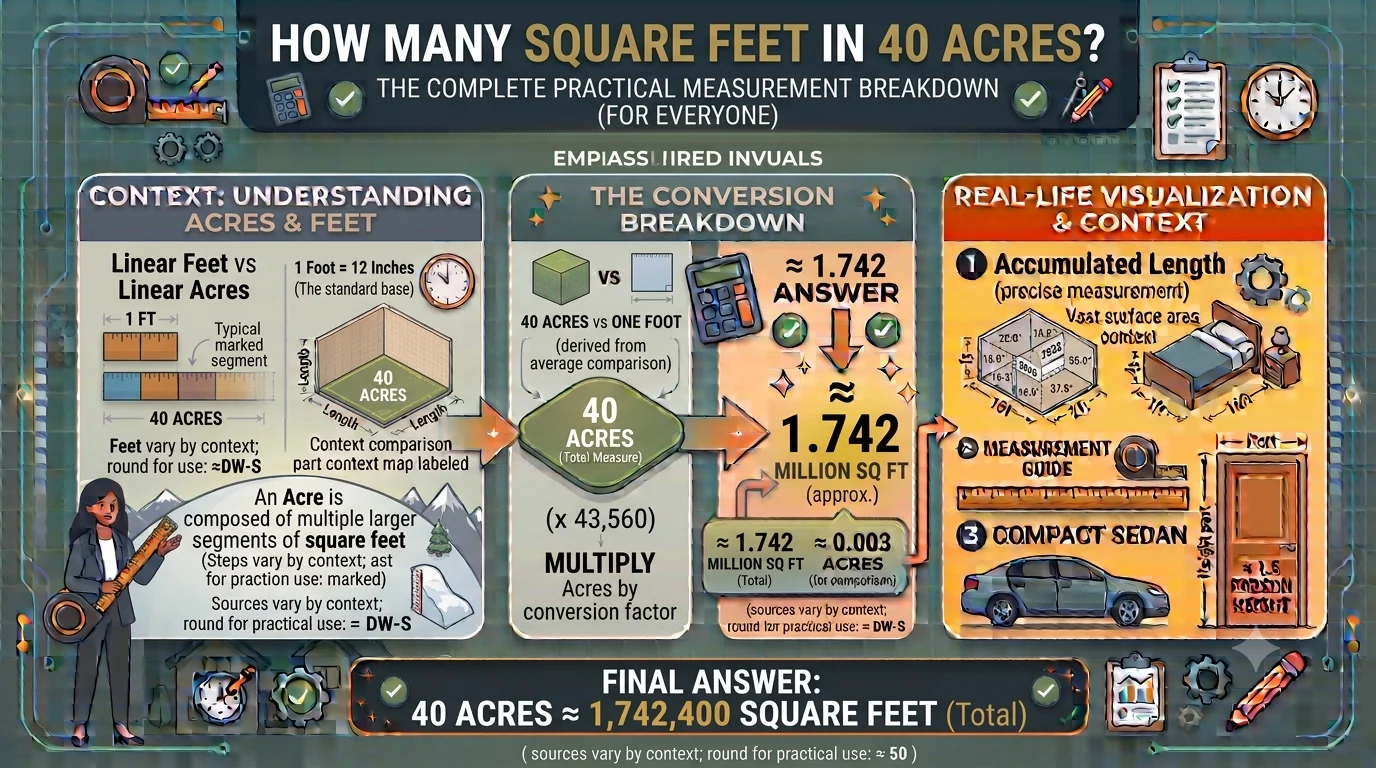
If you’re wondering how many square feet in 40 acres, the answer is simple:
40 acres = 1,742,400 square feet.
This is one of the most common land conversion questions for property buyers, farmers, real estate professionals, surveyors, and anyone planning a construction or landscaping project. While acres are commonly used to describe large parcels of land, square feet provide a more detailed measurement that is easier to visualize and use for planning.
Understanding this conversion can help you compare property sizes, estimate development potential, calculate fencing, or determine how much usable space a parcel offers. In this guide, you’ll learn the exact conversion, the formula behind it, practical examples, comparison tables, and real-world applications.
Quick Answer
The exact conversion is:
- 1 acre = 43,560 square feet
- 40 acres = 1,742,400 square feet
So, there are 1,742,400 square feet in 40 acres.
Understanding Acres and Square Feet
Before converting land measurements, it’s helpful to understand these two units.
An acre is a standard unit of land area used primarily in the United States and several other countries. It has been used for centuries to measure farmland, ranches, forests, and large residential properties.
A square foot is a much smaller unit of area. It represents the area of a square that measures one foot on each side.
Because an acre is such a large measurement, converting it into square feet provides a clearer picture of the property’s actual size.
Why Square Feet Matter
Square feet are commonly used for:
- Home construction
- Commercial buildings
- Landscaping projects
- Property planning
- Flooring estimates
- Fence installation
- Site development
Formula to Convert Acres to Square Feet
Converting acres into square feet is straightforward.
Formula:
Square Feet = Acres × 43,560
Since every acre contains exactly 43,560 square feet, multiplying the number of acres by this value gives the total area.
For example:
40 × 43,560 = 1,742,400 square feet
Therefore:
40 acres = 1,742,400 square feet
Step-by-Step Calculation
Let’s calculate it together.
Step 1: Start with the conversion factor.
1 acre = 43,560 square feet
Step 2: Multiply by the number of acres.
40 × 43,560
Step 3: Solve the equation.
40 × 43,560 = 1,742,400
So, a 40-acre property contains 1,742,400 square feet.
Acres to Square Feet Conversion Chart
| Acres | Square Feet |
|---|---|
| 1 | 43,560 |
| 2 | 87,120 |
| 5 | 217,800 |
| 10 | 435,600 |
| 20 | 871,200 |
| 30 | 1,306,800 |
| 40 | 1,742,400 |
| 50 | 2,178,000 |
| 75 | 3,267,000 |
| 100 | 4,356,000 |
This quick reference chart makes it easy to compare different land sizes.
What Does 40 Acres Look Like?
Many people struggle to picture how large 40 acres really is.
Although the shape of a property can vary, the total area remains the same.
A 40-acre property is approximately:
- 1,742,400 square feet
- About 30 American football fields (excluding surrounding facilities)
- Large enough for commercial farming
- Suitable for ranching or livestock
- Big enough for residential subdivisions in many areas
- Ideal for recreational activities like hunting, camping, or ATV riding
If the land is perfectly square, each side would measure approximately 1,320 feet, or about one-quarter of a mile.
Real-World Uses of 40 Acres
Forty-acre parcels are common across many industries because they offer a significant amount of usable land.
Agriculture
Farmers often use 40 acres for:
- Crop production
- Vegetable farming
- Orchards
- Hay production
- Livestock grazing
Residential Development
Developers may divide 40 acres into smaller residential lots, depending on local zoning laws and infrastructure.
Recreation
Large recreational properties often include:
- Hunting land
- Fishing ponds
- Camping areas
- ATV trails
- Wildlife habitats
Commercial Development
Businesses may use 40-acre properties for:
- Warehouses
- Distribution centers
- Industrial facilities
- Solar farms
- Equipment storage
Acres vs. Square Feet
| Feature | Acre | Square Foot |
|---|---|---|
| Measures | Land area | Land or building area |
| Size | 43,560 sq ft | Basic unit |
| Common Use | Farms and large properties | Homes and buildings |
| Best For | Large land parcels | Construction planning |
Both units measure area, but square feet provide more detailed information for planning projects.
Why Convert Acres to Square Feet?
Converting acreage into square footage has several advantages.
It helps you:
- Compare different properties more accurately
- Estimate construction costs
- Plan landscaping projects
- Calculate fencing requirements
- Understand building density
- Estimate property value
- Prepare permit applications
Many real estate listings use acres, while builders, architects, and contractors typically work in square feet.
Practical Examples
Example 1
A farmer purchases 40 acres for growing crops.
Calculation:
40 × 43,560
= 1,742,400 square feet
Example 2
A developer combines two 20-acre parcels.
Each parcel:
20 × 43,560 = 871,200 square feet
Combined:
871,200 × 2
= 1,742,400 square feet
Example 3
A surveyor confirms a property’s legal description as 40 acres.
After conversion:
40 acres = 1,742,400 square feet
This confirms the property’s total area.
Common Conversion Mistakes
Although converting acres is simple, mistakes still happen.
Using the Wrong Conversion Factor
Some people incorrectly assume one acre equals 40,000 square feet.
The correct value is 43,560 square feet.
Calculation Errors
Always double-check multiplication when working with large numbers.
Confusing Area with Distance
Acres and square feet measure area, not length.
Ignoring Property Shape
Two properties can both be 40 acres while having completely different shapes and dimensions.
Expert Tips for Measuring Land
Professionals recommend following these best practices:
- Use official survey documents whenever possible.
- Verify property boundaries before purchasing land.
- Convert acreage into square feet when estimating construction costs.
- Keep acreage measurements for legal descriptions.
- Work with licensed surveyors when precise measurements are required.
- Review local zoning regulations before developing large parcels.
These steps help avoid costly mistakes and improve planning accuracy.
Quick Conversion Formula
| Conversion | Formula |
|---|---|
| Acres to Square Feet | Acres × 43,560 |
| Square Feet to Acres | Square Feet ÷ 43,560 |
This formula works for any land size.
Frequently Asked Questions
How many square feet are in 40 acres?
There are 1,742,400 square feet in 40 acres.
Is 40 acres considered a large property?
Yes. Forty acres is considered a substantial parcel suitable for farming, recreation, ranching, conservation, or development, depending on local regulations.
Why does one acre equal 43,560 square feet?
The acre is a historical unit of land measurement that has been standardized to exactly 43,560 square feet.
Can two 40-acre properties have different shapes?
Yes. Properties can be square, rectangular, or irregular while still containing the same total area of 1,742,400 square feet.
How do I convert acres into square feet?
Simply multiply the number of acres by 43,560.
For example:
40 × 43,560 = 1,742,400 square feet
Conclusion
Knowing how many square feet in 40 acres is valuable for anyone involved in buying, selling, developing, or managing land. Since 1 acre equals 43,560 square feet, multiplying by 40 gives 1,742,400 square feet. Whether you’re comparing property listings, planning a construction project, estimating fencing, or managing farmland, understanding this conversion makes land measurements easier and more accurate. By remembering this simple formula, you can quickly convert any acreage into square feet and make better-informed decisions about your property.