

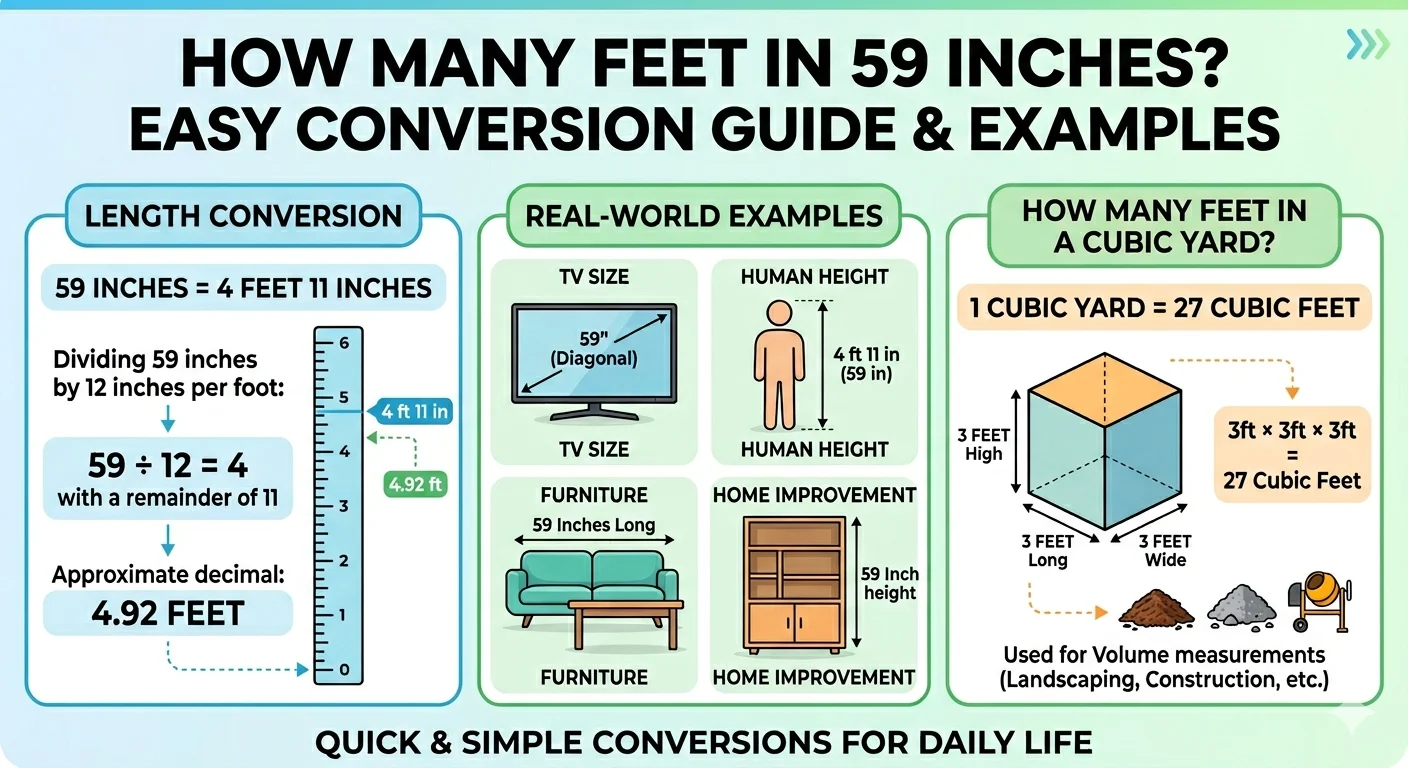
If you are trying to figure out how many feet in 59 inches, the answer is simple. There are approximately 4.92 feet in 59 inches. In everyday measurements, that is usually written as 4 feet 11 inches.
Understanding inch-to-feet conversions is useful for many real-life situations. You may need it when measuring furniture, checking TV sizes, planning home improvement projects, comparing heights, or understanding construction dimensions.
At the same time, many people also ask related measurement questions like how many feet are in a cubic yard. While these measurements are different, both are commonly used in construction, landscaping, and home projects.
This guide explains everything in simple language, including formulas, examples, charts, and practical uses.
How Many Feet in 59 Inches?
The direct conversion formula is:
Since there are 12 inches in one foot, divide 59 by 12.
So:
- 59 inches = 4.9167 feet
- Rounded = 4.92 feet
- In feet and inches = 4 feet 11 inches
This is the most accurate and commonly used answer.
Why Convert Inches to Feet?
People use inch-to-feet conversions every day without realizing it. Some common situations include:
- Measuring room dimensions
- Buying furniture
- Checking TV sizes
- Measuring height
- Construction and remodeling
- DIY projects
- Sports measurements
For example, if a product description says 59 inches, many people immediately want to know the size in feet to better visualize it.
Inches to Feet Conversion Formula
The conversion process is easy.
Basic Formula
Step-by-Step Example
Convert 59 inches into feet.
Step 1: Start with the inches value.
59 inches
Step 2: Divide by 12.
Step 3: Round if needed.
59 inches ≈ 4.92 feet
59 Inches in Feet and Inches
Sometimes decimal feet can look confusing. Many people prefer the traditional feet-and-inches format.
Here is how it works:
- 59 inches ÷ 12 = 4 feet remainder 11 inches
So:
- 59 inches = 4 feet 11 inches
This format is commonly used for:
- Human height
- Furniture
- TVs
- Door measurements
- Interior design
Quick Inches to Feet Conversion Chart
Here is a simple conversion table for nearby measurements.
| Inches | Feet |
|---|---|
| 48 inches | 4 feet |
| 50 inches | 4.17 feet |
| 55 inches | 4.58 feet |
| 59 inches | 4.92 feet |
| 60 inches | 5 feet |
| 65 inches | 5.42 feet |
| 70 inches | 5.83 feet |
| 72 inches | 6 feet |
This chart helps you convert common measurements quickly without a calculator.
Real-Life Examples of 59 Inches
Understanding actual objects that measure around 59 inches makes the conversion easier to visualize.
TV Size
A 59-inch TV is nearly 5 feet across diagonally.
Furniture
Some sofas, benches, and desks are around 59 inches long.
Human Height
A person who is 59 inches tall is approximately:
- 4 feet 11 inches
Home Improvement
Cabinets, shelves, and countertops may also use measurements close to 59 inches.
How Many Feet Are in a Cubic Yard?
Another common measurement question is how many feet are in a cubic yard.
This measurement is different because a cubic yard measures volume, not length.
The correct conversion is:
A cubic yard equals:
- 3 feet long
- 3 feet wide
- 3 feet high
So:
This means one cubic yard contains 27 cubic feet.
Difference Between Linear Feet and Cubic Feet
Many people confuse these measurements.
Here is the difference.
| Measurement | Meaning |
|---|---|
| Linear Feet | Measures length |
| Square Feet | Measures area |
| Cubic Feet | Measures volume |
For example:
- 59 inches converted to feet is a linear measurement
- Cubic yards measure three-dimensional space
Understanding this difference prevents costly mistakes in construction and landscaping projects.
Common Uses for Cubic Yard Measurements
Cubic yard measurements are widely used in:
Landscaping
- Mulch
- Gravel
- Sand
- Soil
Construction
- Concrete
- Excavation
- Debris removal
Gardening
- Compost
- Topsoil
- Raised bed filling
Most suppliers sell these materials by the cubic yard.
How to Convert Cubic Yards to Cubic Feet
The formula is simple.
Example
Convert 2 cubic yards.
Answer:
2 cubic yards = 54 cubic feet
Common Conversion Mistakes
People often make measurement errors when converting inches, feet, and cubic yards.
Forgetting That Feet Use 12 Inches
Always remember:
Mixing Length With Volume
Linear feet and cubic feet are completely different measurements.
Rounding Too Early
When accuracy matters, round only at the final step.
Practical Tips for Accurate Measurements
Use a Calculator
Small mistakes can affect construction and furniture planning.
Double-Check Units
Make sure you know whether the measurement uses:
- Inches
- Feet
- Square feet
- Cubic feet
Convert Before Buying Materials
This helps prevent ordering too much or too little material.
Keep a Conversion Chart Handy
Quick reference tables save time during projects.
Inches to Feet Conversion Examples
Here are more examples to help you understand the process.
24 Inches to Feet
24 inches = 2 feet
36 Inches to Feet
36 inches = 3 feet
84 Inches to Feet
84 inches = 7 feet
Why Understanding Measurements Matters
Measurements affect many parts of daily life.
Correct conversions help with:
- Buying furniture that fits
- Planning renovations
- Ordering construction materials
- Measuring spaces correctly
- Understanding product dimensions
Even small conversion mistakes can create expensive problems.
Frequently Asked Questions
How many feet in 59 inches exactly?
59 inches equals 4.9167 feet, or approximately 4 feet 11 inches.
What is the easiest way to convert inches to feet?
Divide the number of inches by 12.
How many inches are in 5 feet?
There are 60 inches in 5 feet.
How many feet are in a cubic yard?
One cubic yard equals 27 cubic feet.
Is 59 inches considered 5 feet?
Not exactly. It is 1 inch shorter than 5 feet.
Conclusion
Now you know exactly how many feet in 59 inches. The correct conversion is:
- 59 inches = 4.92 feet
- Or 4 feet 11 inches
The conversion is simple once you remember that 1 foot equals 12 inches.
You also learned how many feet are in a cubic yard, which equals 27 cubic feet. While inches-to-feet conversions measure length, cubic yards measure volume.
Understanding these measurements helps with construction, landscaping, furniture shopping, home improvement, and many everyday tasks.