
Introduction
If you have ever worked on a landscaping, construction, or home improvement project, you have probably wondered how many feet are in a cubic yard. This is one of the most common measurement questions people ask when buying materials like mulch, gravel, soil, sand, or concrete.
The short answer is simple:
However, understanding why this conversion works can save you time, money, and frustration. Whether you are filling a garden bed, pouring concrete, or ordering landscaping materials, knowing how cubic yards convert to cubic feet helps you calculate the correct amount.
This guide explains the conversion in easy language, includes formulas, charts, examples, and practical tips you can use in real-world projects.
What Is a Cubic Yard?
A cubic yard is a unit of volume. It measures three-dimensional space using length, width, and height.
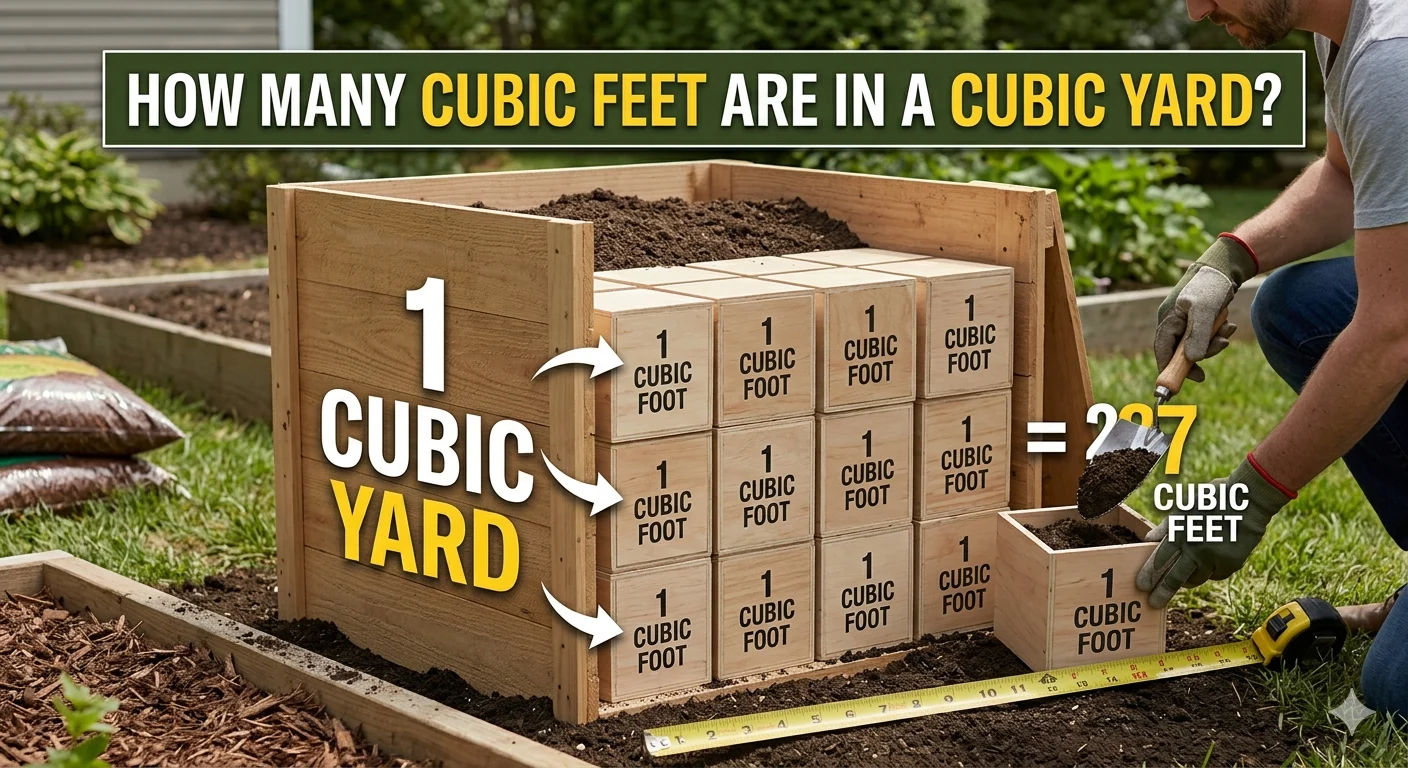
A cubic yard is created when all dimensions measure 1 yard:
- 1 yard long
- 1 yard wide
- 1 yard high
Since 1 yard equals 3 feet, the dimensions in feet become:
- 3 feet long
- 3 feet wide
- 3 feet high
To find the volume:
That is why one cubic yard contains 27 cubic feet.
Understanding Cubic Measurements
Linear measurements use one dimension:
- Feet
- Inches
- Yards
Area measurements use two dimensions:
- Square feet
- Square yards
Volume measurements use three dimensions:
- Cubic feet
- Cubic yards
This is important because volume measures how much space something fills.
Difference Between Square Feet and Cubic Feet
People often confuse square feet with cubic feet.
| Measurement | What It Measures | Example |
|---|---|---|
| Square Feet | Area | Flooring |
| Cubic Feet | Volume | Soil or concrete |
For example:
- A floor may cover 100 square feet.
- A container may hold 100 cubic feet.
One measures surface area, while the other measures volume.
How Many Feet Are in a Cubic Yard?
The exact conversion is:
This means:
| Cubic Yards | Cubic Feet |
|---|---|
| 1 | 27 |
| 2 | 54 |
| 3 | 81 |
| 4 | 108 |
| 5 | 135 |
| 10 | 270 |
To convert cubic yards into cubic feet, multiply by 27.
Cubic Yard to Cubic Feet Formula
Example:
If you have 4 cubic yards:
So, 4 cubic yards equals 108 cubic feet.
Why This Conversion Matters
Understanding cubic yard conversions is useful in many everyday situations.
Landscaping Projects
Landscaping suppliers usually sell:
- Mulch
- Topsoil
- Compost
- Gravel
by the cubic yard.
However, you may measure your garden space in feet. Converting helps you order the correct amount.
Concrete and Cement Work
Concrete for patios, sidewalks, and driveways is commonly ordered in cubic yards.
Incorrect calculations can lead to:
- Wasted money
- Extra delivery fees
- Project delays
Moving and Storage
Storage containers and moving trucks often list capacity in cubic feet.
Knowing cubic yard conversions helps estimate how much material fits.
Construction Planning
Builders frequently use cubic measurements for:
- Excavation
- Backfill
- Sand
- Stone
Accurate conversions improve budgeting and material planning.
How to Convert Cubic Yards to Cubic Feet
The process is simple.
Step 1: Identify the Cubic Yards
Start with the number of cubic yards.
Example:
- 2 cubic yards
Step 2: Multiply by 27
Use the formula:
Step 3: Add Units
Result:
- 54 cubic feet
Real-Life Conversion Examples
Example 1: Mulch for a Garden
You buy 3 cubic yards of mulch.
Calculation:
You receive 81 cubic feet of mulch.
Example 2: Concrete for a Patio
A contractor orders 5 cubic yards of concrete.
Calculation:
That equals 135 cubic feet.
Example 3: Soil Delivery
A landscaping company delivers 7 cubic yards of topsoil.
Calculation:
The delivery contains 189 cubic feet of soil.
Cubic Yard vs Cubic Feet
Although both measure volume, they differ in scale.
| Unit | Size |
|---|---|
| 1 Cubic Foot | 1 ft × 1 ft × 1 ft |
| 1 Cubic Yard | 3 ft × 3 ft × 3 ft |
A cubic yard is much larger.
Key Difference
- Cubic feet are better for small measurements.
- Cubic yards are better for large quantities.
For example:
- Aquarium size → cubic feet
- Concrete truck load → cubic yards
Common Materials Measured in Cubic Yards
Many bulk materials are sold in cubic yards.
Mulch
Mulch is commonly used in gardens and flower beds.
Typical coverage:
- 1 cubic yard covers about 100 square feet at 3 inches deep.
Gravel
Gravel is popular for:
- Driveways
- Pathways
- Drainage systems
It is almost always sold by cubic yard volume.
Soil
Topsoil and compost are often delivered in cubic yards for landscaping projects.
Concrete
Concrete companies usually price ready-mix concrete per cubic yard.
Practical Examples for Home Projects
Example for a Garden Bed
Suppose your garden bed measures:
- 9 feet long
- 6 feet wide
- 1 foot deep
Volume formula:
Calculation:
Convert cubic feet to cubic yards:
You need about 2 cubic yards of soil.
Example for Concrete Slab
A slab measures:
- 12 feet long
- 10 feet wide
- 0.5 feet thick
Volume:
Convert to cubic yards:
Most contractors would order slightly more to avoid shortages.
Example for Gravel Driveway
Driveway dimensions:
- 20 feet long
- 12 feet wide
- 0.5 feet deep
Volume:
Convert:
You would likely order 4.5 to 5 cubic yards.
Common Mistakes People Make
Confusing Linear Feet with Cubic Feet
Feet measure length only. Cubic feet measure volume.
Forgetting Depth
Many people calculate only length and width but ignore depth.
Ordering Too Little Material
Always account for:
- Waste
- Spillage
- Settling
Mixing Square and Cubic Measurements
Square feet measure surface area. Cubic yards measure volume.
Expert Tips for Accurate Measurements
Measure Carefully
Double-check dimensions before ordering materials.
Round Up Slightly
It is safer to order a little extra than run short.
Use Consistent Units
Convert all measurements into feet before calculating volume.
Understand Material Compression
Some materials settle after installation.
Examples include:
- Mulch
- Soil
- Sand
Ask Suppliers About Coverage
Different materials may cover areas differently depending on depth.
FAQs
How many cubic feet are in one cubic yard?
There are 27 cubic feet in one cubic yard.
Why does a cubic yard equal 27 cubic feet?
Because one yard equals 3 feet, and volume uses three dimensions:
3 × 3 × 3 = 27.
How do I convert cubic feet to cubic yards?
Divide cubic feet by 27.
Is cubic yard bigger than cubic foot?
Yes. A cubic yard is 27 times larger than a cubic foot.
What materials are commonly sold in cubic yards?
Common materials include:
- Mulch
- Gravel
- Soil
- Sand
- Concrete
- Compost
Conclusion
Understanding how many feet are in a cubic yard is essential for landscaping, construction, gardening, and home improvement projects.
The key conversion to remember is:
Once you know this formula, calculating material quantities becomes much easier. Whether you are ordering mulch for a flower bed, gravel for a driveway, or concrete for a patio, accurate volume calculations help prevent waste and save money.
By using the formulas, charts, and examples in this guide, you can confidently convert cubic yards to cubic feet for any project.