

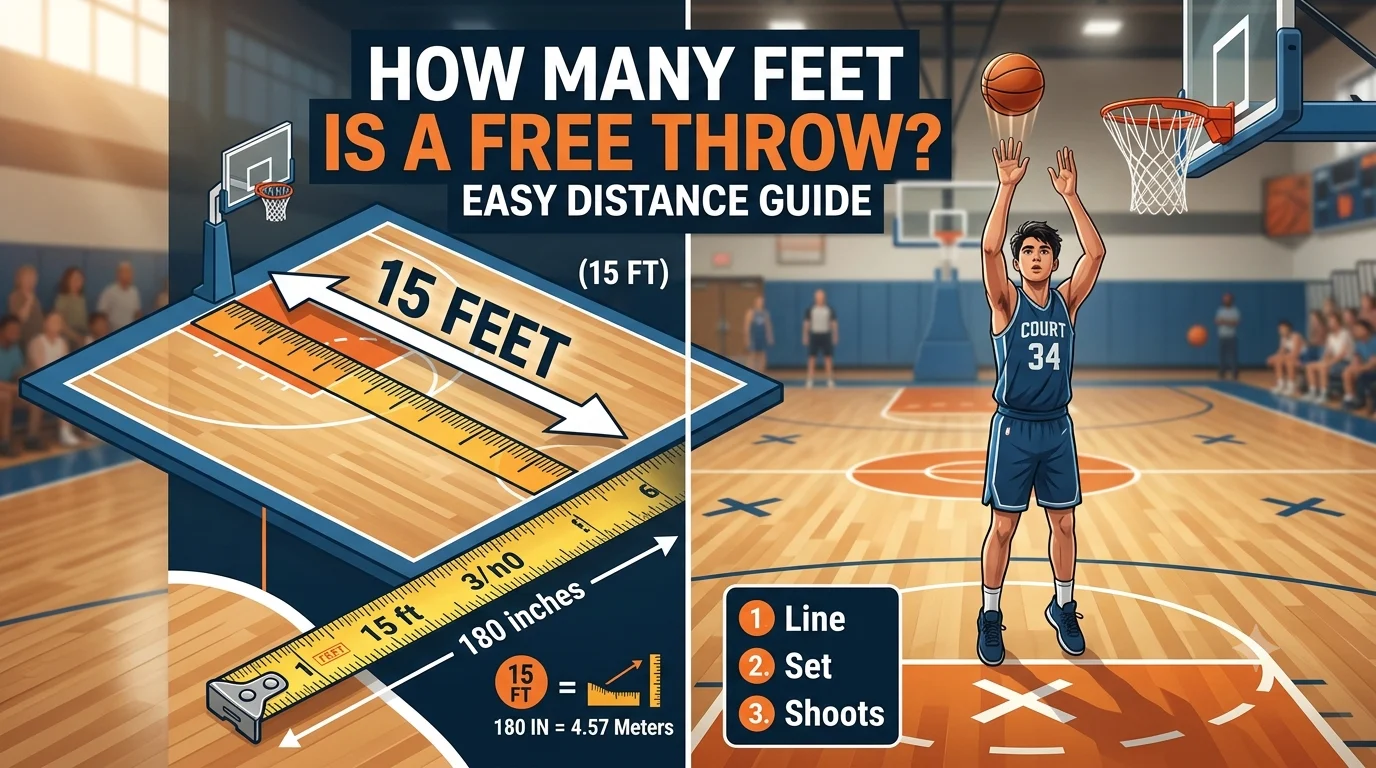
If you’ve ever watched a basketball game, you’ve probably wondered, how many feet is a free throw? Whether you’re a beginner, player, coach, parent, or basketball fan, understanding the official free throw distance is essential.
A free throw is one of the most important shots in basketball because it gives a player an uncontested opportunity to score one point after certain fouls. While the shot may look simple, the distance plays a huge role in shooting accuracy and player development.
In this guide, you’ll learn the official free throw distance, how it compares across different leagues, why it matters, and practical tips for improving your free throw shooting.
What Is a Free Throw?
A free throw is a penalty shot awarded after specific fouls or rule violations. The shooter stands behind the free throw line and attempts to score without defenders interfering.
Each successful free throw is worth:
- 1 point
- Taken without defensive pressure
- Must be attempted within the time allowed by league rules
Free throws often decide close games, making them one of the most valuable skills in basketball.
How Many Feet Is a Free Throw?
The official answer is simple.
| Measurement | Distance |
|---|---|
| Feet | 15 feet |
| Inches | 180 inches |
| Meters | 4.57 meters |
The free throw line is exactly 15 feet from the front of the backboard.
This measurement is used in:
- NBA
- WNBA
- NCAA men’s basketball
- NCAA women’s basketball
- Most high school basketball leagues
So, if someone asks, how many feet is a free throw, the correct answer is 15 feet.
Understanding the Free Throw Distance
Many people mistakenly believe the distance is measured from the basketball hoop.
In reality, the official measurement is taken:
- From the front surface of the backboard
- To the outer edge of the free throw line
Since the rim extends away from the backboard, the actual shooting distance to the center of the basket is slightly longer.
Approximate shooting distance to the rim:
- About 13 feet 9 inches from the free throw line to the center of the rim.
This difference is important for court construction and official measurements.
Why Is the Free Throw Line 15 Feet Away?
The 15-foot distance has remained largely unchanged for decades because it creates the right balance between difficulty and fairness.
Reasons include:
- Rewards skilled shooters
- Creates consistent standards worldwide
- Allows fair scoring opportunities after fouls
- Develops shooting fundamentals
If the line were much closer, free throws would become too easy.
If it were farther away, scoring percentages would drop dramatically.
Free Throw Distance Across Different Basketball Levels
One interesting fact is that younger players often shoot from shorter distances.
| League | Free Throw Distance |
|---|---|
| NBA | 15 feet |
| WNBA | 15 feet |
| NCAA | 15 feet |
| High School | 15 feet |
| Youth Basketball (varies) | 10–15 feet |
Many youth leagues shorten the distance so children can develop proper shooting mechanics before moving to the official distance.
How Far Is 15 Feet?
Fifteen feet can be difficult to visualize.
Here are a few comparisons:
- Around the length of a large SUV
- About five average adult footsteps
- Approximately 4.57 meters
- Equal to 180 inches
These comparisons make it easier to understand the official free throw distance.
Why Free Throws Matter
Free throws may seem simple, but they often determine who wins or loses.
Benefits of making free throws include:
- Easy scoring opportunities
- Builds player confidence
- Punishes opponents for fouling
- Helps finish close games
- Improves overall offensive efficiency
Many championship games have been decided by free throw accuracy.
How to Improve Your Free Throw Shooting
Improving free throw accuracy takes practice, consistency, and proper technique.
1. Develop a Routine
Use the same routine before every shot.
For example:
- Bounce the ball twice
- Take a deep breath
- Focus on the rim
- Shoot
Repeating the same routine builds confidence.
2. Balance Your Feet
Keep your feet shoulder-width apart.
Your shooting foot should be slightly ahead of the other.
Proper balance improves consistency.
3. Bend Your Knees
Power should come from your legs rather than your arms.
A smooth upward motion creates a softer shot.
4. Follow Through
After releasing the ball:
- Extend your arm fully
- Snap your wrist
- Hold your follow-through
This classic “gooseneck” position helps improve accuracy.
5. Practice Daily
Professional players often shoot:
- 100
- 200
- Even 500 free throws each day
Consistent practice produces better results.
Common Free Throw Mistakes
Avoid these common errors.
Rushing the Shot
Take your time.
A calm routine produces better accuracy.
Using Too Much Arm Strength
Generate power from your legs.
Your arms should guide the shot.
Looking at the Ball
Always focus on the rim instead of the basketball.
Poor Follow-Through
Stopping your motion early reduces accuracy.
Finish every shot completely.
Free Throw Success Rates
Average free throw percentages vary by skill level.
| Level | Average Percentage |
|---|---|
| NBA | 75–80% |
| College | 68–75% |
| High School | 60–70% |
| Youth | 40–60% |
Elite shooters often exceed 90%.
Real-World Example
Imagine two basketball teams.
Team A shoots:
- 10 of 20 free throws
Team B shoots:
- 18 of 20 free throws
Both teams play equally well otherwise.
Team B scores 8 more points simply by making free throws.
That’s often enough to win the game.
Free Throw vs Three-Point Shot
| Feature | Free Throw | Three-Point Shot |
|---|---|---|
| Distance | 15 feet | 22–23.75 feet (varies) |
| Defense | None | Defended |
| Points | 1 | 3 |
| Difficulty | Moderate | High |
Although free throws are much closer than three-pointers, mental pressure often makes them challenging.
Interesting Facts About Free Throws
- Every successful free throw scores one point.
- The free throw line has remained 15 feet for many decades.
- Some NBA games are decided entirely by free throw shooting.
- Great shooters often spend hours practicing free throws.
- Free throws are among the highest-percentage shots in basketball.
Tips for Coaches
Coaches can improve player performance by:
- Practicing under game-like pressure
- Tracking free throw percentages
- Creating shooting routines
- Teaching proper mechanics first
- Encouraging confidence over speed
Small improvements in free throw accuracy can significantly impact a team’s record.
Why Consistency Matters
Basketball is a game of repetition.
Players who use identical shooting mechanics every time generally shoot better percentages.
Consistency includes:
- Same stance
- Same grip
- Same routine
- Same follow-through
These habits help players perform under pressure.
Frequently Asked Questions
How many feet is a free throw in basketball?
The official free throw distance is 15 feet from the front of the backboard to the free throw line.
Is the NBA free throw 15 feet?
Yes. NBA players shoot free throws from 15 feet, the same distance used in most major basketball leagues.
How many meters is a free throw?
A free throw is 4.57 meters.
Is the free throw measured from the hoop?
No. The official measurement is taken from the front of the backboard, not directly from the basket.
Why do youth leagues use shorter free throw distances?
Younger players often lack the strength to shoot comfortably from 15 feet, so many youth leagues reduce the distance to help develop proper shooting technique.
Conclusion
How Many Feet Is a Free Throw?
The answer is straightforward: a free throw is 15 feet from the front of the backboard to the free throw line. This official distance is used in the NBA, WNBA, NCAA, and most high school basketball leagues.
Knowing the free throw distance helps players improve their shooting mechanics, coaches teach proper fundamentals, and fans better understand the game. With consistent practice, solid technique, and a reliable routine, players of all ages can become more confident and accurate from the free throw line.