
If you’ve ever wondered how many cubic feet in 5 gallons, you’re not alone. This is a common question for people working in gardening, construction, aquariums, or simple home projects.
Understanding this conversion helps you measure materials correctly, avoid waste, and plan more efficiently. The good news? It’s very easy once you know the formula.
Let’s break it down step by step in a simple and practical way.
Understanding Gallons and Cubic Feet
Before jumping into the calculation, it’s important to understand what these units mean.
What Is a Gallon?
A gallon is a unit used to measure liquid volume in the United States.
- 1 US gallon = 128 fluid ounces
- Common uses: water, fuel, paint, and liquids
What Is a Cubic Foot?
A cubic foot measures volume in three dimensions.
- It represents a cube that is 1 foot long × 1 foot wide × 1 foot high
- Widely used in construction, storage, and material estimation
How Many Cubic Feet in 5 Gallon (Quick Answer)
Here’s the simple answer:
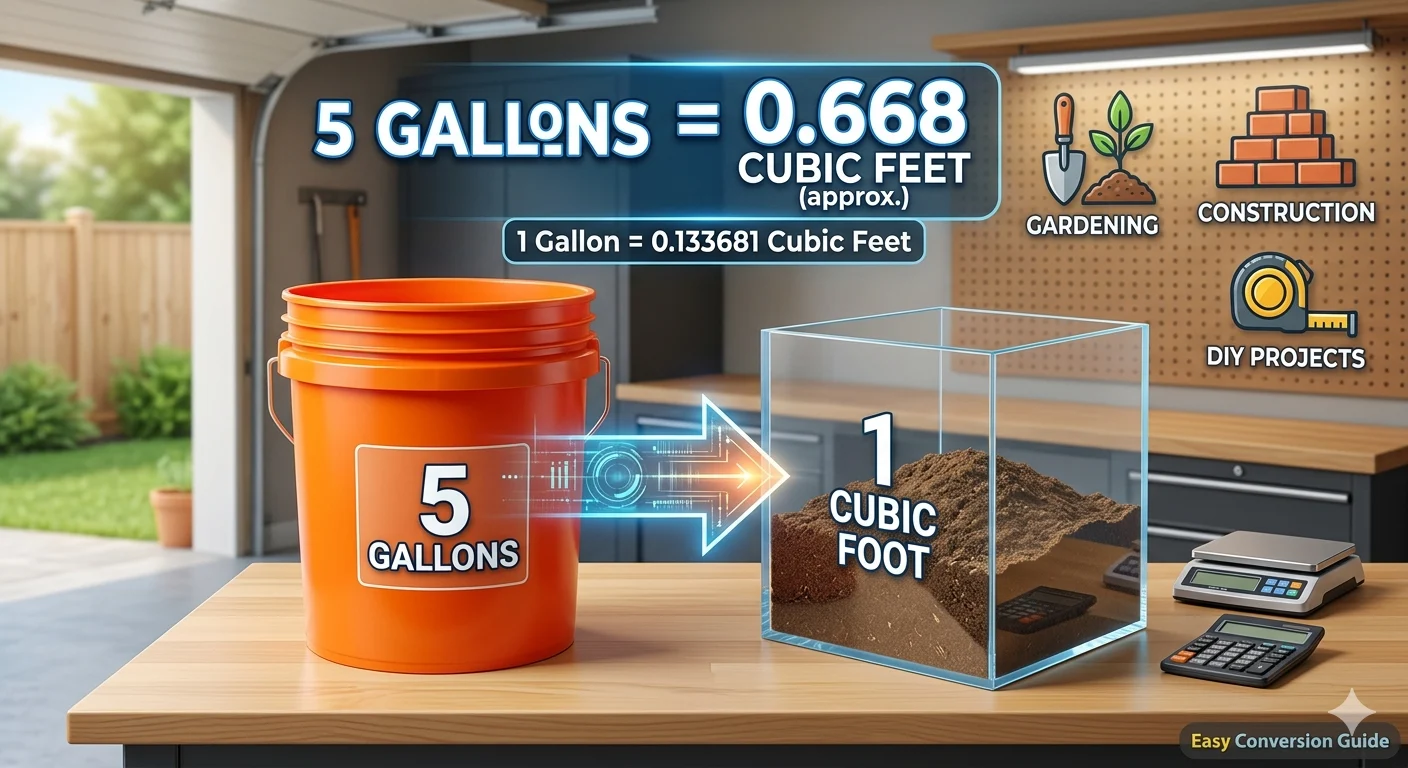
👉 5 gallons = 0.668 cubic feet (approximately)
So, a standard 5-gallon container holds just under 0.67 cubic feet of volume.
Conversion Formula Explained
To understand where this number comes from, let’s look at the formula.
Gallons to Cubic Feet Formula
The standard conversion is:
- 1 gallon = 0.133681 cubic feet
Step-by-Step Calculation
Let’s calculate it:
- 5 gallons × 0.133681 = 0.668405
👉 Rounded value: 0.668 cubic feet
This is the most accurate and commonly used result.
Conversion Chart (Gallons to Cubic Feet)
Here’s a quick reference chart to make things easier:
| Gallons | Cubic Feet |
| 1 gallon | 0.1337 cu ft |
| 2 gallons | 0.2674 cu ft |
| 3 gallons | 0.4010 cu ft |
| 4 gallons | 0.5347 cu ft |
| 5 gallons | 0.6684 cu ft |
| 10 gallons | 1.3368 cu ft |
| 20 gallons | 2.6736 cu ft |
You can use this chart when you need quick estimates without calculating every time.
Real-Life Examples
Understanding this conversion becomes more useful when applied in real situations.
5 Gallon Bucket Volume
A standard 5-gallon bucket holds:
👉 0.668 cubic feet
This is useful when measuring:
- Sand
- Cement
- Water
- Paint
Soil and Gardening Calculations
In gardening, volume matters a lot.
- 1 cubic foot ≈ 7.48 gallons
- So, 5 gallons is about 67% of a cubic foot
Example:
If a plant needs 1 cubic foot of soil, a 5-gallon bucket won’t be enough. You’ll need about 7.5 gallons.
Construction and Material Planning
If you’re mixing concrete or measuring gravel:
- A container of 2 cubic feet = about 15 gallons
- That means you need 3 full 5-gallon buckets
This makes planning much easier on-site.
Aquarium and Water Storage
If you’re setting up an aquarium or storing water:
- 5 gallons = 0.668 cubic feet
- This helps when calculating tank dimensions or storage space
Why This Conversion Matters
Knowing how many cubic feet in 5 gallon is important for:
- ✅ Accurate measurements
- ✅ Better material planning
- ✅ Reducing waste
- ✅ Saving money
- ✅ Improving efficiency
Even small errors in volume can lead to big mistakes in projects.
Common Mistakes to Avoid
Many people make simple but costly mistakes when converting units.
1. Confusing Volume with Weight
Gallons and cubic feet measure volume, not weight.
- Water, sand, and soil all weigh differently
- Always separate volume from weight
2. Using the Wrong Conversion Factor
Always use:
👉 1 gallon = 0.133681 cubic feet
Using incorrect values can lead to inaccurate results.
3. Mixing Measurement Systems
US gallons and UK gallons are different.
- Always confirm you’re using US gallons for this conversion
4. Rounding Too Early
Rounding numbers too soon can reduce accuracy.
- Always round at the final step only
Expert Tips for Accurate Conversion
Here are some practical tips to improve your calculations:
- ✔️ Use a calculator for precise results
- ✔️ Keep a conversion chart handy
- ✔️ Convert everything into one unit before starting
- ✔️ Label containers with their volume
- ✔️ Double-check large calculations
These small habits can make a big difference.
Practical Use Cases
This conversion is commonly used in:
- Home improvement projects
- Gardening and landscaping
- Construction work
- Water storage planning
- DIY projects
For example, if you’re filling a raised garden bed, knowing the cubic feet helps you buy the right amount of soil.
Comparing Gallons and Cubic Feet
Here’s a simple comparison:
- 1 cubic foot = 7.48 gallons
- 5 gallons = 0.668 cubic feet
So:
- Gallons → smaller unit
- Cubic feet → larger unit
Understanding this relationship makes conversions much easier.
FAQs
1. How many cubic feet is a 5 gallon bucket?
A standard 5-gallon bucket equals 0.668 cubic feet.
2. Is 5 gallons equal to 1 cubic foot?
No.
1 cubic foot = 7.48 gallons, so 5 gallons is less than 1 cubic foot.
3. How do you convert gallons to cubic feet?
Multiply gallons by 0.133681.
Example:
5 × 0.133681 = 0.668 cubic feet
4. How many gallons are in 1 cubic foot?
There are approximately 7.48 gallons in 1 cubic foot.
5. Why is this conversion important?
It helps with accurate measurements in gardening, construction, and storage planning.
Conclusion
So, how many cubic feet in 5 gallon?
👉 The answer is approximately 0.668 cubic feet.
This simple conversion is extremely useful in everyday tasks like gardening, construction, and DIY projects. Once you understand the formula and relationship between gallons and cubic feet, you can quickly make accurate calculations without confusion.
Whether you’re filling a bucket, planning a project, or measuring materials, knowing this conversion helps you work smarter and more efficiently.