

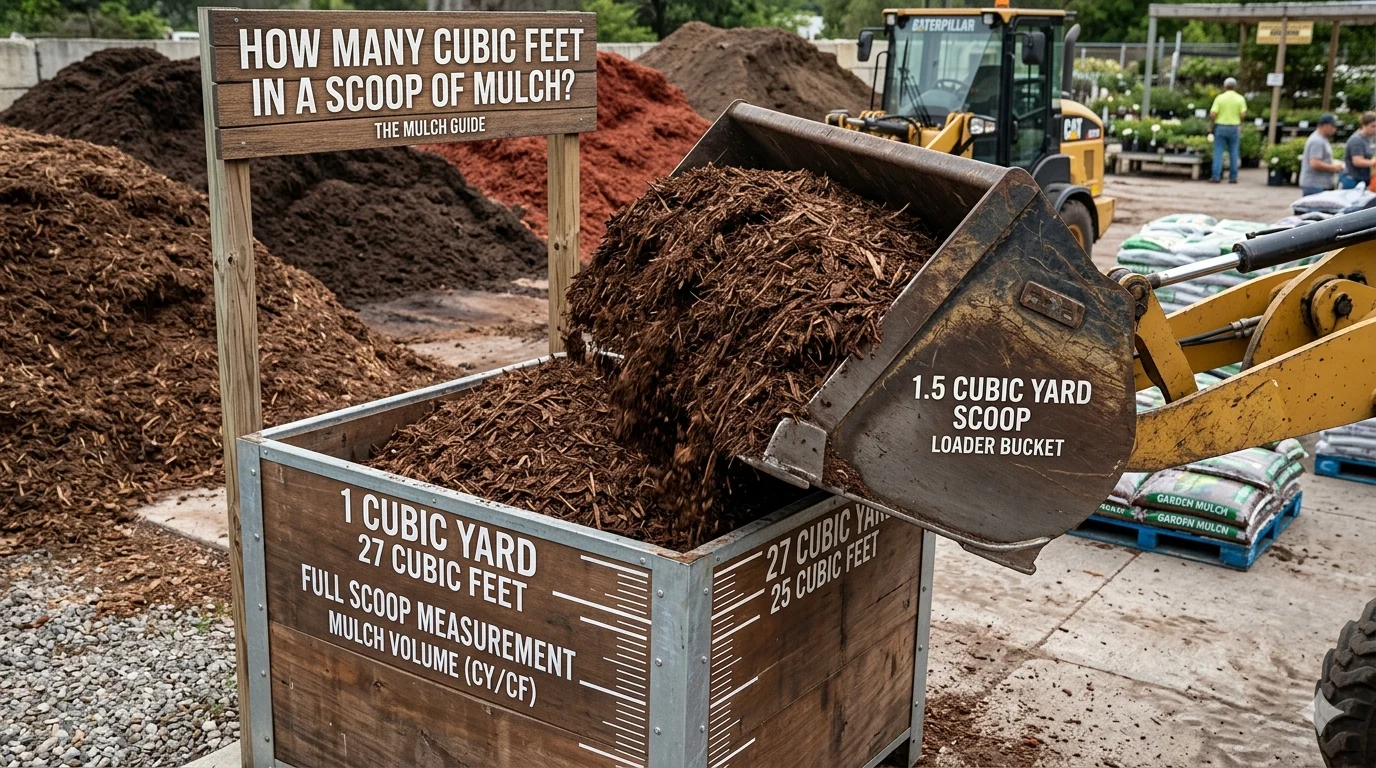
If you are planning a landscaping project, one of the most common questions you may ask is: “how many cubic feet in a scoop of mulch?” Understanding mulch measurements helps you avoid ordering too little or too much material.
A scoop of mulch is not always a fixed size. Different suppliers and landscaping companies may use different bucket sizes. However, in most cases, one scoop of mulch equals about 1 cubic yard of mulch.
Since 1 cubic yard equals 27 cubic feet, a standard scoop of mulch usually contains around 27 cubic feet.
Knowing this simple conversion can save time, money, and frustration during your landscaping project.
What Is a Scoop of Mulch?
A “scoop” is a common landscaping term used by mulch suppliers and garden centers. It refers to the amount of mulch loaded into a bucket, usually by a skid steer, tractor, or front-end loader.
The actual size of the scoop depends on:
- The equipment used
- The supplier’s definition
- Local landscaping standards
- Type of mulch material
In many landscaping businesses, one scoop equals one cubic yard. However, some companies may offer smaller or larger scoops.
That is why it is always smart to ask the supplier for the exact volume before ordering.
How Many Cubic Feet Are in One Scoop of Mulch?
The most common answer is simple: a standard scoop of mulch usually contains 27 cubic feet.
This is because:
- 1 cubic yard = 27 cubic feet
- Most mulch scoops = 1 cubic yard
However, some suppliers may use half-yard or oversized scoops.
Standard Scoop Sizes
Here is a simple comparison table:
| Scoop Type | Cubic Yards | Cubic Feet |
|---|---|---|
| Small Scoop | 0.5 cubic yard | 13.5 cubic feet |
| Standard Scoop | 1 cubic yard | 27 cubic feet |
| Large Scoop | 1.5 cubic yards | 40.5 cubic feet |
| Double Scoop | 2 cubic yards | 54 cubic feet |
Always confirm scoop size with your supplier because the term “scoop” is not legally standardized.
Why Scoop Sizes Vary
Mulch companies may use different loader buckets. One business may use a compact skid steer while another uses a large tractor bucket.
Factors affecting scoop size include:
- Equipment dimensions
- Material density
- Moisture content
- Company pricing methods
- Local industry practices
For example, wet mulch may weigh more and settle differently compared to dry mulch.
Cubic Feet vs Cubic Yards Explained
Many homeowners get confused between cubic feet and cubic yards. Understanding the difference makes mulch calculations easier.
A cubic foot measures volume in a space that is:
- 1 foot wide
- 1 foot long
- 1 foot high
A cubic yard measures volume in a space that is:
- 3 feet wide
- 3 feet long
- 3 feet high
Since 3 × 3 × 3 = 27, one cubic yard equals 27 cubic feet.
Most bulk mulch is sold in cubic yards, while bagged mulch is often sold in cubic feet.
Mulch Coverage Chart
Coverage depends on mulch depth. Most landscapers recommend applying mulch at 2–4 inches deep.
Here is a helpful mulch coverage chart for one cubic yard (27 cubic feet):
| Mulch Depth | Coverage Area |
|---|---|
| 1 inch | 324 square feet |
| 2 inches | 162 square feet |
| 3 inches | 108 square feet |
| 4 inches | 81 square feet |
This chart helps you estimate how many scoops of mulch you need.
How Much Area Does One Scoop Cover?
A standard scoop containing 27 cubic feet can cover different areas depending on mulch thickness.
Coverage at 2 Inches Deep
At 2 inches deep:
- 1 scoop covers about 162 square feet
This depth works well for:
- Decorative landscaping
- Flower beds
- Weed suppression
- Moisture retention
Coverage at 3 Inches Deep
At 3 inches deep:
- 1 scoop covers about 108 square feet
This is often considered the ideal depth for most garden beds because it balances moisture control and weed prevention.
How to Calculate Mulch Needed
Before ordering mulch, calculate your project area carefully.
Step 1: Measure the Area
Measure the length and width of the space.
Example:
- Length = 20 feet
- Width = 10 feet
Multiply both numbers:
- 20 × 10 = 200 square feet
Your garden bed is 200 square feet.
Step 2: Choose Mulch Depth
Most projects use:
- 2 inches for light coverage
- 3 inches for normal landscaping
- 4 inches for strong weed control
For this example, use 3 inches.
Step 3: Convert to Cubic Feet
Use this formula:
Cubic Feet = (Square Feet × Depth in Inches) ÷ 12
Example:
- (200 × 3) ÷ 12 = 50 cubic feet
You would need about 50 cubic feet of mulch.
Since one scoop equals about 27 cubic feet:
- 50 ÷ 27 = 1.85
You would need roughly 2 scoops of mulch.
Scoop of Mulch vs Bagged Mulch
Many homeowners compare bulk mulch to bagged mulch before buying.
Here is a quick comparison:
| Feature | Bulk Mulch | Bagged Mulch |
|---|---|---|
| Best For | Large projects | Small projects |
| Cost | Usually cheaper | More expensive |
| Delivery | Often available | Easy transport |
| Measurement | Cubic yards | Cubic feet |
| Waste | Less packaging | More plastic waste |
A standard mulch bag usually contains:
- 2 cubic feet
- 3 cubic feet
If one scoop equals 27 cubic feet, then:
- 1 scoop equals about 13 bags of 2-cubic-foot mulch
This comparison helps homeowners decide which option is more cost-effective.
Types of Mulch and Density Differences
Different mulch materials may look larger or smaller even when measured by volume.
Common mulch types include:
- Hardwood mulch
- Cedar mulch
- Pine bark mulch
- Dyed mulch
- Compost mulch
- Rubber mulch
Heavier mulch types may compact more during transport. Wet mulch also settles differently than dry mulch.
Even though the cubic footage remains the same, appearance and coverage can vary slightly.
Common Mistakes When Ordering Mulch
Many landscaping mistakes happen because of incorrect calculations.
Avoid these common issues:
Ordering Too Little
Running out of mulch mid-project can create color differences if the second batch comes from another source.
Ignoring Depth Recommendations
Too little mulch will not suppress weeds properly.
Too much mulch can trap moisture and damage plant roots.
Forgetting Settlement
Fresh mulch settles over time. Ordering slightly extra is usually smart.
Confusing Cubic Feet and Cubic Yards
This is one of the biggest mistakes homeowners make.
Remember:
- 1 cubic yard = 27 cubic feet
Expert Tips for Buying Bulk Mulch
Professional landscapers often follow these tips:
Buy Slightly More Than Needed
Adding 5–10% extra helps cover uneven areas and future touch-ups.
Ask for Exact Scoop Size
Never assume every company uses the same measurement.
Consider Delivery Costs
Bulk mulch may require delivery fees, especially for large orders.
Measure Carefully
Double-check your area measurements before placing an order.
Choose the Right Mulch Depth
For most landscaping:
- 2–3 inches works best
- Avoid exceeding 4 inches
FAQs
How many cubic feet are in a standard scoop of mulch?
A standard scoop usually contains 27 cubic feet because it typically equals 1 cubic yard.
How many bags of mulch equal one scoop?
If mulch bags contain 2 cubic feet each, one scoop equals about 13–14 bags.
Does every company use the same scoop size?
No. Scoop sizes vary by supplier and equipment type. Always ask for exact measurements.
How much area does one scoop of mulch cover?
One scoop covers approximately:
- 162 square feet at 2 inches deep
- 108 square feet at 3 inches deep
Is bulk mulch cheaper than bagged mulch?
Yes. Bulk mulch is usually more affordable for medium and large landscaping projects.
Conclusion
Understanding how many cubic feet in a scoop of mulch is essential for accurate landscaping planning. In most cases, one scoop equals one cubic yard, which contains 27 cubic feet of mulch.
However, scoop sizes can vary between suppliers, so always confirm measurements before ordering. Knowing the relationship between cubic feet, cubic yards, and coverage area helps you estimate mulch needs more accurately.
Whether you are refreshing flower beds, improving curb appeal, or starting a new landscaping project, proper mulch calculations can save money, reduce waste, and make your project much easier.