
When people ask how many feet are in a road, they are usually trying to understand the width of a road in simple terms. The truth is, there is no single fixed number because roads are built differently depending on their purpose, location, and traffic needs. A small village road may be just a few feet wide, while a modern highway can stretch over 100 feet or more. So instead of one exact answer, we get a range of standard measurements used in civil engineering and urban planning.
To fully understand this, we need to look at road types, lane systems, global standards, and how engineers actually design and measure roads in feet.
Why Road Width Does Not Have One Fixed Answer
Roads are not like standard objects with one size. They are designed based on real-world conditions. That is why the question how many feet are in a road cannot be answered with a single number.
Several factors decide road width:
- Number of lanes required
- Type of traffic (cars, trucks, bikes)
- Urban or rural location
- Safety regulations
- Available land space
- Country-specific design standards
For example, a narrow street in an old city cannot be widened easily, while a newly built highway is designed with maximum width from the beginning.
Understanding Road Width vs Road Length
Before going deeper, it is important to clear a major confusion.
- Road length: How long the road stretches (measured in kilometers or miles)
- Road width: How wide the road is from one side to another (measured in feet or meters)
When people ask about how many feet are in a road, they are referring to road width, not length.
Standard Road Width in Feet (Global Overview)
Different countries follow different engineering guidelines, but most roads fall within similar ranges.
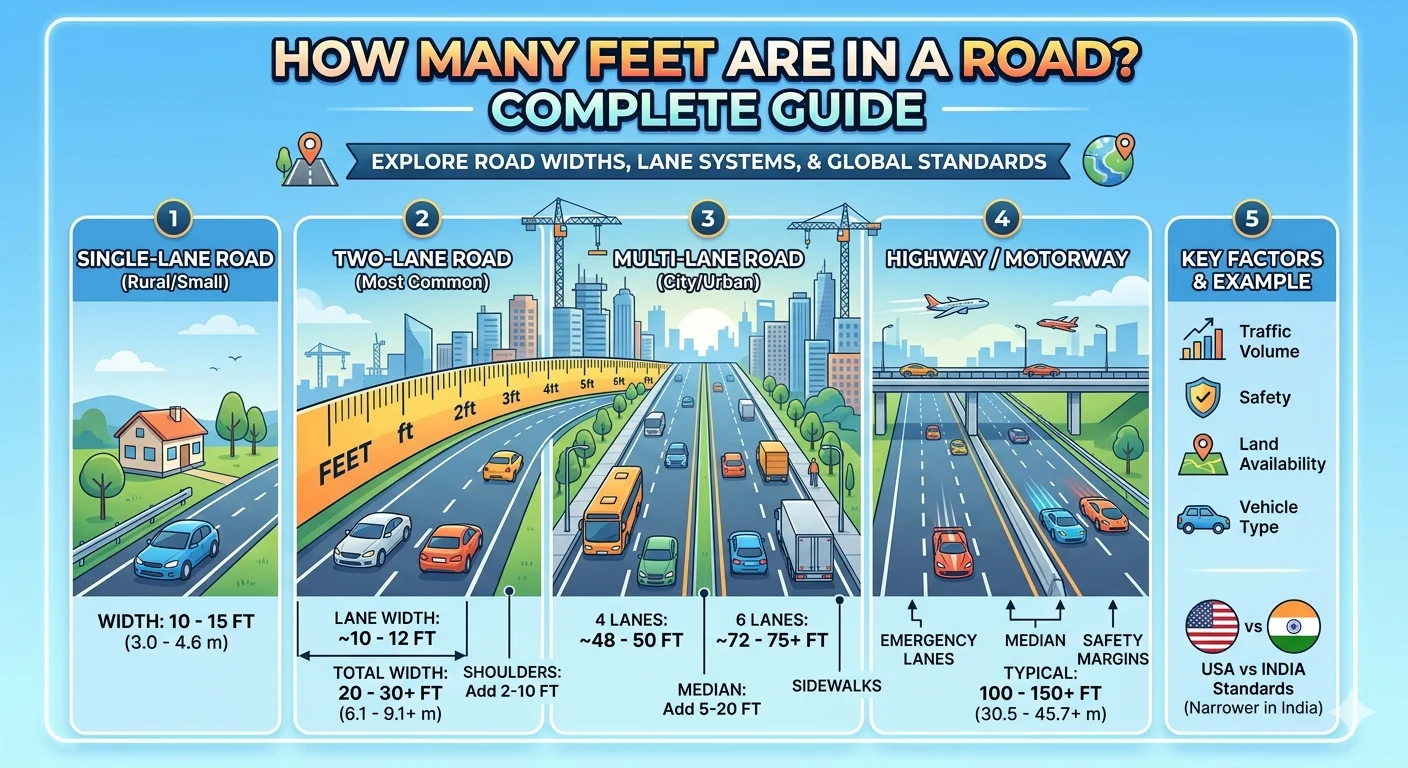
Single Lane Roads
A single lane is usually designed for one line of moving traffic.
- Width: 10 to 12 feet
These are common in rural areas or small streets where traffic is light.
Two-Lane Roads
Two-lane roads are the most common type worldwide.
- Each lane: 10–12 feet
- Total width: 20 to 30 feet
- With shoulders: up to 35 feet
These roads allow traffic in both directions.
Multi-Lane Roads
In cities and highways, roads expand to handle more traffic.
- 4 lanes: 40–50 feet
- 6 lanes: 60–75 feet
- With medians and shoulders: 80–120 feet
Highways
Highways are the widest type of road.
- Typical width: 100 to 150+ feet
- Includes: lanes, shoulders, emergency lanes, medians
Highways are designed for speed, safety, and heavy traffic flow.
Road Width in Different Countries
Road standards vary across regions, but the differences are not extreme.
United States
- Residential streets: 12–20 feet
- Two-lane roads: 24–30 feet
- Highways: 100–150+ feet
The US focuses on wide lanes for safety and high-speed travel.
India
- Village roads: 10–18 feet
- Two-lane roads: 20–24 feet
- Urban roads: 30–60 feet
- National highways: 60–150+ feet
In India, urban space constraints often influence narrower roads.
United Kingdom and Europe
- Small roads: 9–11 feet per lane
- Two-lane roads: 18–24 feet
- Motorways: 100+ feet
European roads often prioritize efficiency and compact design.
Lane System Explained in Feet
To understand how many feet are in a road, you must understand lanes.
Standard Lane Width
Most traffic lanes follow this standard:
- 1 lane = 10 to 12 feet wide
This allows safe movement of cars and small trucks.
How Lanes Build Total Road Width
Road width is calculated like this:
- 1 lane = 12 feet
- 2 lanes = 24 feet
- 4 lanes = 48 feet
- 6 lanes = 72 feet
Then additional space is added for:
- Shoulders (2–10 feet each side)
- Medians (5–20 feet)
- Sidewalks (in urban roads)
Real Examples of Road Width in Feet
Let’s look at real-world examples to make it clearer.
Example 1: Small Village Road
- Width: 10–15 feet
- One vehicle passes at a time
- No lane markings
These roads are often shared by pedestrians, animals, and vehicles.
Example 2: Urban City Road
- Width: 20–60 feet
- Multiple lanes possible
- Includes sidewalks and parking space
These roads handle daily city traffic.
Example 3: Highway
- Lanes: 4–8 or more
- Total width: 100–150+ feet
- Includes emergency lanes and medians
Highways are designed for long-distance fast travel.
Factors That Decide Road Width
Road engineers do not choose width randomly. They consider several important factors.
1. Traffic Volume
More vehicles require wider roads. Busy cities need multi-lane roads.
2. Road Function
- Residential roads = narrow
- Commercial roads = medium
- Highways = very wide
Each road serves a different purpose.
3. Safety Requirements
Safety standards ensure:
- Enough space between vehicles
- Safe overtaking distance
- Emergency stopping area
4. Urban Planning Limitations
In crowded cities, land availability limits road expansion.
5. Vehicle Types
Heavy trucks require wider lanes than small cars.
Conversion: Feet and Meters in Road Measurement
Engineers often use both meters and feet.
Quick Conversion Table
| Meters | Feet |
|---|---|
| 1 m | 3.28 ft |
| 3 m | 9.84 ft |
| 3.5 m | 11.48 ft |
| 6 m | 19.68 ft |
| 10 m | 32.81 ft |
| 15 m | 49.21 ft |
Standard Lane in Meters
- 1 lane ≈ 3 to 3.5 meters
- In feet: 10–12 feet
This is a global standard used in most countries.
Common Misunderstandings About Road Width
Mistake 1: Thinking all roads are the same size
Roads vary widely depending on their purpose and location.
Mistake 2: Confusing lanes with total road width
One lane is not the entire road. A road includes:
- Multiple lanes
- Shoulders
- Sidewalks
- Medians
Mistake 3: Assuming wider always means better
Wider roads are not always better in small towns where traffic is light.
How Civil Engineers Measure Road Width
Civil engineers use precise tools to measure roads:
- Measuring wheels
- Laser distance meters
- GPS mapping systems
- Total station instruments
They measure:
- Lane width
- Shoulder width
- Total carriageway width
Accuracy is important for safety and long-term durability.
Expert Insights on Road Design
Professionals follow strict guidelines when designing roads.
- Roads are designed for 20–30 year usage
- Future traffic growth is considered
- Safety margins are always included
- Drainage and sidewalks are part of planning
Good road design is not just about width but also efficiency and safety.
Why Understanding Road Width Matters
Knowing road measurements helps in many ways:
- Understanding infrastructure planning
- Real estate evaluation
- Construction projects
- Travel awareness
- Civil engineering studies
It also helps you read maps and understand city layouts better.
Summary of Road Width in Feet
To simplify everything:
- Small roads: 10–20 feet
- Two-lane roads: 20–30 feet
- City roads: 30–60 feet
- Highways: 100–150+ feet
So, when asking how many feet are in a road, the answer depends entirely on the type of road.
Conclusion
The question how many feet are in a road does not have a single fixed answer because roads are designed differently based on their purpose, traffic, and location. A narrow village road may be just 10 feet wide, while a modern highway can exceed 150 feet. Understanding these variations helps you better interpret infrastructure, urban planning, and transportation systems. Every road is built with a specific purpose, and its width is carefully planned for safety, efficiency, and long-term use.