

When people search for how many miles is 13,000 feet, they usually want a quick and accurate answer. However, understanding the relationship between feet, miles, and building story heights can also help in real-world situations.
Whether you are comparing mountain elevations, calculating walking distances, understanding aircraft altitude, or learning how tall skyscrapers are, knowing how to convert feet into miles makes measurements easier to understand.
At the same time, many people also ask how many feet is a story of a building because buildings are often measured in stories instead of exact height. This guide explains both topics in simple language with formulas, examples, charts, and practical comparisons.
Understanding Feet and Miles
Feet and miles are common units of measurement used in the United States and several other countries.
- A foot is a smaller unit of length.
- A mile is a larger unit used for longer distances.
The standard conversion is:
Because miles are much larger than feet, converting large numbers into miles helps make distances easier to visualize.
How Many Miles Is 13,000 Feet?
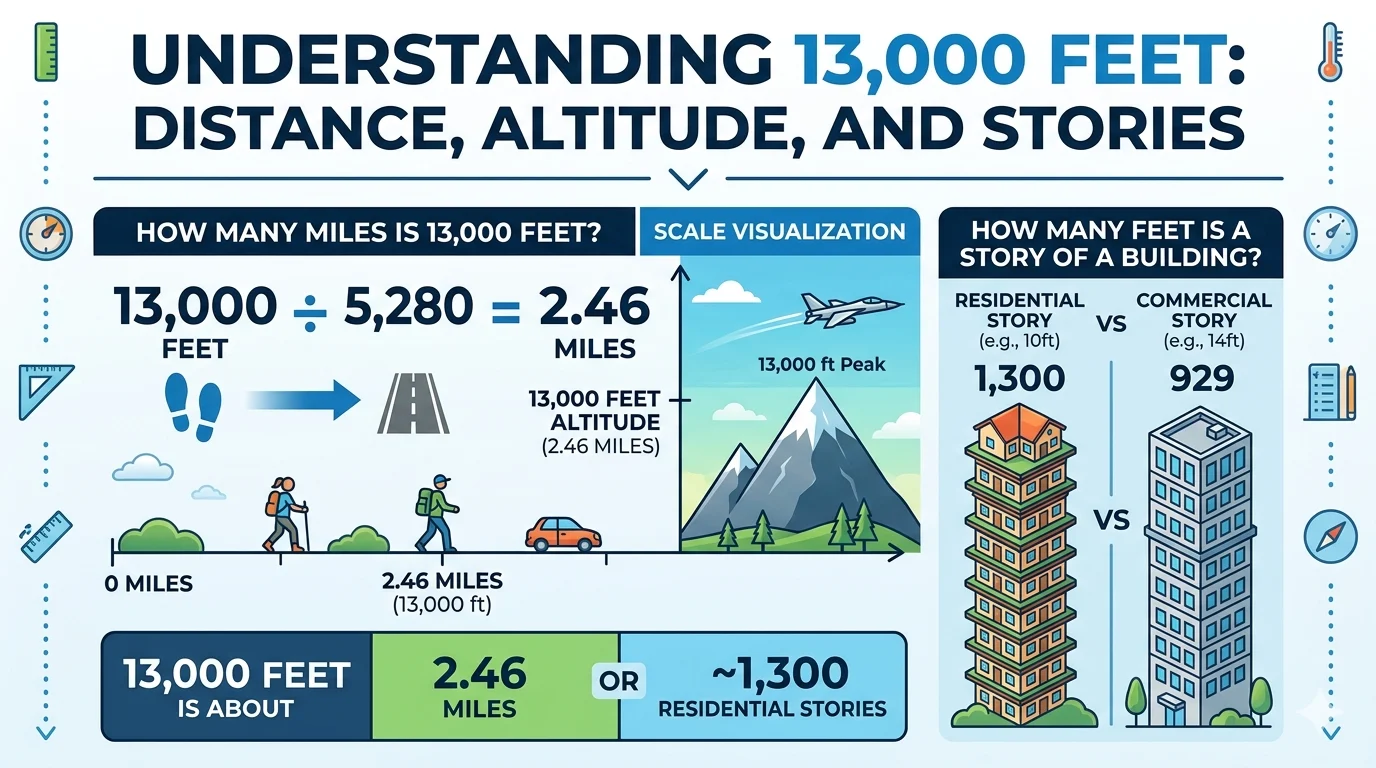
To convert 13,000 feet into miles, divide 13,000 by 5,280.
So, 13,000 feet is approximately 2.46 miles.
This means if you walked 13,000 feet in a straight line, you would travel slightly less than two and a half miles.
Simple Formula to Convert Feet to Miles
The formula for converting feet into miles is straightforward:
Example Conversion
Suppose you want to convert 10,560 feet into miles.
Result:
- 10,560 feet = 2 miles
You can use this same formula for any feet-to-miles conversion.
Feet to Miles Conversion Chart
Here is a quick conversion chart for commonly searched measurements.
| Feet | Miles |
|---|---|
| 1,000 feet | 0.19 miles |
| 2,500 feet | 0.47 miles |
| 5,280 feet | 1 mile |
| 10,000 feet | 1.89 miles |
| 13,000 feet | 2.46 miles |
| 15,000 feet | 2.84 miles |
| 20,000 feet | 3.79 miles |
This chart helps you estimate distances quickly without using a calculator.
Real World Examples of 13,000 Feet
Understanding the size of 13,000 feet becomes easier when compared with real-world situations.
Mountain Elevation
Many mountains reach elevations above 13,000 feet. When hikers discuss altitude, they often use feet instead of miles.
For example:
- A mountain summit at 13,000 feet sits about 2.46 miles above sea level vertically.
Aircraft Altitude
Pilots measure altitude in feet.
- A plane flying at 13,000 feet is traveling approximately 2.46 miles above the ground.
Walking Distance
Walking 13,000 feet horizontally equals almost 2.5 miles.
Depending on your pace, this distance may take:
- 45 to 55 minutes to walk
How Many Feet Is a Story of a Building?
Another common question is: how many feet is a story of a building?
The answer depends on the building type and design.
Average Height of One Story
Most buildings follow these average measurements:
| Building Type | Average Height Per Story |
|---|---|
| Residential homes | 8 to 10 feet |
| Apartment buildings | 9 to 12 feet |
| Office buildings | 12 to 15 feet |
| Commercial buildings | 14 to 20 feet |
| Skyscrapers | 14 feet or more |
In general:
- One residential story is usually around 10 feet tall.
- Commercial stories are often taller because they need extra space for wiring, plumbing, lighting, and air systems.
Residential vs Commercial Story Heights
Residential Buildings
Homes and small apartments often have:
- 8-foot ceilings
- Floor thickness between levels
- Roof and insulation space
This usually creates a total story height of:
- 9 to 10 feet
Commercial Buildings
Office buildings need:
- Larger ceilings
- HVAC systems
- Electrical systems
- Elevator space
As a result, one commercial story may range from:
- 12 to 15 feet
Skyscrapers
Modern skyscrapers often include:
- Mechanical floors
- Structural support systems
- High ceilings
Luxury towers may exceed:
- 15 feet per floor
How Many Stories Would 13,000 Feet Be?
Now let’s compare 13,000 feet with building stories.
If one residential story averages 10 feet:
That means:
- 13,000 feet equals approximately 1,300 residential stories.
For commercial buildings averaging 14 feet per story:
So:
- 13,000 feet could equal around 929 commercial stories.
This comparison shows how enormous 13,000 feet really is.
Why Building Story Heights Vary
Not every story has the same height. Several factors affect floor-to-floor measurements.
Ceiling Height
Luxury properties often use:
- Higher ceilings
- Larger windows
- Open layouts
Structural Design
Steel-frame buildings can support:
- Taller floors
- Larger open spaces
Mechanical Systems
Commercial buildings need room for:
- HVAC ducts
- Electrical wiring
- Plumbing systems
- Fire protection systems
Building Purpose
Different structures require different ceiling heights:
- Warehouses need tall storage areas
- Hotels prioritize comfort
- Offices require technical infrastructure
Practical Uses of Feet-to-Miles Conversions
Feet-to-miles conversions are useful in many industries and everyday situations.
Construction
Builders and engineers compare:
- Property dimensions
- Building heights
- Site distances
Aviation
Pilots use feet for altitude and miles for travel distance.
Hiking and Outdoor Activities
Trails and mountain elevations are commonly measured in feet.
Sports
Some sports facilities use feet for field measurements.
Real Estate
Property listings may include:
- Elevation
- Lot size
- Building dimensions
Common Conversion Mistakes
Even simple calculations can lead to errors.
Using the Wrong Conversion Number
Some people incorrectly assume:
- 1 mile = 5,000 feet
The correct conversion is:
- 1 mile = 5,280 feet
Rounding Too Early
Rounding before completing calculations can reduce accuracy.
Mixing Vertical and Horizontal Distance
- 13,000 feet vertically refers to elevation
- 13,000 feet horizontally refers to travel distance
These measurements represent different concepts.
Assuming All Stories Are Equal
Story heights vary widely between:
- Homes
- Offices
- Hotels
- Industrial buildings
Expert Tips for Accurate Measurement Conversions
Memorize the Standard Formula
Always remember:
Double Check Units
Ensure you are converting:
- Feet into miles
- Not feet into yards or meters
Use Real-World Comparisons
Visual comparisons make measurements easier to understand.
For example:
- 13,000 feet is nearly 2.5 miles
- That is taller than most skyscrapers in the world
Comparing 13,000 Feet to Famous Structures
Here are some interesting comparisons.
| Structure | Approximate Height |
|---|---|
| Eiffel Tower | 1,083 feet |
| Empire State Building | 1,454 feet |
| Burj Khalifa | 2,717 feet |
| 13,000 feet | 2.46 miles |
This means:
- 13,000 feet is almost five times taller than the Burj Khalifa.
Why Understanding Measurements Matters
Understanding measurements like feet and miles improves:
- Navigation
- Planning
- Construction knowledge
- Educational understanding
- Travel awareness
It also helps people better visualize large distances and heights.
When someone says:
- “The mountain is 13,000 feet high” or
- “The building has 100 stories”
you can understand what those numbers really mean.
FAQs
How many miles is 13,000 feet exactly?
13,000 feet equals approximately 2.46 miles.
How do you convert feet into miles?
Divide the number of feet by 5,280.
How many feet are in one mile?
There are exactly 5,280 feet in one mile.
How many feet is one story of a building?
One story is usually between 10 and 14 feet depending on the building type.
How many stories is 13,000 feet?
It could equal around:
- 1,300 residential stories
- About 929 commercial stories
depending on average floor height.
Conclusion
Understanding how many miles is 13,000 feet becomes simple once you know the standard conversion formula. Since one mile equals 5,280 feet, 13,000 feet converts to approximately 2.46 miles.
Learning how many feet is a story of a building also helps put large measurements into perspective. Most residential stories are around 10 feet tall, while commercial buildings often range from 12 to 15 feet per story.
Whether you are calculating hiking distances, aircraft altitude, skyscraper heights, or construction measurements, knowing how to convert feet into miles helps you better understand scale, distance, and real-world dimensions.