
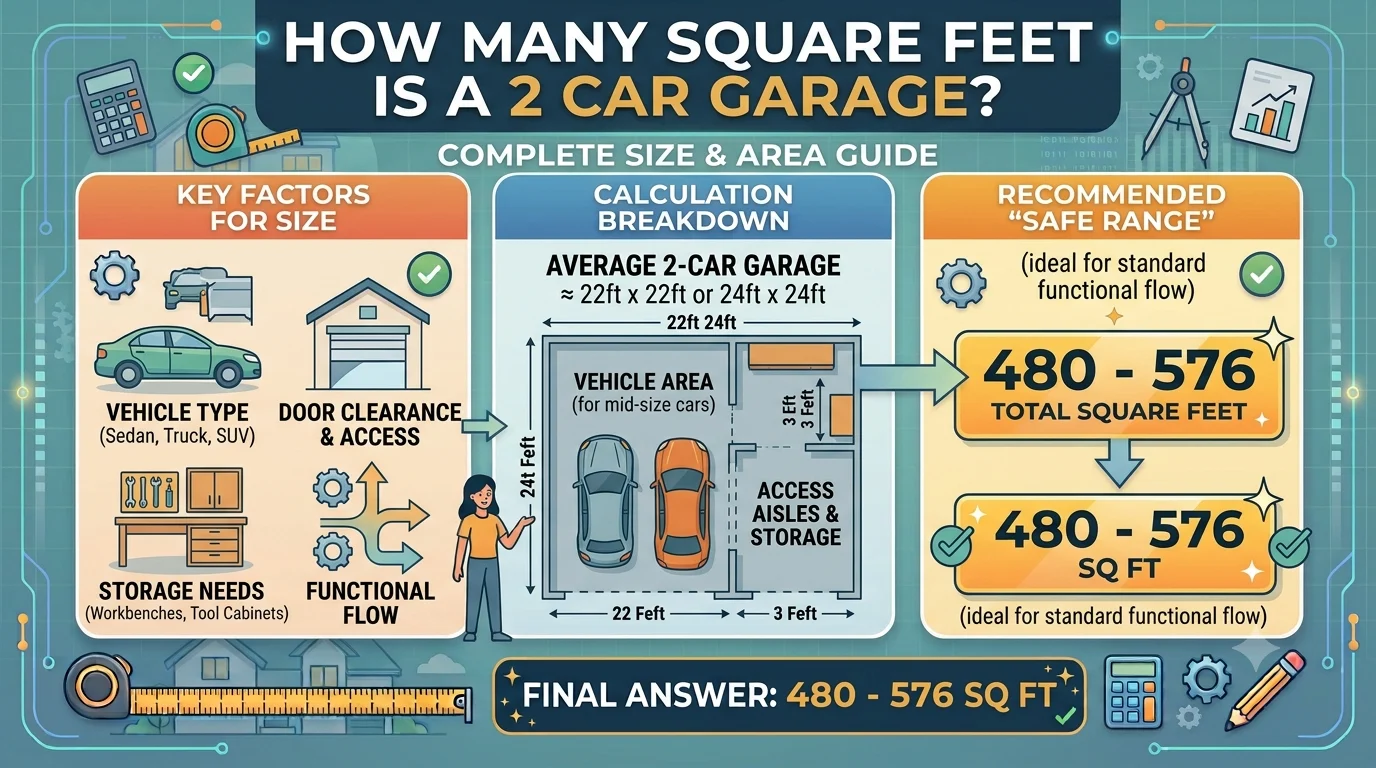
If you’re planning to build a garage, buy a home, or remodel your existing space, one of the first questions you’ll likely ask is how many square feet is a 2 car garage. The answer depends on the garage’s dimensions, but most standard two-car garages range between 400 and 576 square feet.
The most common size is 20 feet by 20 feet, which provides 400 square feet of floor space. However, many modern homes include larger garages to accommodate bigger vehicles, storage, or work areas.
In this guide, you’ll learn the average square footage of a two-car garage, common dimensions, how to calculate garage size, and how to choose the best option for your needs.
What Is the Average Square Footage of a 2 Car Garage?
A standard two-car garage typically measures between 400 and 576 square feet, depending on its width and depth.
Here are the most common garage sizes:
| Garage Dimensions | Square Feet |
|---|---|
| 20 × 20 ft | 400 sq ft |
| 20 × 22 ft | 440 sq ft |
| 22 × 22 ft | 484 sq ft |
| 22 × 24 ft | 528 sq ft |
| 24 × 24 ft | 576 sq ft |
Most builders recommend choosing a garage that provides a little extra room beyond simply parking two vehicles.
Standard 2 Car Garage Dimensions
Although there is no universal standard, these dimensions are commonly used for residential garages.
20×20 Garage (400 Square Feet)
A 20×20 garage is the traditional two-car garage found in many homes.
Features include:
- Fits two compact or midsize vehicles
- Affordable construction cost
- Limited storage space
- Suitable for homes with minimal storage needs
20×22 Garage (440 Square Feet)
This slightly deeper design offers additional flexibility.
Benefits include:
- Easier movement around vehicles
- Room for shelving
- Better organization
- More comfortable parking
22×22 Garage (484 Square Feet)
Many homeowners consider this an ideal size.
Advantages include:
- Comfortable space for two vehicles
- Additional room for storage cabinets
- Better door clearance
- Space for bicycles and tools
24×24 Garage (576 Square Feet)
A larger two-car garage provides excellent flexibility.
It offers:
- Room for trucks and SUVs
- Workshop space
- Large storage area
- Easier parking
- Higher resale appeal
Square Footage Comparison Chart
Use this chart to compare common garage sizes.
| Width | Length | Total Square Feet |
|---|---|---|
| 20 ft | 20 ft | 400 sq ft |
| 20 ft | 22 ft | 440 sq ft |
| 22 ft | 22 ft | 484 sq ft |
| 22 ft | 24 ft | 528 sq ft |
| 24 ft | 24 ft | 576 sq ft |
| 24 ft | 26 ft | 624 sq ft |
Adding just a few feet to the width or depth can significantly improve usability.
How to Calculate Garage Square Footage
Finding the square footage of any garage is simple.
Use this formula:
Square Feet = Length × Width
Example 1
20 × 20 = 400 square feet
Example 2
22 × 22 = 484 square feet
Example 3
24 × 24 = 576 square feet
Always use the interior floor measurements if you want the actual usable space.
Factors That Affect Garage Size
Several factors determine how large your two-car garage should be.
Vehicle Size
Compact cars require much less space than pickup trucks or full-size SUVs.
If you own larger vehicles, consider increasing both the width and depth.
Storage Requirements
Many homeowners use garages to store:
- Lawn equipment
- Seasonal decorations
- Sports gear
- Bicycles
- Tools
- Shelving
- Freezers
Storage needs often justify a larger garage.
Workshop Area
If you enjoy woodworking, DIY projects, or home repairs, you’ll benefit from additional floor space.
Future Needs
Think about future vehicle upgrades or changing family needs before selecting a garage size.
Planning ahead can save money on future renovations.
Is a 20×20 Garage Big Enough?
For many families, yes.
A 20×20 garage comfortably fits two standard vehicles and provides basic parking functionality.
However, it may feel cramped if:
- You drive full-size trucks
- You own large SUVs
- You need significant storage
- You want a workbench
- You regularly work inside the garage
If your budget allows, a 22×22 or 24×24 garage offers much greater flexibility.
Best Garage Size for Storage
Parking isn’t the only reason people build garages.
Many homeowners also use the space for:
- Home gyms
- Workshops
- Tool storage
- Gardening supplies
- Holiday decorations
- Outdoor equipment
Here’s a quick comparison.
| Garage Size | Parking | Storage |
|---|---|---|
| 20×20 | Good | Limited |
| 20×22 | Very Good | Moderate |
| 22×22 | Excellent | Good |
| 24×24 | Excellent | Excellent |
If storage is important, choosing a larger garage is usually worth the extra investment.
Real-World Examples
Example 1: Small Family
A family owns two midsize sedans and stores a few bicycles.
A 20×20 garage provides enough room without increasing construction costs.
Example 2: SUV Owners
A couple owns two SUVs and several outdoor tools.
A 22×24 garage gives them enough room to park comfortably and organize storage shelves.
Example 3: DIY Enthusiast
A homeowner enjoys woodworking and repairs.
A 24×24 garage allows space for vehicles, a workbench, tool cabinets, and equipment.
Benefits of a Larger Two-Car Garage
Choosing a larger garage offers several advantages.
More Comfortable Parking
Extra width makes it easier to open doors and move around vehicles.
Better Storage
You’ll have room for shelves, cabinets, and seasonal items.
Multi-Purpose Space
A larger garage can serve as:
- Home gym
- Hobby room
- Workshop
- Storage room
Increased Home Value
Many buyers appreciate larger garages because they offer greater functionality.
Future Flexibility
As your family or vehicle collection changes, additional space becomes valuable.
Drawbacks of a Larger Garage
Although larger garages are useful, they also have a few disadvantages.
These include:
- Higher construction costs
- More concrete and building materials
- Larger roofing expenses
- Increased heating or cooling costs if insulated
- More land required
Choose a size that balances your budget with your long-term needs.
Expert Tips for Choosing the Right Garage Size
Before building your garage, consider these recommendations.
- Measure your largest vehicle first.
- Leave at least two to three feet beside each vehicle.
- Plan storage before construction begins.
- Include overhead storage if possible.
- Install plenty of electrical outlets.
- Add bright lighting for safety.
- Consider wider garage doors for easier access.
- Think about future vehicle purchases.
Proper planning helps you avoid expensive upgrades later.
Common Mistakes to Avoid
Many homeowners regret choosing the smallest possible garage.
Avoid these common mistakes:
- Underestimating storage needs
- Ignoring vehicle size
- Forgetting workspace requirements
- Not measuring available property space
- Choosing narrow garage doors
- Leaving no room for future needs
Taking time to plan carefully can save both money and frustration.
Frequently Asked Questions
How many square feet is a standard 2 car garage?
A standard two-car garage typically ranges from 400 to 576 square feet, with 400 square feet (20×20 feet) being the most common size.
Is 400 square feet enough for two cars?
Yes. A 400-square-foot garage can fit two standard vehicles, although storage space may be limited.
What is the ideal size for a two-car garage?
Many homeowners prefer 22×22 feet (484 square feet) or 24×24 feet (576 square feet) because these sizes provide additional room for storage and larger vehicles.
Can two SUVs fit in a standard two-car garage?
Yes, but a larger garage such as 22×24 or 24×24 feet offers more comfortable parking and easier movement.
How do I calculate the square footage of my garage?
Multiply the garage’s length by its width.
For example:
20 × 20 = 400 square feet
Conclusion
If you’re wondering how many square feet is a 2 car garage, the answer depends on the dimensions you choose. Most standard two-car garages range between 400 and 576 square feet, with 20×20 feet being the traditional size. Larger garages, such as 22×22 or 24×24 feet, provide additional room for storage, workshops, and larger vehicles.
Before building or buying a garage, consider your vehicle size, storage needs, and future plans. Choosing the right garage dimensions today can improve convenience, increase your home’s value, and ensure the space remains functional for years to come.