
If you’re planning a home renovation, building a new house, or simply curious about standard home layouts, you may wonder: how many square feet is a bathroom? The answer depends on the type of bathroom, the fixtures it contains, and the available space in the home.
Bathrooms come in many sizes, ranging from small powder rooms of around 15 square feet to spacious master bathrooms that exceed 100 square feet. Knowing the average bathroom square footage can help you estimate remodeling costs, plan layouts, and maximize comfort.
In this guide, you’ll learn the average size of different types of bathrooms, how to calculate bathroom square footage, and what factors influence bathroom dimensions.
What Does Bathroom Square Footage Mean?
Bathroom square footage refers to the total floor area of the room. It is calculated by multiplying the room’s length by its width.
Formula:
Square Feet = Length × Width
For example:
- A bathroom that measures 5 feet by 8 feet has 40 square feet.
- A bathroom that measures 6 feet by 10 feet has 60 square feet.
This measurement includes the entire usable floor area, regardless of where the toilet, sink, shower, or bathtub is placed.
Average Bathroom Sizes by Type
The average size of a bathroom varies depending on its purpose. Some homes include a small guest powder room, while others have large primary bathrooms with luxury features.
Half Bathroom (Powder Room)
A half bathroom typically contains:
- One toilet
- One sink
Since it does not include a shower or bathtub, it requires less space.
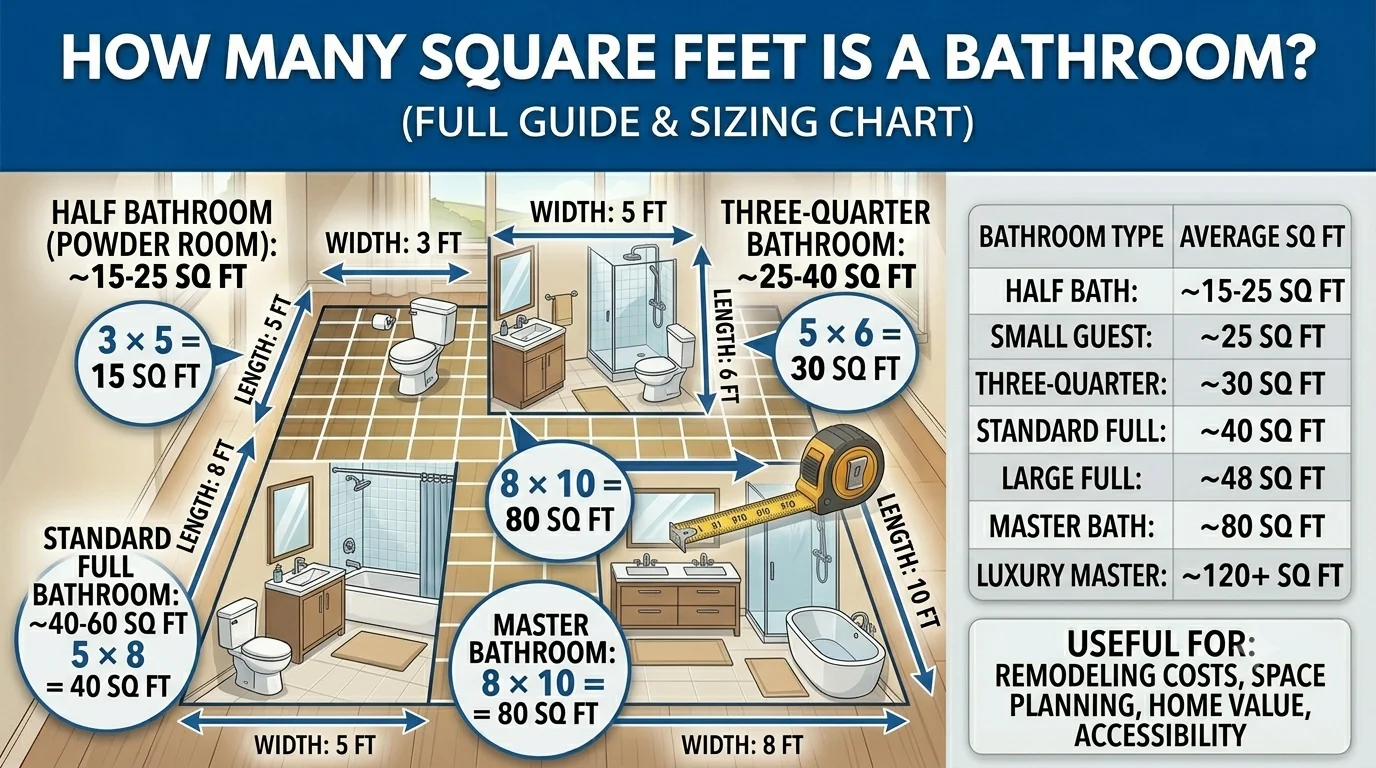
Average size: 15–25 square feet.
A common half-bath layout measures 3 feet by 5 feet, giving it a total of 15 square feet.
Three-Quarter Bathroom
A three-quarter bathroom generally includes:
- Toilet
- Sink
- Shower
It does not have a bathtub.
Average size: 25–40 square feet.
Many apartments and guest bathrooms use a layout of about 5 feet by 6 feet, providing roughly 30 square feet of space.
Full Bathroom
A full bathroom contains:
- Toilet
- Sink
- Shower or bathtub
Some layouts combine the shower and bathtub into a single unit to save space.
Average size: 40–60 square feet.
One of the most common full bathroom layouts is 5 feet by 8 feet, which equals 40 square feet.
Master Bathroom
A master or primary bathroom is connected to the main bedroom and often includes premium features such as:
- Double vanity
- Separate shower
- Bathtub
- Private toilet area
- Storage cabinets
Average size: 60–100 square feet or more.
In larger homes, luxury master bathrooms can easily exceed 120 square feet.
Bathroom Size Chart
| Bathroom Type | Typical Dimensions | Average Square Feet |
|---|---|---|
| Half Bathroom | 3 ft × 5 ft | 15 sq ft |
| Small Guest Bathroom | 5 ft × 5 ft | 25 sq ft |
| Three-Quarter Bathroom | 5 ft × 6 ft | 30 sq ft |
| Standard Full Bathroom | 5 ft × 8 ft | 40 sq ft |
| Large Full Bathroom | 6 ft × 8 ft | 48 sq ft |
| Master Bathroom | 8 ft × 10 ft | 80 sq ft |
| Luxury Master Bathroom | 10 ft × 12 ft | 120 sq ft |
This chart provides a quick overview of common bathroom sizes found in modern homes.
Standard Bathroom Dimensions
Although bathroom sizes can vary, builders often follow common dimensions to create practical and comfortable spaces.
Typical measurements include:
- Minimum half bathroom: 3 × 5 feet
- Standard full bathroom: 5 × 8 feet
- Guest bathroom: 5 × 7 feet
- Master bathroom: 8 × 10 feet or larger
These dimensions allow enough room for essential fixtures while maintaining comfortable movement throughout the space.
How to Calculate Bathroom Square Footage
Calculating bathroom size is straightforward and only requires a tape measure.
Step 1: Measure the Length
Measure the longest side of the bathroom from one wall to the opposite wall.
Step 2: Measure the Width
Measure the shorter side from wall to wall.
Step 3: Multiply the Measurements
Multiply the length by the width to determine the total square footage.
Example:
- Length = 8 feet
- Width = 5 feet
8 × 5 = 40 square feet
Measuring an Irregular Bathroom
If your bathroom is not a perfect rectangle, divide it into smaller rectangular sections. Measure each section individually, calculate the square footage for each, and then add the results together.
For example:
- Section A: 5 × 5 = 25 sq ft
- Section B: 2 × 4 = 8 sq ft
Total bathroom size = 33 square feet.
Why Bathroom Size Matters
Understanding how many square feet a bathroom has is useful for several reasons.
Remodeling and Renovation Costs
Many renovation materials, including flooring, tile, paint, and labor, are priced based on square footage. Knowing the exact size helps create a realistic budget.
Better Space Planning
Bathroom size determines what fixtures and storage options can fit comfortably. Proper planning helps avoid overcrowding and improves usability.
Increased Home Value
Bathrooms are one of the most important spaces buyers evaluate. A well-designed bathroom with adequate square footage can improve a home’s market appeal.
Accessibility and Comfort
Larger bathrooms provide easier movement and can accommodate accessibility features such as wider doorways or walk-in showers when needed.
Typical Bathroom Layouts and Space Requirements
Different layouts require different amounts of floor space depending on the number of fixtures and storage features included.
Compact Bathroom Layout (15–25 Square Feet)
Ideal for:
- Powder rooms
- Small apartments
- Tiny homes
Features:
- Toilet
- Small sink
- Limited storage
Standard Family Bathroom (40–50 Square Feet)
Ideal for:
- Guest bathrooms
- Family homes
Features:
- Toilet
- Vanity
- Bathtub and shower combination
Spacious Master Bathroom (80–120 Square Feet)
Ideal for:
- Primary bedroom suites
- Luxury homes
Features:
- Double vanity
- Separate bathtub and shower
- Linen storage
- Private toilet area
Small vs. Large Bathrooms: Quick Comparison
| Feature | Small Bathroom | Large Bathroom |
|---|---|---|
| Average Size | 15–40 sq ft | 60–120+ sq ft |
| Typical Fixtures | Toilet, sink, shower | Double vanity, tub, shower |
| Construction Cost | Lower | Higher |
| Maintenance | Easier | Requires more upkeep |
| Best For | Apartments, guest use | Families and master suites |
Factors That Affect Bathroom Size
Several factors influence how many square feet a bathroom should have.
Home Size
Larger homes usually have more spacious bathrooms, while smaller homes prioritize efficient layouts.
Family Requirements
Families with children often prefer larger bathrooms with extra storage and multiple sinks.
Budget
A bigger bathroom requires more materials and labor, increasing construction or remodeling costs.
Building Codes
Local building regulations may specify minimum clearances around toilets, sinks, and showers to ensure safety and usability.
Accessibility Needs
Bathrooms designed for aging in place or wheelchair access need additional floor space for comfortable movement.
Tips for Maximizing Bathroom Space
Even a smaller bathroom can feel open and functional with smart design choices.
- Use wall-mounted vanities to increase visible floor space.
- Install sliding or pocket doors instead of traditional swing doors.
- Choose a glass shower enclosure to create a more open appearance.
- Add recessed shelves or built-in storage niches.
- Use large mirrors to make the room appear bigger.
- Select light-colored finishes and bright lighting to create an airy feel.
These simple strategies can make a compact bathroom more practical without increasing its square footage.
Common Bathroom Size Mistakes to Avoid
When planning a bathroom, avoid these common errors:
Ignoring Clearance Space
Leaving too little room around fixtures can make the bathroom uncomfortable to use.
Choosing Oversized Fixtures
Large tubs or vanities can overwhelm a small bathroom and reduce usable floor space.
Forgetting Storage
A bathroom without enough storage can quickly become cluttered.
Miscalculating Measurements
Incorrect dimensions can lead to ordering the wrong amount of flooring, tile, or cabinetry.
Focusing Only on Appearance
A beautiful bathroom should also be practical and easy to use every day.
Frequently Asked Questions
How many square feet is a standard bathroom?
A standard full bathroom is typically around 40 square feet, with common dimensions of 5 feet by 8 feet.
What is the average size of a master bathroom?
Most master bathrooms range between 60 and 100 square feet, though luxury designs can be larger.
How big is a half bathroom?
A half bathroom generally measures 15 to 25 square feet and contains only a toilet and sink.
How do you calculate bathroom square footage?
Multiply the room’s length by its width. For example, a bathroom that measures 5 feet by 8 feet has 40 square feet.
Is a 5×8 bathroom a common size?
Yes. A 5×8 layout is one of the most common full bathroom sizes because it comfortably fits a toilet, vanity, and bathtub-shower combination.
Conclusion
If you’ve been asking how many square feet is a bathroom, the answer depends on the bathroom type and its intended function. A small powder room may be as little as 15 square feet, while a standard full bathroom averages around 40 square feet. Master bathrooms often range from 60 to 100 square feet or even larger.
Knowing the average bathroom square footage is helpful for remodeling, designing a new home, estimating costs, and planning efficient layouts. By understanding standard bathroom dimensions and calculating square footage correctly, you can create a space that is both functional and comfortable for everyday use.