

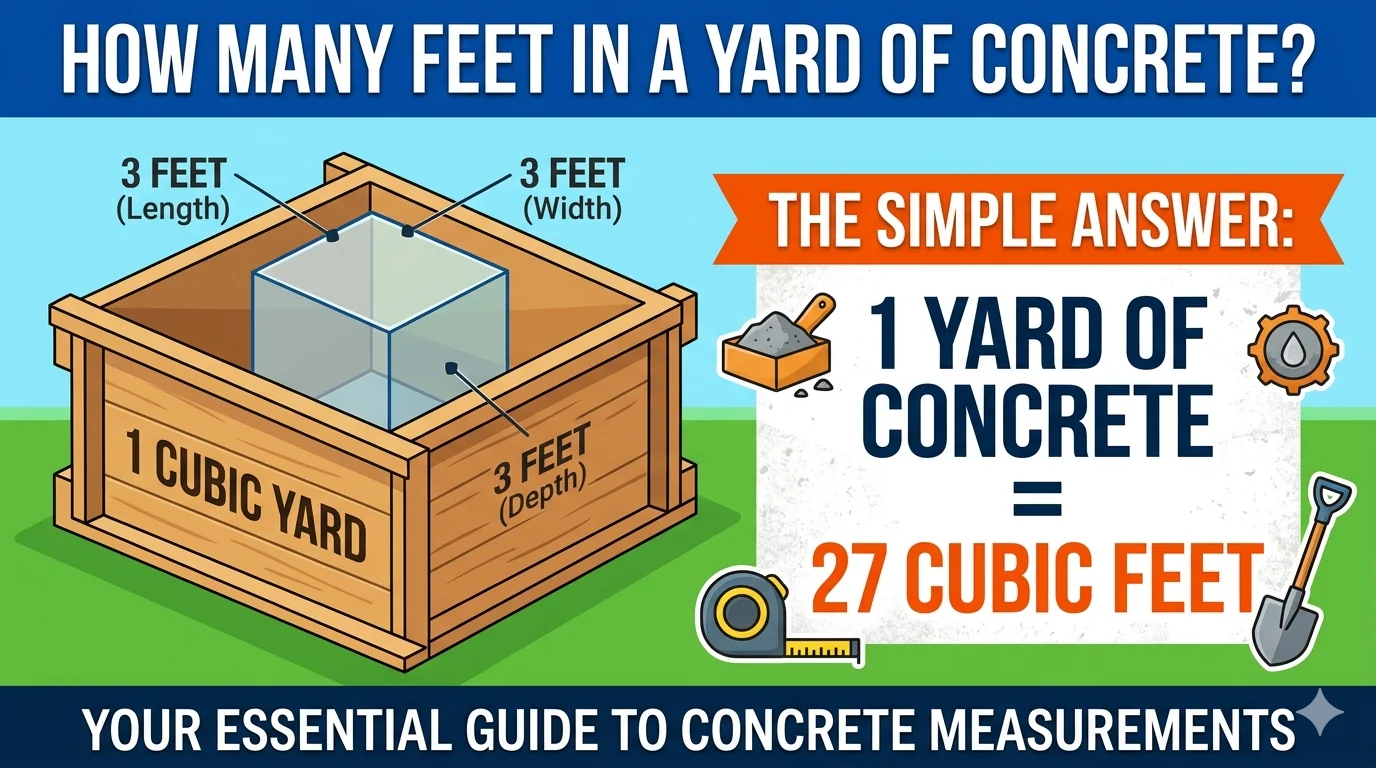
If you are planning a concrete project, one of the most common questions is: “How many feet in a yard of concrete?” Understanding this measurement is important because concrete is usually sold by the cubic yard, not by square feet or linear feet.
Whether you are pouring a driveway, patio, sidewalk, slab, or foundation, knowing how to calculate concrete correctly can save time, money, and material waste.
The simple answer is:
That means one yard of concrete equals 27 cubic feet of concrete.
However, there is much more to understand when estimating concrete accurately. In this guide, you will learn exactly how concrete measurements work, how to calculate concrete volume, practical examples, coverage charts, and expert tips to avoid expensive mistakes.
Understanding a Yard of Concrete
Before calculating anything, it helps to understand what a “yard” means in construction.
What Is a Cubic Yard?
A cubic yard is a unit of volume. It measures three-dimensional space using:
- Length
- Width
- Depth
A cubic yard measures:
Imagine a box that is:
- 3 feet long
- 3 feet wide
- 3 feet deep
That box would contain exactly one cubic yard of concrete.
Why Concrete Is Measured in Cubic Yards
Concrete is poured into spaces with depth, so contractors measure volume instead of area.
For example:
- Square feet measure surface area
- Cubic yards measure total volume
Because concrete has thickness, volume calculations are necessary.
How Many Cubic Feet Are in a Yard of Concrete?
The exact conversion is simple:
This is the standard measurement used throughout the construction industry.
Easy Formula to Remember
To convert cubic yards into cubic feet:
To convert cubic feet into cubic yards:
Quick Examples
| Cubic Yards | Cubic Feet |
|---|---|
| 1 yard | 27 cubic feet |
| 2 yards | 54 cubic feet |
| 3 yards | 81 cubic feet |
| 5 yards | 135 cubic feet |
| 10 yards | 270 cubic feet |
These conversions are useful when estimating material needs.
Concrete Measurement Basics
To calculate concrete properly, you need three measurements:
Length
Measure the longest side of the area in feet.
Width
Measure the shorter side in feet.
Depth
Measure the concrete thickness in inches, then convert it into feet.
For example:
| Inches | Feet |
|---|---|
| 2 inches | 0.167 feet |
| 4 inches | 0.333 feet |
| 6 inches | 0.5 feet |
| 8 inches | 0.667 feet |
| 12 inches | 1 foot |
Depth is very important because even a small thickness change can greatly affect the amount of concrete needed.
How to Calculate Concrete Needed
The standard formula for concrete volume is:
Once you find cubic feet, divide by 27 to get cubic yards.
Step-by-Step Formula
Step 1: Measure Dimensions
Measure:
- Length
- Width
- Thickness
Step 2: Convert Thickness to Feet
Example: 4 inches ÷ 12 = 0.333 feet
Step 3: Multiply Measurements
Example:
- Length = 10 feet
- Width = 10 feet
- Depth = 0.333 feet
Step 4: Convert to Cubic Yards
You would need about 1.25 cubic yards of concrete.
Concrete Coverage Chart
Many people ask how many square feet one yard of concrete covers.
The answer depends on thickness.
Coverage by Thickness
| Thickness | Coverage per Cubic Yard |
|---|---|
| 2 inches | 162 square feet |
| 3 inches | 108 square feet |
| 4 inches | 81 square feet |
| 5 inches | 65 square feet |
| 6 inches | 54 square feet |
| 8 inches | 40 square feet |
| 12 inches | 27 square feet |
Why Thickness Matters
Thicker concrete means less area coverage because more material is used vertically.
For example:
- A patio may use 4-inch concrete
- A driveway may need 6 inches
- Foundations may require 8 to 12 inches
Always check project requirements before ordering concrete.
Real World Concrete Examples
Understanding real projects makes calculations easier.
Driveway Example
Suppose you are pouring a driveway:
- Length = 20 feet
- Width = 12 feet
- Thickness = 6 inches
Convert depth: 6 inches = 0.5 feet
Calculate cubic feet:
Convert to cubic yards:
You would order about 4.5 to 5 yards of concrete.
Patio Example
Patio dimensions:
- 15 feet × 15 feet
- 4-inch thickness
Depth: 4 inches = 0.333 feet
Volume:
Convert:
You would need about 3 cubic yards.
Sidewalk Example
Sidewalk dimensions:
- 30 feet long
- 4 feet wide
- 4 inches thick
Calculation:
Convert:
You would likely order 1.5 yards.
Common Mistakes When Ordering Concrete
Many people order too much or too little concrete because of simple mistakes.
1. Forgetting to Convert Inches to Feet
This is the most common error.
Always divide inches by 12 before calculating volume.
2. Ordering Exact Amounts
Concrete can spill, settle, or vary slightly.
Experts usually order 5% to 10% extra.
3. Ignoring Uneven Ground
Uneven surfaces may require additional concrete depth.
4. Confusing Square Feet With Cubic Feet
Square feet only measure area.
Concrete requires cubic measurements because thickness matters.
5. Not Accounting for Waste
Some material loss is normal during transport and pouring.
Tips for Accurate Concrete Estimation
Measure Twice
Small measurement errors can lead to major cost differences.
Round Up Slightly
Never order less than needed.
Running short during a pour can create weak joints and uneven finishes.
Use Consistent Units
Keep all measurements in feet before calculating.
Consider Reinforcement
Rebar or wire mesh may slightly affect final volume.
Talk to Suppliers
Ready-mix suppliers often help confirm estimates.
Why Concrete Is Sold by the Cubic Yard
Concrete is heavy and dense, making volume-based selling more practical.
A cubic yard of concrete weighs around:
- 4,000 pounds on average
That is about:
- 2 tons
Selling by cubic yard helps suppliers:
- Mix accurately
- Transport efficiently
- Price fairly
- Estimate delivery loads
Most concrete trucks carry:
- 8 to 10 cubic yards
Large construction projects may require multiple truckloads.
Practical Concrete Estimation Table
Here is a quick guide for common slab sizes.
| Slab Size | Thickness | Approx. Concrete Needed |
|---|---|---|
| 10 × 10 ft | 4 inches | 1.25 yards |
| 12 × 12 ft | 4 inches | 1.8 yards |
| 20 × 20 ft | 4 inches | 5 yards |
| 20 × 20 ft | 6 inches | 7.5 yards |
| 30 × 10 ft | 4 inches | 3.7 yards |
| 40 × 20 ft | 6 inches | 15 yards |
These estimates help during planning and budgeting.
Benefits of Calculating Concrete Correctly
Accurate calculations provide several advantages:
- Prevent overspending
- Reduce material waste
- Avoid project delays
- Improve construction quality
- Simplify contractor communication
- Ensure structural consistency
Even small projects benefit from proper measurements.
Expert Tips From Contractors
Experienced builders follow several best practices:
Add Extra Material
Most contractors order at least:
- 5% extra for small jobs
- 10% extra for complex pours
Consider Weather Conditions
Hot weather can speed drying and increase waste.
Plan Delivery Timing
Concrete begins curing quickly after mixing.
Prepare Forms First
Have forms, tools, and workers ready before delivery.
Check Local Building Codes
Some projects require minimum slab thicknesses.
FAQs
How many cubic feet are in a yard of concrete?
One cubic yard of concrete contains 27 cubic feet.
How many square feet does one yard of concrete cover?
Coverage depends on thickness. At 4 inches thick, one cubic yard covers about 81 square feet.
How do I calculate yards of concrete?
Multiply length × width × depth in feet to get cubic feet, then divide by 27.
Why is concrete measured in cubic yards?
Concrete is measured by volume because projects require depth and thickness calculations.
Should I order extra concrete?
Yes. Most experts recommend ordering 5% to 10% extra to account for waste and uneven surfaces.
Conclusion
Understanding how many feet are in a yard of concrete is essential for any construction or DIY project. The key fact to remember is simple:
Once you understand this conversion, calculating concrete becomes much easier. By measuring length, width, and depth accurately, you can estimate concrete needs confidently and avoid costly mistakes.
Whether you are pouring a driveway, patio, sidewalk, or foundation, proper concrete calculations help you:
- Save money
- Reduce waste
- Improve project quality
- Finish work more efficiently
Always measure carefully, convert units correctly, and order a little extra concrete to stay on the safe side.