
If you’re shopping for an air conditioner, heat pump, or mini-split system, one of the first questions you’ll probably ask is: how many BTU for 1000 square feet do I need? Choosing the correct BTU rating is important because an undersized unit will struggle to maintain a comfortable temperature, while an oversized system may cycle on and off too often, wasting energy and increasing utility bills.
In general, a 1,000-square-foot space requires between 18,000 and 24,000 BTU for cooling, depending on climate, insulation, ceiling height, and other conditions. However, there is no one-size-fits-all answer. Several factors can increase or decrease your actual BTU requirement.
This guide explains what BTU means, how HVAC sizing works, and how to determine the ideal cooling or heating capacity for a 1,000-square-foot area.
Understanding What BTU Means
BTU stands for British Thermal Unit, a standard measurement used to describe the amount of heat an HVAC system can remove or generate. In simple terms, the higher the BTU rating, the greater the heating or cooling capacity.
For example:
- A 5,000 BTU window AC is suitable for a small bedroom.
- An 18,000–24,000 BTU system can handle much larger spaces.
- Central air systems are often rated in both BTUs and tons, where 1 ton equals 12,000 BTU.
Proper BTU sizing directly affects:
- Energy efficiency.
- Indoor comfort.
- Monthly electricity costs.
- Equipment lifespan.
- Humidity control.
A correctly sized HVAC unit keeps your home comfortable while operating efficiently.
How Many BTU for 1000 Square Feet?
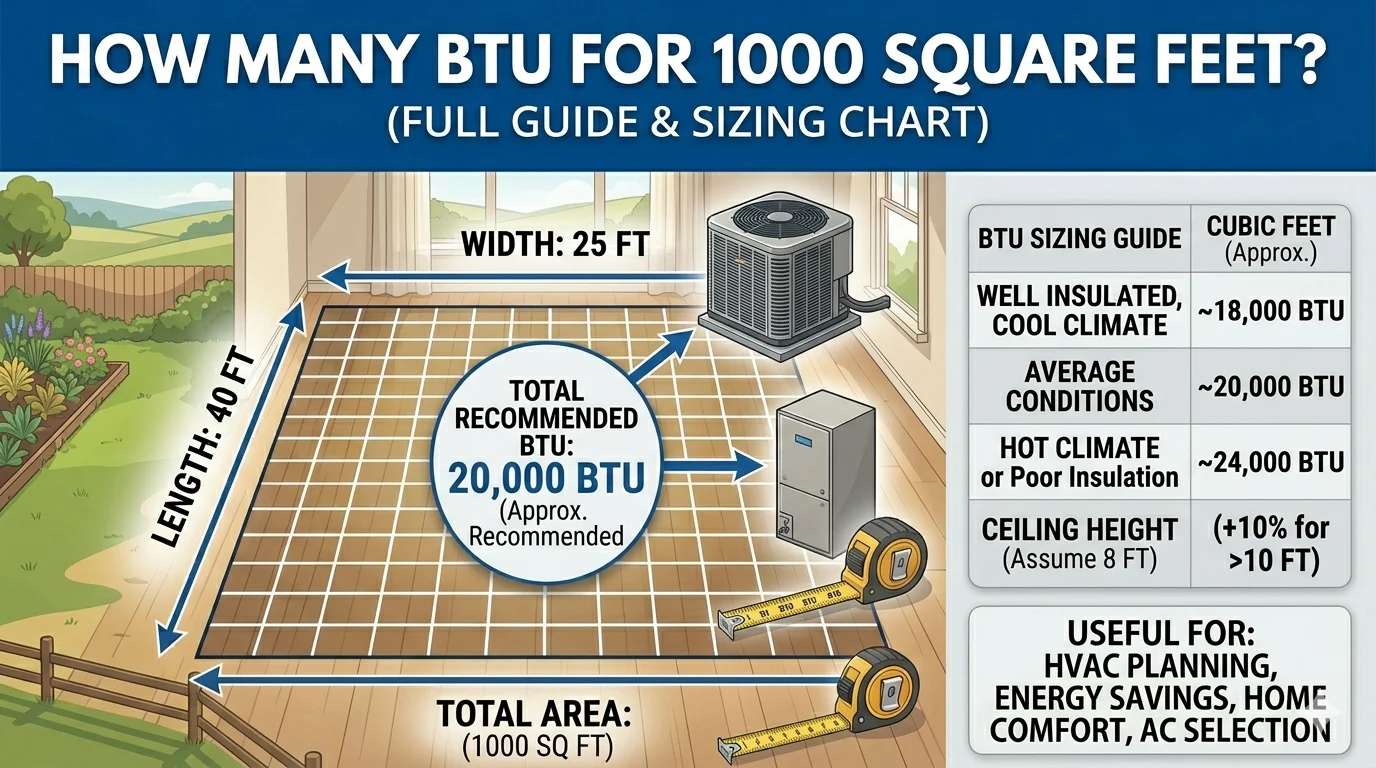
The most common HVAC rule of thumb suggests that you need approximately 20 BTU per square foot for standard residential cooling. Based on this guideline, a 1,000-square-foot area requires around 20,000 BTU.
Here is a simple BTU sizing chart:
| Area Size | Estimated BTU Needed |
|---|---|
| 500 sq ft | 10,000 BTU |
| 700 sq ft | 14,000 BTU |
| 800 sq ft | 16,000 BTU |
| 900 sq ft | 18,000 BTU |
| 1000 sq ft | 20,000 BTU |
| 1200 sq ft | 24,000 BTU |
| 1500 sq ft | 30,000 BTU |
For most homes, 20,000 BTU is an excellent starting point. However, HVAC professionals often recommend a range of 18,000 to 24,000 BTU depending on the specific characteristics of the home.
Standard BTU Recommendations
| Home Condition | Recommended BTU |
|---|---|
| Well insulated, cool climate | 18,000 BTU |
| Average home conditions | 20,000 BTU |
| Hot climate or high sun exposure | 22,000–24,000 BTU |
| Poor insulation or high ceilings | Up to 24,000 BTU |
Factors That Affect BTU Requirements
Although square footage is the main factor, several other elements can change how many BTUs you actually need.
Climate and Geographic Location
Homes in hot and humid climates require more cooling power than those in mild regions. If you live where summers are long and temperatures regularly climb above 90°F (32°C), you may need to add 10–20% more BTU capacity.
General recommendations include:
- Cooler climates: 18,000–20,000 BTU.
- Moderate climates: Around 20,000 BTU.
- Hot or desert climates: 22,000–24,000 BTU.
Ceiling Height
Standard BTU calculations assume 8-foot ceilings. If your home has vaulted ceilings or ceilings that are 10 feet or higher, there is more air volume to cool, meaning you may need additional BTU capacity.
Insulation Quality
Well-insulated homes retain cool air more effectively and place less strain on the HVAC system. Older homes with poor insulation often require larger units because they gain heat more quickly.
Number of Windows and Sun Exposure
Large windows, especially those facing south or west, can dramatically increase indoor temperatures. Homes with significant sun exposure may require an additional 10–20% BTU capacity.
Occupancy and Heat-Producing Appliances
People and appliances create heat. Kitchens, home offices, and entertainment rooms with multiple electronics often need a little extra cooling power.
You may need additional BTUs if your home includes:
- Multiple computers.
- Large televisions.
- Kitchen appliances.
- Frequent gatherings or high occupancy.
BTU Chart by Square Footage
The following chart offers a quick estimate for different home sizes:
| Square Footage | Approximate BTU |
|---|---|
| 150–250 sq ft | 6,000 BTU |
| 250–350 sq ft | 8,000 BTU |
| 350–450 sq ft | 10,000 BTU |
| 450–550 sq ft | 12,000 BTU |
| 550–700 sq ft | 14,000 BTU |
| 700–1,000 sq ft | 18,000 BTU |
| 1,000 sq ft | 20,000 BTU |
| 1,000–1,200 sq ft | 22,000–24,000 BTU |
| 1,200–1,500 sq ft | 24,000–30,000 BTU |
Keep in mind that this chart is only a general guideline. A professional HVAC load calculation will provide the most accurate result.
What Size AC Unit Is Best for 1000 Square Feet?
Air conditioners are commonly rated by both BTUs and tons.
| AC Size | BTU Rating | Typical Coverage |
|---|---|---|
| 1 Ton | 12,000 BTU | Up to 600 sq ft |
| 1.5 Ton | 18,000 BTU | 700–1,000 sq ft |
| 2 Ton | 24,000 BTU | 1,000–1,200 sq ft |
For a typical 1,000-square-foot home:
- A 1.5-ton (18,000 BTU) system works well for well-insulated homes in moderate climates.
- A 2-ton (24,000 BTU) system is often better for hotter regions or homes with greater cooling demands.
Whether you choose a central air conditioner or a mini-split system, the same basic BTU sizing principles apply.
How to Calculate BTU for Your Home
You can estimate your cooling needs with a simple calculation.
Step 1: Measure the Area
Multiply the length by the width of the space.
Length × Width = Square Footage
For example:
- 25 feet × 40 feet = 1,000 square feet.
Step 2: Multiply by the BTU Rule
Use the standard guideline of approximately 20 BTU per square foot.
- 1,000 × 20 = 20,000 BTU.
Step 3: Adjust for Home Conditions
Increase or decrease the estimate based on:
- Climate.
- Insulation.
- Ceiling height.
- Window size and orientation.
- Number of occupants.
Example Calculation
Suppose your home is:
- 1,000 square feet.
- Located in a warm climate.
- Has large sun-facing windows.
- Features average insulation.
Base requirement:
- 1,000 × 20 = 20,000 BTU.
Adjustments:
- Hot climate: +10%.
- High sun exposure: +10%.
Recommended cooling capacity:
- Approximately 22,000–24,000 BTU.
Common Mistakes When Choosing BTU Capacity
Many homeowners think that buying the biggest unit available will deliver the best results. In reality, proper sizing is much more important.
Choosing an Oversized Unit
An oversized air conditioner cools the room too quickly and shuts off before removing enough humidity. This can leave your home feeling damp and uncomfortable while increasing energy costs.
Buying an Undersized Unit
A system that is too small will run almost continuously, leading to higher electricity bills, uneven temperatures, and faster wear on the equipment.
Ignoring Insulation
Two homes with the same square footage may have completely different BTU requirements if one is well insulated and the other is not.
Forgetting About Ceiling Height
Higher ceilings increase the amount of air that needs to be cooled, making a larger BTU capacity necessary.
Relying Only on Square Footage
While square footage is an excellent starting point, factors like climate, occupancy, windows, and building materials should also be considered.
Benefits of Proper HVAC Sizing
Selecting the right BTU capacity provides several important benefits:
- Lower monthly energy bills.
- Better indoor comfort.
- More consistent room temperatures.
- Improved humidity control.
- Reduced wear and tear on equipment.
- Longer HVAC system lifespan.
- Lower maintenance and repair costs.
Proper HVAC sizing not only keeps your home comfortable but also saves money over the long term.
Central AC vs Mini Split for 1000 Square Feet
Both central air conditioning and mini-split systems can effectively cool a 1,000-square-foot space, but they have different advantages.
| Feature | Central AC | Mini Split |
|---|---|---|
| Best For | Whole-home cooling | Individual zones |
| Installation | Requires ductwork | No ducts required |
| Energy Efficiency | Good | Excellent |
| Upfront Cost | Moderate to high | Moderate |
| Flexibility | Fixed cooling zones | Independent room control |
If your home already has ductwork, central AC may be the easiest solution. If you want room-by-room control or don’t have ducts installed, a mini-split system can offer excellent efficiency.
Expert Tips for Choosing the Right BTU
Before purchasing an HVAC system, keep these practical tips in mind:
- Start with the guideline of 20 BTU per square foot.
- Increase capacity for hot climates and sunny rooms.
- Consider insulation quality and ceiling height.
- Choose an energy-efficient unit with a high SEER rating.
- Request a professional HVAC load calculation for maximum accuracy.
- Compare long-term operating costs, not just the initial purchase price.
A little extra planning can help you avoid costly mistakes and ensure your system performs efficiently for years.
Frequently Asked Questions
Is 20,000 BTU enough for 1000 square feet?
Yes, 20,000 BTU is generally considered the standard requirement for cooling a 1,000-square-foot space under average conditions.
Can an 18,000 BTU air conditioner cool 1000 square feet?
Yes. In a well-insulated home located in a moderate climate, an 18,000 BTU unit can often provide sufficient cooling.
What size AC unit do I need for a 1000-square-foot house?
Most homeowners should choose a 1.5-ton to 2-ton air conditioner, which equals approximately 18,000–24,000 BTU.
Does ceiling height affect BTU requirements?
Absolutely. Higher ceilings increase the amount of air that needs to be cooled, often requiring a larger HVAC system.
Should I use an online BTU calculator?
An online BTU calculator is a useful starting point, but a professional HVAC load calculation offers the most accurate sizing recommendation.
Conclusion
If you’re wondering how many BTU for 1000 square feet, the answer for most homes is around 20,000 BTU, with a practical range of 18,000 to 24,000 BTU depending on climate, insulation, ceiling height, and sun exposure.
Choosing the correct BTU capacity helps improve comfort, reduce energy bills, and extend the life of your HVAC system. While square footage provides a reliable starting point, it’s important to consider the unique characteristics of your home before making a final decision. Whether you’re installing a central air conditioner, heat pump, or mini-split system, selecting the right BTU rating will ensure efficient and reliable performance for years to come.