
If you’ve ever read about horse height, you’ve probably seen measurements given in hands instead of feet or inches. But what does 16 hands actually mean?
The short answer is:
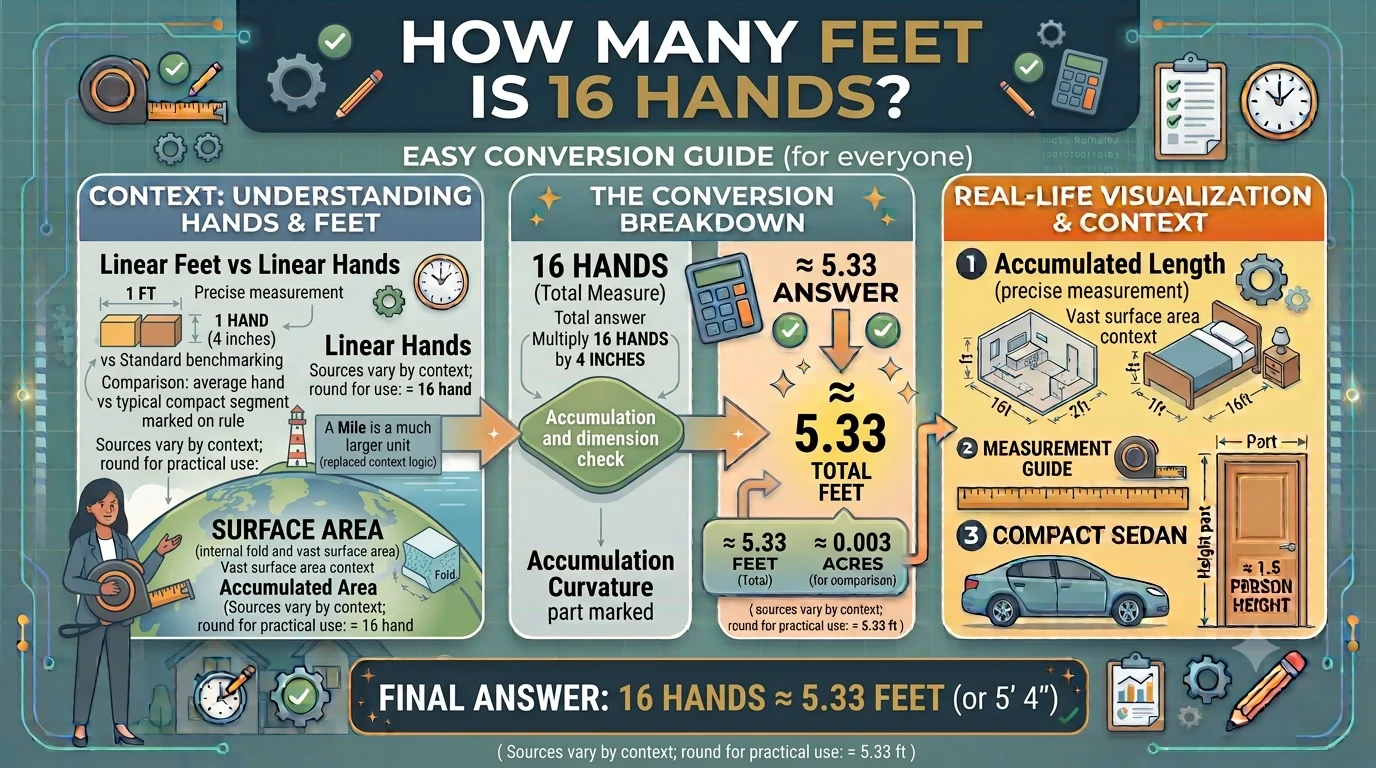
16 hands = 5 feet 4 inches (64 inches or approximately 1.63 meters).
Horse owners, breeders, veterinarians, and equestrians use the “hand” as the standard unit for measuring a horse’s height from the ground to the highest point of its withers (the ridge between the shoulder blades).
In this guide, you’ll learn exactly how to convert 16 hands into feet, why horses are measured in hands, and how to make similar conversions yourself.
What Is a Hand?
A hand is a traditional unit of measurement used almost exclusively for horses.
One hand always equals:
- 4 inches
- 0.333 feet (approximately)
- 10.16 centimeters
- 0.1016 meters
Unlike many old measurement systems, the size of a hand is standardized worldwide.
How Many Feet Is 16 Hands?
To convert hands into feet:
1 hand = 4 inches
Multiply:
16 × 4 = 64 inches
Now convert inches into feet:
- 64 ÷ 12 = 5 feet with 4 inches remaining
Answer
| Measurement | Value |
|---|---|
| Hands | 16 hands |
| Inches | 64 inches |
| Feet | 5 feet 4 inches |
| Decimal Feet | 5.33 feet |
| Centimeters | 162.56 cm |
| Meters | 1.63 m |
So, 16 hands equals 5 feet 4 inches.
Understanding Horse Height
When someone says a horse is 16 hands high (16 hh), they’re referring to the horse’s height at the withers—not to the top of its head.
The withers provide a consistent measuring point because horses naturally move their heads up and down.
For example:
- A horse measuring 16 hands stands 5 feet 4 inches at the withers.
- The horse’s head and ears extend much higher than this.
How to Convert Hands to Feet
The conversion process is straightforward.
Step 1: Convert Hands to Inches
Multiply the number of hands by 4.
Example:
16 × 4 = 64 inches
Step 2: Convert Inches to Feet
Divide by 12.
64 ÷ 12 = 5 feet 4 inches
Quick Conversion Chart
| Hands | Feet & Inches | Inches |
|---|---|---|
| 10 | 3 ft 4 in | 40 |
| 11 | 3 ft 8 in | 44 |
| 12 | 4 ft | 48 |
| 13 | 4 ft 4 in | 52 |
| 14 | 4 ft 8 in | 56 |
| 15 | 5 ft | 60 |
| 16 | 5 ft 4 in | 64 |
| 17 | 5 ft 8 in | 68 |
| 18 | 6 ft | 72 |
Why Are Horses Measured in Hands?
The hand has been used for centuries because it was a convenient measuring tool before rulers became common.
Today, the unit remains popular because it provides:
- A universal standard
- Easy communication among horse owners
- Consistent measurements worldwide
- Simple conversions
Most horse organizations still record horse height in hands.
What Does 16 Hands Mean for a Horse?
A horse standing 16 hands high is generally considered above average in height.
Typical examples include:
- Thoroughbreds
- Warmbloods
- American Quarter Horses (larger individuals)
- Standardbreds
- Sport horses
Many riding horses used for jumping, dressage, and eventing fall close to this height.
Hands vs Feet
| Hands | Feet |
|---|---|
| Horse-specific measurement | General measurement |
| Equals 4 inches | Equals 12 inches |
| Used at the withers | Used for people, buildings, and objects |
| Standard in equestrian sports | Standard everywhere else |
Common Horse Heights
| Horse Type | Typical Height |
|---|---|
| Pony | Under 14.2 hands |
| Arabian | 14.1–15.1 hands |
| Quarter Horse | 14.3–16 hands |
| Thoroughbred | 15.2–17 hands |
| Warmblood | 16–17.2 hands |
| Draft Horse | 16–19 hands |
A horse measuring 16 hands fits comfortably into the average range for many riding horses.
Understanding the “HH” Measurement
Horse heights are often written like this:
- 15 hh
- 15.1 hh
- 15.2 hh
- 15.3 hh
- 16 hh
The number after the decimal is not a decimal fraction.
Instead, it represents additional inches.
Examples:
- 16.0 hh = 16 hands exactly
- 16.1 hh = 16 hands 1 inch
- 16.2 hh = 16 hands 2 inches
- 16.3 hh = 16 hands 3 inches
There is no such measurement as 16.4 hands, because four inches equal another full hand.
Practical Examples
Example 1
A horse measures 16 hands.
- 16 × 4 = 64 inches
- 64 inches = 5 ft 4 in
Example 2
A horse measures 15 hands.
- 15 × 4 = 60 inches
- 60 inches = 5 feet
Example 3
A horse measures 17 hands.
- 17 × 4 = 68 inches
- 68 inches = 5 ft 8 in
Formula for Converting Hands
Use this simple formula:
Height in inches = Hands × 4
To convert inches into feet:
- Divide by 12.
- The quotient gives feet.
- The remainder gives inches.
Why Accurate Horse Measurement Matters
Knowing a horse’s exact height helps with:
- Buying and selling horses
- Breed registration
- Competition requirements
- Saddle fitting
- Rider suitability
- Transportation planning
- Stable and trailer sizing
Even a difference of one inch can matter in certain competitions.
Common Conversion Mistakes
Avoid these common errors:
Treating Hands as Feet
One hand is 4 inches, not one foot.
Measuring to the Head
Horse height is measured to the withers, not the ears.
Misreading Decimal Hands
16.2 hands means 16 hands plus 2 inches, not 16.2 hands mathematically.
Forgetting the 12-Inch Rule
Always divide total inches by 12 to convert to feet and inches correctly.
Expert Tips
- Remember that 1 hand always equals 4 inches.
- Measure horses while they stand on level ground.
- Use a horse measuring stick for the most accurate reading.
- Measure at the highest point of the withers.
- Double-check conversions when filling out registration or competition forms.
Frequently Asked Questions
Is 16 hands equal to 5 feet?
Not exactly. 16 hands equals 5 feet 4 inches, not exactly 5 feet.
How many inches are 16 hands?
There are 64 inches in 16 hands.
How many meters is 16 hands?
Sixteen hands equals approximately 1.63 meters.
Is 16 hands a tall horse?
Yes. A horse measuring 16 hands is considered above average and is common among many sport horse breeds.
Why do horses use hands instead of feet?
The hand is a long-established equestrian measurement that provides a consistent way to measure horse height around the world.
Conclusion
So, how many feet is 16 hands? The answer is 5 feet 4 inches, which is 64 inches or approximately 1.63 meters. Since one hand always equals four inches, converting horse height is simple once you know the formula.
Whether you’re buying a horse, comparing breeds, or simply curious about equestrian measurements, understanding how to convert hands into feet makes horse height much easier to interpret.