

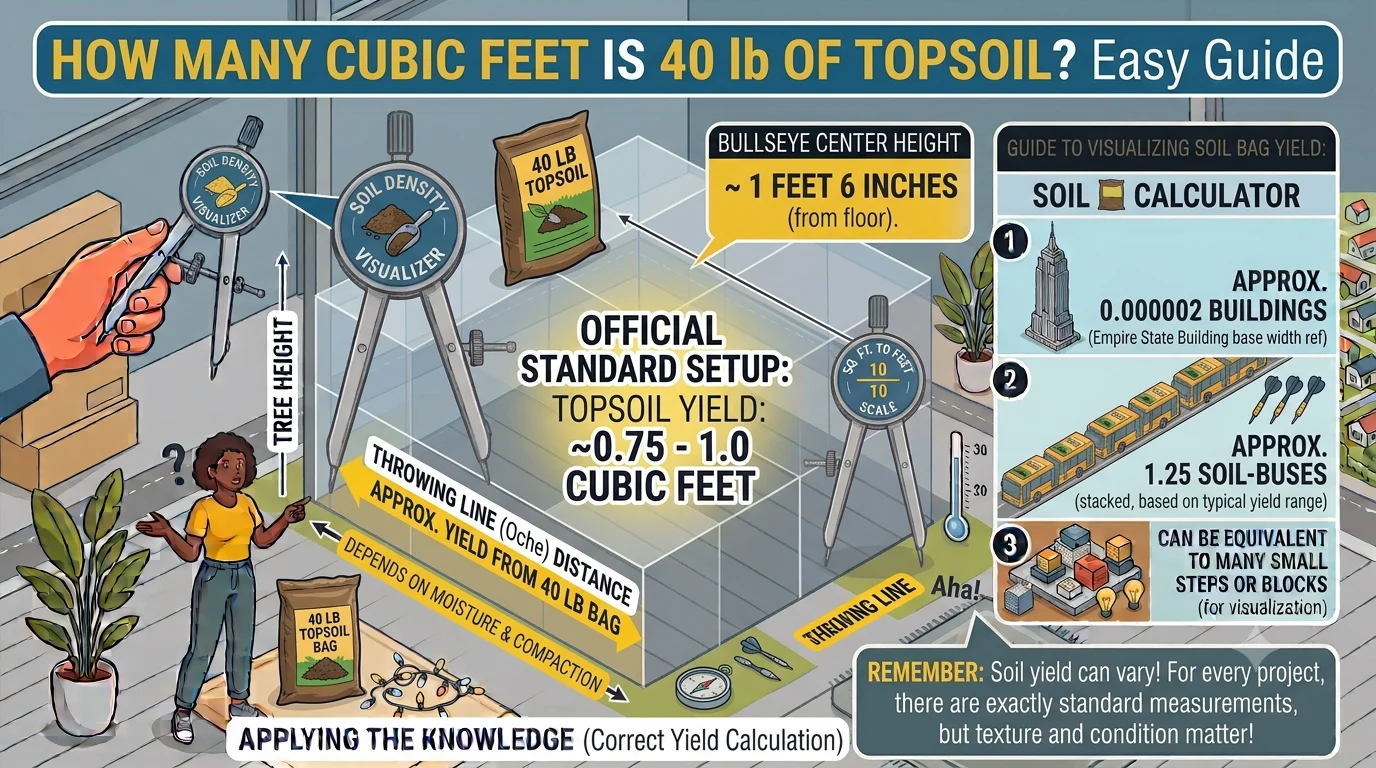
If you’re filling a garden bed, leveling your lawn, or planting flowers, you may wonder how many cubic feet is 40 lb of topsoil. The answer isn’t always exact because the weight of topsoil changes depending on its moisture content and composition. However, a standard 40 lb bag of topsoil typically contains about 0.75 cubic feet of material.
Knowing this conversion helps you estimate how many bags you need, compare products, and avoid buying too much or too little. This guide explains everything you need to know, including conversion charts, practical examples, and tips for calculating the right amount of topsoil for your project.
What Is the Volume of a 40 lb Bag of Topsoil?
Most manufacturers package 40 lb bags of topsoil to contain approximately:
| Bag Weight | Approximate Volume |
|---|---|
| 40 lb | 0.75 cubic feet |
While 0.75 cubic feet is the industry standard, some brands may vary slightly because:
- Soil density differs by manufacturer.
- Organic matter changes the weight.
- Moisture increases the total weight.
- Packaging methods are different.
Always check the label on the bag if you need an exact measurement.
Quick Answer: How Many Cubic Feet Is 40 lb of Topsoil?
For most gardening and landscaping projects:
40 pounds of topsoil = approximately 0.75 cubic feet
This is the measurement most home improvement stores and landscaping suppliers use when selling bagged topsoil.
Why Doesn’t Every 40 lb Bag Have Exactly the Same Volume?
Unlike water, soil is not uniform. Two bags weighing 40 pounds can have slightly different volumes because of differences in:
Moisture
Wet soil weighs much more than dry soil.
Organic Material
Topsoil with compost or peat moss is usually lighter than dense clay soil.
Soil Texture
Different textures include:
- Sandy soil
- Clay soil
- Loamy soil
- Garden soil mixes
Each has a different density.
Understanding Cubic Feet
A cubic foot measures volume, not weight.
One cubic foot equals a space measuring:
- 12 inches wide
- 12 inches long
- 12 inches high
When purchasing soil, you’re really buying volume to fill a space rather than simply buying weight.
Weight vs. Volume
| Measurement | What It Measures |
|---|---|
| Pounds | Weight |
| Cubic Feet | Volume |
This distinction is important because soil density changes.
For example:
- Dry soil takes up more space for the same weight.
- Wet soil takes up slightly less space while weighing more.
Typical Topsoil Bag Sizes
| Bag Weight | Approximate Cubic Feet |
|---|---|
| 20 lb | 0.40 cu ft |
| 30 lb | 0.50 cu ft |
| 40 lb | 0.75 cu ft |
| 50 lb | 0.75–1.00 cu ft |
Always verify the package because manufacturers vary.
How Much Area Does a 40 lb Bag Cover?
Coverage depends on the depth of soil you need.
| Soil Depth | Coverage from One 40 lb Bag |
|---|---|
| 1 inch | About 9 square feet |
| 2 inches | About 4.5 square feet |
| 3 inches | About 3 square feet |
| 4 inches | About 2.25 square feet |
These estimates are based on a bag containing approximately 0.75 cubic feet.
How to Calculate How Much Topsoil You Need
Use this simple formula:
Length × Width × Depth = Cubic Feet Needed
Example:
Garden bed dimensions:
- Length: 10 feet
- Width: 5 feet
- Depth: 3 inches
Convert 3 inches into feet:
3 ÷ 12 = 0.25 feet
Now calculate:
10 × 5 × 0.25 = 12.5 cubic feet
Since each bag contains about 0.75 cubic feet:
12.5 ÷ 0.75 = 16.7 bags
Round up to:
17 bags of 40 lb topsoil
Example Calculations
Small Flower Bed
Dimensions:
- 4 ft × 4 ft
- Depth: 2 inches
Required volume:
4 × 4 × 0.167 = 2.67 cubic feet
Bags required:
2.67 ÷ 0.75 ≈ 4 bags
Raised Garden Bed
Dimensions:
- 8 ft × 4 ft
- Depth: 6 inches
Volume:
8 × 4 × 0.5 = 16 cubic feet
Bags:
16 ÷ 0.75 = 21.3
You’ll need approximately 22 bags.
Lawn Repair
Patch size:
- 20 sq ft
- Depth: 1 inch
Volume:
20 × 0.083 = 1.66 cubic feet
Bags:
1.66 ÷ 0.75 ≈ 3 bags
Cubic Feet to Bags Conversion Chart
| Cubic Feet Needed | 40 lb Bags Needed |
|---|---|
| 1 | 2 |
| 2 | 3 |
| 5 | 7 |
| 10 | 14 |
| 15 | 20 |
| 20 | 27 |
| 30 | 40 |
Round up to ensure you have enough soil.
Cubic Yards Compared to 40 lb Bags
Large landscaping jobs often use cubic yards.
| Cubic Yard | Cubic Feet |
|---|---|
| 1 | 27 |
Since one bag contains about 0.75 cubic feet:
27 ÷ 0.75 = 36 bags
So:
One cubic yard equals approximately 36 bags of 40 lb topsoil.
Common Uses for 40 lb Bags of Topsoil
These bags work well for:
- Filling flower beds
- Vegetable gardens
- Lawn patching
- Tree planting
- Shrub planting
- Raised beds
- Filling low spots
- Potting mixes
- Landscaping borders
When Should You Buy Bagged Topsoil?
Bagged topsoil is ideal if you:
- Need small quantities
- Want easy transportation
- Have limited storage space
- Prefer cleaner soil
- Need premium screened topsoil
When Is Bulk Topsoil Better?
Bulk delivery becomes more economical if you need:
- More than one cubic yard
- Large landscaping projects
- Extensive lawn grading
- Multiple garden beds
Buying in bulk often costs less per cubic foot.
Factors That Affect Topsoil Density
Several things influence how much space 40 pounds of soil occupies.
Moisture Content
Freshly watered soil is heavier.
Clay Content
Clay weighs more than sandy soil.
Organic Matter
Compost-rich mixes weigh less.
Screening
Screened soil contains fewer rocks and clumps, affecting density.
Expert Tips for Buying Topsoil
Before purchasing, consider these tips:
- Measure your project area carefully.
- Buy slightly more than your estimate.
- Check the cubic feet listed on the bag.
- Choose screened topsoil for gardens.
- Mix compost for better soil health.
- Water after spreading the soil.
- Avoid buying frozen or overly wet bags.
Common Mistakes to Avoid
Buying Based Only on Weight
Always compare cubic feet instead of pounds.
Ignoring Soil Depth
Many homeowners underestimate the depth needed.
Forgetting Settling
Fresh soil settles over time.
Not Accounting for Waste
Keep one or two extra bags for unexpected needs.
Topsoil vs. Garden Soil
| Topsoil | Garden Soil |
|---|---|
| Natural upper soil layer | Blend of topsoil and organic matter |
| Good for filling | Better for planting |
| Less nutrient-rich | More nutrients |
| Less expensive | Slightly more expensive |
How Many 40 lb Bags Are Needed for Common Projects?
| Project | Bags Needed |
|---|---|
| Small flower bed | 4 |
| Raised garden | 22 |
| Lawn repair | 3 |
| New vegetable bed | 15–20 |
| Shrub planting | 2–5 |
These are estimates and depend on your dimensions.
Is 40 lb of Topsoil Enough?
A single 40 lb bag is enough for:
- Filling one or two planting holes
- Topping off a planter
- Repairing a small lawn patch
- Refreshing a flower bed
- Adding soil around shrubs
For larger gardens, you’ll likely need multiple bags.
Frequently Asked Questions
How many cubic feet is 40 lb of topsoil?
A standard 40 lb bag of topsoil contains approximately 0.75 cubic feet.
How many 40 lb bags make one cubic yard?
Since one cubic yard equals 27 cubic feet, you’ll need about 36 bags of 40 lb topsoil.
How much area does one 40 lb bag cover?
At a depth of 1 inch, one bag covers approximately 9 square feet. Coverage decreases as the desired depth increases.
Why do different brands have different volumes?
Moisture levels, soil composition, and manufacturing processes affect density, so bag volume can vary slightly.
Should I buy extra topsoil?
Yes. Buying one or two extra bags helps compensate for settling, uneven ground, and minor calculation errors.
Conclusion
If you’ve been asking how many cubic feet is 40 lb of topsoil, the standard answer is approximately 0.75 cubic feet. While slight variations occur due to moisture and soil composition, this measurement is accurate enough for nearly all gardening and landscaping projects. By understanding the relationship between weight and volume, calculating the required cubic feet, and using simple conversion formulas, you can confidently purchase the right amount of topsoil, save money, and complete your project with less waste.