
If you have ever watched a school basketball game or planned to build a court, you may have wondered: how many feet is a high school basketball court?
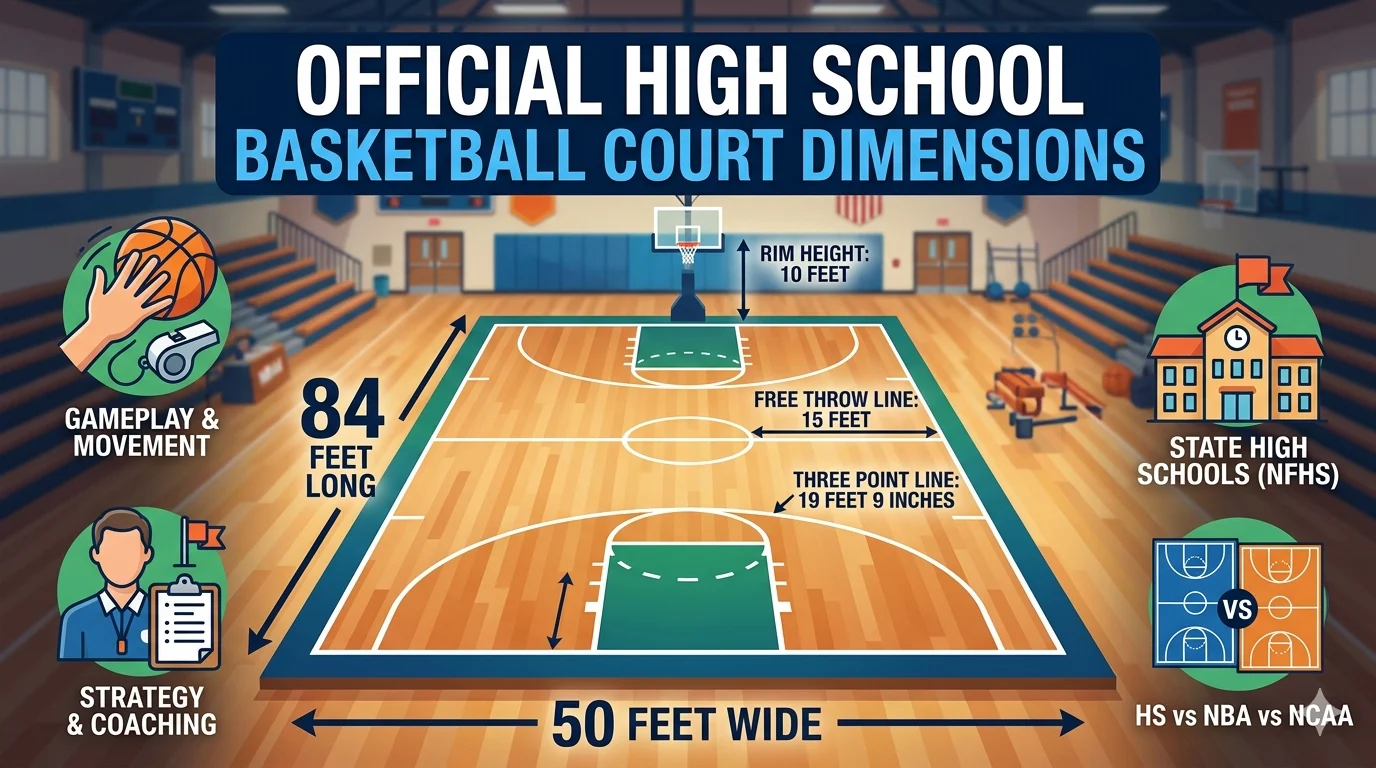
A standard high school basketball court is 84 feet long and 50 feet wide. These dimensions are used across most schools in the United States and follow official guidelines from the National Federation of State High School Associations (NFHS).
Understanding basketball court dimensions is important for players, coaches, schools, and even homeowners planning a practice area. Court measurements affect gameplay, player movement, shooting distance, and overall performance.
In this guide, you will learn the official high school basketball court dimensions, important court markings, comparisons with NBA and college courts, and practical tips for court setup and maintenance.
Official Size of a High School Basketball Court
The official size of a high school basketball court is:
| Measurement | Size |
|---|---|
| Court Length | 84 feet |
| Court Width | 50 feet |
| Rim Height | 10 feet |
| Free Throw Line | 15 feet from backboard |
| Three Point Line | 19 feet 9 inches |
These dimensions are standard for competitive high school basketball games in the United States.
Court Length
A high school basketball court measures 84 feet from baseline to baseline.
The length gives players enough space for offense, defense, fast breaks, and transitions during gameplay. While younger leagues may use smaller courts, high schools follow this full-size standard.
Court Width
The width of a high school basketball court is 50 feet.
This width allows teams to spread out, create passing lanes, and run offensive plays effectively.
Standard Basketball Court Measurements Explained
Besides the overall court size, several important markings help organize the game.
Free Throw Line Distance
The free throw line is located 15 feet from the backboard.
Players take free throws from this line after certain fouls occur during the game.
Three Point Line Distance
The high school three point line is 19 feet 9 inches from the center of the basket.
Shots made behind this line count for three points instead of two.
Hoop Height
The basketball rim is positioned 10 feet above the floor.
This standard height is used in high school, college, and professional basketball.
Key or Paint Area
The rectangular painted area under the basket is commonly called the “key” or “paint.”
In high school basketball, the key is typically:
- 12 feet wide
- Extends from the baseline to the free throw line
This area is important for rebounding, defense, and post play.
High School Basketball Court Layout
A high school basketball court includes several lines and sections that help regulate the game.
Main parts of the court include:
- Center circle
- Midcourt line
- Sidelines
- Baselines
- Free throw lanes
- Three point arcs
- Restricted shooting areas
- Team bench areas
Here is a simplified breakdown of court zones:
| Court Area | Purpose |
|---|---|
| Baseline | End boundary lines |
| Sideline | Side boundary lines |
| Center Circle | Used for jump balls |
| Key/Paint | Area near the basket |
| Three Point Arc | Determines 3-point shots |
| Free Throw Circle | Area for foul shots |
Every line has a purpose and helps maintain fair gameplay.
Comparison Between High School, College, and NBA Courts
Many people assume all basketball courts are the same size, but there are important differences.
Dimension Comparison Table
| Court Type | Length | Width | Three Point Line |
|---|---|---|---|
| High School | 84 feet | 50 feet | 19 ft 9 in |
| College (NCAA) | 94 feet | 50 feet | 22 ft 1.75 in |
| NBA | 94 feet | 50 feet | 23 ft 9 in |
| WNBA | 94 feet | 50 feet | 22 ft 1.75 in |
As you can see, high school courts are shorter than college and NBA courts.
This smaller size makes the game slightly faster and more manageable for younger athletes.
Why Basketball Court Dimensions Matter
Court size has a major impact on how basketball is played.
Player Movement
A properly sized court allows players to move safely and efficiently during games.
Skill Development
Official dimensions help players prepare for higher competition levels such as college basketball.
Fair Competition
Standard court measurements ensure all teams compete under the same conditions.
Coaching Strategy
Coaches design offensive and defensive systems based on available court space.
Common Mistakes People Make About Court Sizes
Many people misunderstand basketball court dimensions. Here are some common mistakes.
Assuming Every Court Is 94 Feet Long
Only college and professional courts measure 94 feet. High school courts are shorter at 84 feet.
Ignoring Safety Space
The actual gym area should be larger than the court itself to allow safe movement outside boundary lines.
Incorrect Three Point Measurements
Different leagues use different three point distances. Using the wrong measurement can affect gameplay and training.
Misplacing Court Lines
Improper markings can make games confusing and even violate official rules.
How to Measure a High School Basketball Court
If you are marking or checking a basketball court, follow these steps carefully.
Step 1: Measure the Length
Use a measuring tape to confirm the court is 84 feet long from baseline to baseline.
Step 2: Measure the Width
Measure 50 feet across from sideline to sideline.
Step 3: Mark the Center Line
Divide the court equally into two halves.
Step 4: Add the Free Throw Lines
Place free throw lines 15 feet from each backboard.
Step 5: Draw the Three Point Arcs
Measure 19 feet 9 inches from the center of the hoop.
Accuracy matters because even small mistakes can affect gameplay.
Can You Build a High School Basketball Court at Home?
Yes, but a full-size high school basketball court requires significant space.
Space Requirements
A complete court needs:
- 84 feet length
- 50 feet width
- Extra safety area around the court
Most homeowners choose a half-court instead of a full court.
Best Surface Options
Popular basketball court surfaces include:
- Concrete
- Asphalt
- Modular sport tiles
- Hardwood (indoor courts)
Estimated Costs
Costs vary based on location and materials.
| Court Type | Estimated Cost |
|---|---|
| Basic Half Court | $5,000–$15,000 |
| Full Outdoor Court | $25,000–$80,000 |
| Indoor Hardwood Court | $50,000+ |
Tips for Maintaining a Basketball Court
A well-maintained court improves safety and performance.
Keep the Surface Clean
Dust and dirt can make courts slippery.
Repair Cracks Quickly
Outdoor courts often develop cracks due to weather changes.
Repaint Lines When Needed
Faded markings can create confusion during games.
Check Hoops Regularly
Loose rims or damaged backboards can become dangerous.
Protect Indoor Hardwood Floors
Use proper cleaning products designed for gym flooring.
Practical Uses of Knowing Basketball Court Dimensions
Understanding court measurements can help in many situations.
For Coaches
Coaches can design drills that match real game spacing.
For Players
Players improve shooting accuracy when practicing at regulation distances.
For Schools
Schools need official measurements for tournaments and league approval.
For Homeowners
Knowing dimensions helps homeowners plan backyard courts efficiently.
High School Basketball Court vs Backyard Courts
Backyard courts are often much smaller than official courts.
| Court Type | Typical Size |
|---|---|
| Full High School Court | 84 x 50 feet |
| Half Court | 42 x 50 feet |
| Small Backyard Court | 30 x 30 feet |
| Driveway Hoop Area | Varies |
A smaller court may still work well for casual practice.
Expert Tips for Basketball Court Planning
If you plan to build or renovate a court, consider these expert recommendations.
Leave Extra Space Around the Court
Add at least 3 to 10 feet of safety clearance around all sides.
Use Proper Lighting
Good lighting improves visibility and safety.
Choose Weather-Resistant Materials
Outdoor courts should handle rain, heat, and sunlight.
Consider Drainage
Poor drainage can damage court surfaces over time.
Install Quality Hoops
Professional-grade hoops last longer and provide better gameplay.
Frequently Asked Questions
How many feet long is a high school basketball court?
A standard high school basketball court is 84 feet long.
How wide is a high school basketball court?
The official width is 50 feet.
Is a high school basketball court smaller than an NBA court?
Yes. NBA courts are 94 feet long, while high school courts are 84 feet long.
How high is a basketball hoop in high school?
The hoop height is 10 feet above the playing surface.
What is the three point line distance in high school basketball?
The three point line is 19 feet 9 inches from the basket.
Conclusion
So, how many feet is a high school basketball court?
The official dimensions are 84 feet long and 50 feet wide. These measurements are used across most high schools and create a balanced playing environment for student athletes.
Understanding high school basketball court dimensions is useful for players, coaches, schools, and homeowners. It helps with training, court construction, game preparation, and proper court maintenance.
Whether you are building a court, coaching a team, or simply learning more about basketball, knowing the official measurements gives you a strong foundation and a better understanding of the game.