
If you have ever bought land, searched for property, or looked at real estate listings, you have probably wondered, “how many feet make an acre?” This is one of the most common land measurement questions people ask.
An acre is a standard unit used to measure land area. However, many people confuse feet with square feet, which leads to misunderstandings about actual property size.
The simple answer is:
- 1 acre = 43,560 square feet
But there is more to understand than just the number. Acres can come in many shapes and dimensions, which is why learning how acreage works is important for property buyers, farmers, builders, and homeowners.
This guide explains acre measurements in simple language, including formulas, charts, examples, and practical comparisons that make acreage easy to understand.
What Is an Acre?
An acre is a unit of land measurement commonly used in the United States and several other countries. It measures area, not length.
That means an acre is not a straight line of feet. Instead, it represents a total amount of space measured in square feet.
History of the Acre Measurement
The acre has historical roots going back hundreds of years. Traditionally, it represented the amount of land a farmer with oxen could plow in one day.
Over time, the measurement became standardized. Today, one acre always equals:
- 43,560 square feet
- 4,840 square yards
- 0.4047 hectares
Even though modern surveying methods are more advanced, the acre remains one of the most widely used land measurements in real estate and agriculture.
Why Acres Are Still Used Today
Acres are popular because they make large land sizes easier to describe.
For example:
- Saying “2 acres” is simpler than saying “87,120 square feet.”
- Farms, ranches, and large residential lots are often listed in acres.
- Developers and builders frequently use acreage when planning projects.
How Many Feet Make an Acre?
The direct answer is:
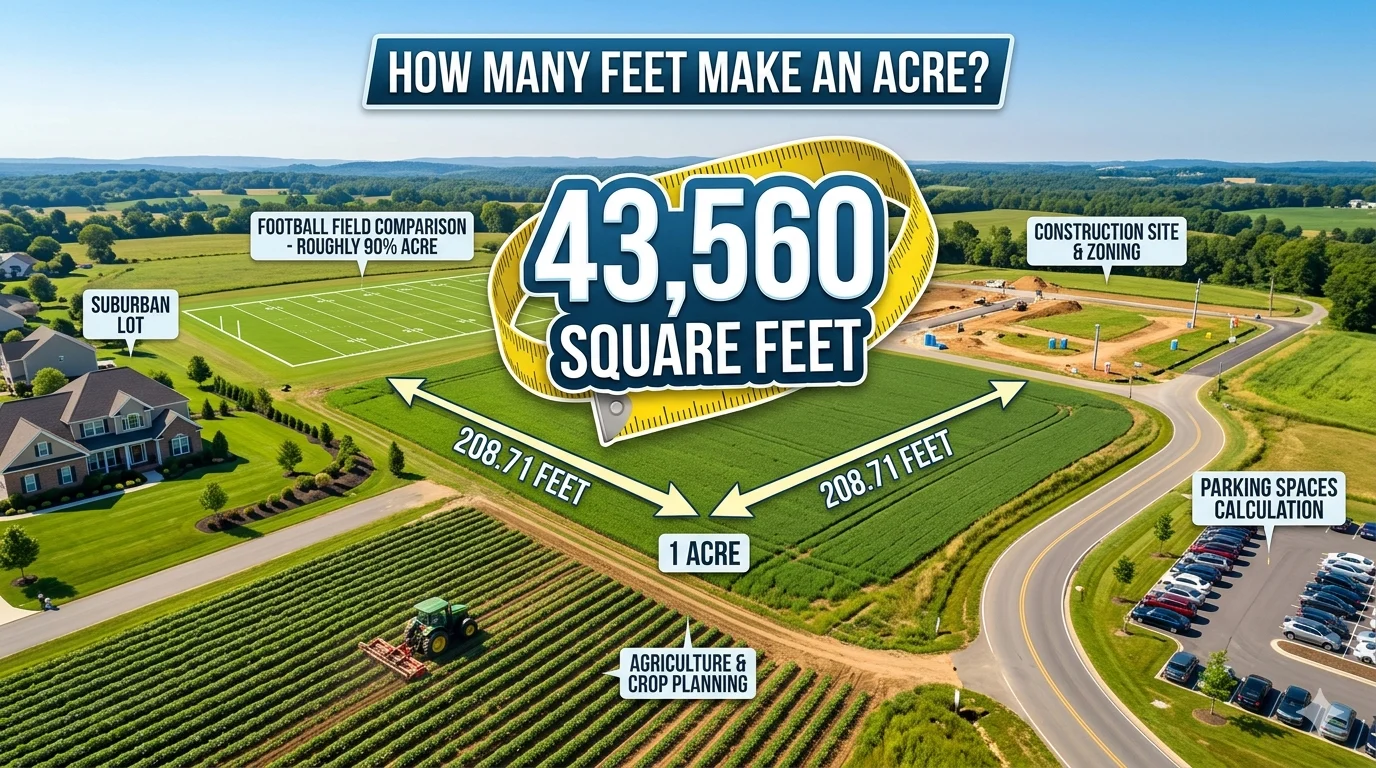
- 1 acre = 43,560 square feet
This is the standard conversion used everywhere.
However, many people ask this question expecting a length measurement, such as “how many feet long is an acre?”
That is where confusion happens.
An acre is measured in square feet because it represents area. The dimensions can vary depending on the shape of the land.
Acre to Square Feet Formula
1 acre = 43,560 square feet
To convert acres into square feet:
Square Feet = Acres × 43,560
Examples:
- 2 acres = 87,120 square feet
- 5 acres = 217,800 square feet
- 10 acres = 435,600 square feet
Standard Acre Measurement
A perfectly square acre would measure approximately:
- 208.71 feet × 208.71 feet
So, if land is square-shaped, each side would be around 208.71 feet long.
Common Acre Dimensions
One important thing to know is that an acre does not need to be square.
Many combinations of length and width equal 43,560 square feet.
Different Shapes That Equal One Acre
Here are some common examples:
| Length | Width | Total Area |
|---|---|---|
| 208.71 ft | 208.71 ft | 1 acre |
| 435.6 ft | 100 ft | 1 acre |
| 660 ft | 66 ft | 1 acre |
| 300 ft | 145.2 ft | 1 acre |
As long as the total area equals 43,560 square feet, the property equals one acre.
Acre Dimension Table
| Acres | Square Feet |
|---|---|
| 0.25 acre | 10,890 sq ft |
| 0.5 acre | 21,780 sq ft |
| 1 acre | 43,560 sq ft |
| 2 acres | 87,120 sq ft |
| 5 acres | 217,800 sq ft |
| 10 acres | 435,600 sq ft |
This table helps quickly estimate property sizes.
Visualizing the Size of an Acre
Many people struggle to picture how large an acre actually is.
Here are some practical comparisons that make understanding acreage easier.
Acre Compared to Football Fields
An acre is slightly smaller than a standard American football field without the end zones.
- Football field = about 48,000 square feet
- Acre = 43,560 square feet
So, one acre is roughly 90% of a football field.
Acre Compared to Houses
A typical suburban home may sit on:
- 0.15 to 0.30 acres
That means one acre could hold several average-sized homes depending on zoning laws and spacing.
Acre Compared to Parking Spaces
One acre can fit approximately:
- 150 to 160 parking spaces
This comparison is commonly used in commercial real estate.
How to Calculate Acreage
Understanding acreage calculations helps when measuring property or checking land listings.
Formula for Rectangular Land
If the property is rectangular:
Area = Length × Width
Then divide by 43,560:
Acres = Square Feet ÷ 43,560
Example:
- Land size = 300 ft × 200 ft
- Total area = 60,000 sq ft
Calculation:
- 60,000 ÷ 43,560 = 1.38 acres
Formula for Irregular Land
Irregular land is often divided into smaller rectangles or triangles.
Surveyors may also use:
- GPS measurements
- Property surveys
- Mapping software
- GIS tools
For accurate results, professional surveying is recommended for expensive land purchases.
Feet to Acre Conversion Chart
Here is a quick reference chart for converting square feet into acres.
| Square Feet | Acres |
|---|---|
| 1,000 sq ft | 0.023 acre |
| 5,000 sq ft | 0.115 acre |
| 10,000 sq ft | 0.23 acre |
| 20,000 sq ft | 0.46 acre |
| 43,560 sq ft | 1 acre |
| 100,000 sq ft | 2.30 acres |
This chart is useful for homeowners, builders, and real estate agents.
Acre vs Square Feet
Many people confuse acres and square feet, but they are closely related.
| Measurement | Purpose |
|---|---|
| Feet | Measures length |
| Square feet | Measures area |
| Acre | Large land area measurement |
For example:
- A fence may be 200 feet long.
- A property may contain 43,560 square feet.
- That same property equals one acre.
Understanding the difference prevents mistakes when buying or selling land.
Why Understanding Acre Measurements Matters
Knowing how many feet make an acre helps in many real-world situations.
Real Estate Purchases
Buyers can better understand property listings and compare lot sizes.
Farming and Agriculture
Farmers use acreage to calculate:
- Crop planning
- Irrigation needs
- Fertilizer requirements
- Equipment use
Construction Projects
Builders use acreage for:
- Zoning compliance
- Site planning
- Parking layouts
- Utility design
Landscaping
Landscapers estimate:
- Grass seed amounts
- Irrigation systems
- Soil requirements
- Tree spacing
Common Mistakes When Measuring an Acre
People often misunderstand acreage because they focus only on length.
Here are common mistakes to avoid.
Confusing Feet With Square Feet
Feet measure distance.
Square feet measure area.
This is the biggest source of confusion.
Assuming All Acres Are Square
An acre can have many shapes.
It does not need equal sides.
Ignoring Property Shape
Long narrow lots and square lots can both equal one acre.
Shape affects usability and appearance.
Estimating Without Measuring
Visual estimates are often inaccurate.
Always verify dimensions using surveys or maps.
Expert Tips for Land Buyers and Property Owners
Request a Property Survey
A professional survey confirms exact boundaries and acreage.
Learn Local Zoning Rules
Some areas require minimum acreage for:
- Building homes
- Farming
- Livestock
- Commercial use
Use Online Mapping Tools
Satellite maps and GIS systems help estimate land dimensions quickly.
Think Beyond Acreage
Two one-acre properties may feel very different depending on:
- Shape
- Terrain
- Access roads
- Trees
- Slopes
FAQs
How many square feet make an acre?
One acre equals 43,560 square feet.
What are the dimensions of one acre?
A square acre measures approximately 208.71 feet by 208.71 feet.
Is an acre bigger than a football field?
No. An acre is slightly smaller than a standard football field.
How do I convert square feet into acres?
Divide the total square feet by 43,560.
Can an acre have different shapes?
Yes. Any shape totaling 43,560 square feet equals one acre.
Conclusion
Understanding how many feet make an acre is important for real estate, farming, construction, and land planning. The key thing to remember is that an acre measures area, not length.
One acre always equals 43,560 square feet, but the dimensions can vary depending on the property shape.
Whether you are buying land, measuring property, or simply learning about acreage, knowing how acres convert into square feet makes land measurements much easier to understand. By using the formulas, charts, and examples in this guide, you can confidently calculate acreage and better visualize property size in real-world situations.