
When planning a concrete project, one of the most common questions homeowners and builders ask is: how many square feet is in a yard of concrete? The answer is not a fixed number because concrete is measured differently from materials like flooring or paint. Concrete is sold by cubic yards because it has volume, while square feet measure only surface area.
A single cubic yard of concrete can cover different amounts of square footage depending on how thick the concrete slab is poured. For example, one yard of concrete can cover more area when used for a thin sidewalk compared with a thick driveway or foundation.
Understanding how to convert a cubic yard of concrete into square feet helps you estimate materials accurately, avoid waste, and plan your construction project with confidence.
Understanding Square Feet and Cubic Yards
Before calculating concrete coverage, it is important to understand the difference between square feet and cubic yards.
A square foot is a measurement of surface area. It tells you how much flat space a material covers.
The formula for square feet is:
Length × Width = Square Feet
For example, if you have a patio that is 12 feet long and 10 feet wide:
12 × 10 = 120 square feet
A cubic yard measures volume. It includes three dimensions:
- Length
- Width
- Depth
Concrete is sold in cubic yards because a concrete slab is not just a flat surface. It has thickness.
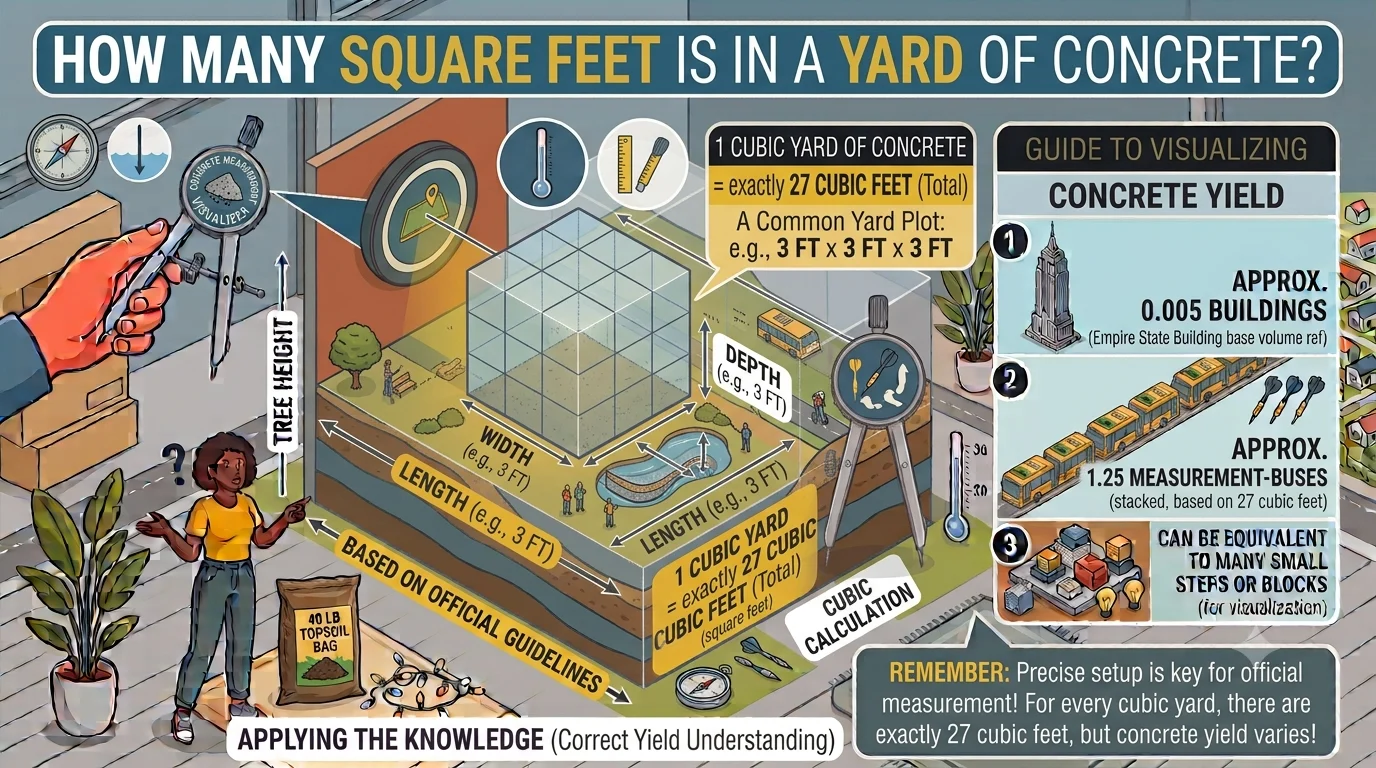
One cubic yard of concrete equals:
- 27 cubic feet
- A space measuring 3 feet × 3 feet × 3 feet
Because concrete includes depth, you need to know the thickness of your slab before determining how many square feet one yard will cover.
How Many Square Feet Does One Yard of Concrete Cover?
The amount of square feet covered by one cubic yard of concrete depends on the thickness of the pour.
Here are common coverage estimates:
Concrete Thickness| Square Feet Covered by 1 Cubic Yard
2 inches| About 162 sq ft
3 inches| About 108 sq ft
4 inches| About 81 sq ft
5 inches| About 65 sq ft
6 inches| About 54 sq ft
8 inches| About 41 sq ft
For most residential concrete projects, a 4-inch slab is common. At this thickness, one cubic yard of concrete covers approximately 81 square feet.
However, if you increase the thickness to 6 inches, the same cubic yard will only cover around 54 square feet.
Why Concrete Thickness Matters
Thickness is the most important factor when converting cubic yards of concrete into square feet.
A concrete slab needs enough thickness to support the weight and purpose of the structure.
Common concrete thickness requirements include:
- Sidewalks: 3–4 inches
- Patios: 4 inches
- Residential driveways: 4–6 inches
- Garage floors: 4–6 inches
- Heavy-use areas: 6 inches or more
A thicker slab uses more concrete because it requires more volume.
For example:
A 4-inch slab may allow one cubic yard of concrete to cover about 81 square feet.
A 6-inch slab may only cover about 54 square feet.
This difference can significantly affect your material costs.
How to Calculate Concrete Coverage Step by Step
Calculating how much concrete you need becomes easier when you follow a simple process.
Step 1: Measure the Project Area
First, measure the length and width of the area where you will pour concrete.
Example:
A patio measures:
- Length: 20 feet
- Width: 15 feet
Multiply:
20 × 15 = 300 square feet
Your project area is 300 square feet.
Step 2: Determine the Concrete Thickness
Next, decide how thick the concrete slab needs to be.
For example:
- Patio = 4 inches
- Driveway = 5–6 inches
Convert inches into feet:
4 inches ÷ 12 = 0.33 feet
Step 3: Calculate Cubic Feet
Use this formula:
Length × Width × Depth = Cubic Feet
Example:
20 × 15 × 0.33 = 99 cubic feet
Step 4: Convert Cubic Feet Into Cubic Yards
Since one cubic yard equals 27 cubic feet:
99 ÷ 27 = 3.67 cubic yards
You would need approximately 3.7 cubic yards of concrete.
Most contractors would round this up and order about 4 cubic yards.
Real-World Concrete Coverage Examples
Understanding real examples makes concrete calculations easier.
Example 1: Small Concrete Patio
A homeowner wants to build a patio:
- 12 feet long
- 12 feet wide
- 4 inches thick
First calculate square footage:
12 × 12 = 144 square feet
At 4 inches thick:
1 cubic yard covers about 81 square feet.
Calculation:
144 ÷ 81 = 1.78 cubic yards
The homeowner would need about 2 cubic yards of concrete.
Example 2: Concrete Driveway
A driveway measures:
- 30 feet long
- 10 feet wide
- 6 inches thick
Square footage:
30 × 10 = 300 square feet
At 6 inches thick, one cubic yard covers about 54 square feet.
Calculation:
300 ÷ 54 = 5.55 cubic yards
The project requires approximately 6 cubic yards of concrete.
Example 3: Sidewalk Project
A sidewalk measures:
- 40 feet long
- 4 feet wide
- 4 inches thick
Area:
40 × 4 = 160 square feet
Concrete needed:
160 ÷ 81 = 1.97 cubic yards
You would need about 2 cubic yards of concrete.
Factors That Can Change Concrete Coverage
Several factors can affect how much concrete your project requires.
Uneven Ground
If the ground underneath is not perfectly level, some areas may need extra concrete.
Low spots can increase the amount of material required.
Concrete Waste
It is always smart to order slightly more concrete than your exact calculation.
Professionals often recommend adding 5–10% extra for:
- Spills
- Uneven surfaces
- Measurement errors
- Small adjustments
Running out of concrete during a pour can create major problems.
Project Shape
Simple rectangular areas are easier to calculate.
However, projects with:
- Curves
- Steps
- Decorative designs
- Irregular shapes
may require additional concrete.
Common Mistakes When Estimating Concrete
Many people make mistakes when calculating concrete requirements.
Mistake 1: Assuming One Yard Equals a Fixed Square Foot Number
A cubic yard does not always cover the same square footage.
The thickness of the concrete changes the coverage.
Mistake 2: Forgetting Slab Depth
Only measuring length and width is not enough.
Concrete calculations require all three measurements:
- Length
- Width
- Thickness
Mistake 3: Ordering Exact Amounts
Ordering exactly what your calculation shows can be risky.
Small mistakes or unexpected conditions may leave you without enough concrete.
Mistake 4: Ignoring Reinforcement Requirements
Some projects require:
- Steel reinforcement
- Gravel base
- Additional depth
These factors can affect your final concrete needs.
Expert Tips for Accurate Concrete Estimates
Follow these tips to improve accuracy:
- Measure your area carefully.
- Confirm the recommended thickness.
- Use a concrete calculator for large projects.
- Add extra material for waste.
- Check measurements twice before ordering.
- Ask your concrete supplier for advice.
For major construction projects, professional estimates can help prevent expensive mistakes.
Benefits of Accurate Concrete Calculations
Correct concrete calculations provide several benefits:
- Reduce material waste
- Save money
- Prevent project delays
- Improve planning
- Ensure stronger results
Whether you are building a patio, driveway, walkway, or foundation, accurate measurement is an important part of successful concrete work.
Frequently Asked Questions
How many square feet does one yard of concrete cover?
One cubic yard of concrete covers approximately 81 square feet when poured at 4 inches thick. Coverage changes depending on slab thickness.
How many square feet will 2 yards of concrete cover?
At 4 inches thick, 2 cubic yards of concrete will cover about 162 square feet.
Can I calculate concrete in square feet?
Concrete is usually calculated in cubic yards because thickness is required. Square feet alone are not enough to determine concrete volume.
How much concrete do I need for a 10×10 slab?
A 10×10 slab equals 100 square feet. At 4 inches thick, it requires about 1.25 cubic yards of concrete.
Should I buy extra concrete?
Yes. Adding around 5–10% extra concrete is recommended to handle waste, uneven surfaces, and small measurement errors.
Conclusion
Knowing how many square feet is in a yard of concrete depends on the thickness of the concrete slab. One cubic yard does not represent a fixed square footage because concrete has depth.
For a standard 4-inch slab, one cubic yard covers around 81 square feet. Thicker slabs cover less area because they require more concrete volume.
By understanding the relationship between cubic yards, square feet, and slab thickness, you can estimate concrete requirements more accurately and complete your project without unnecessary costs or delays.