
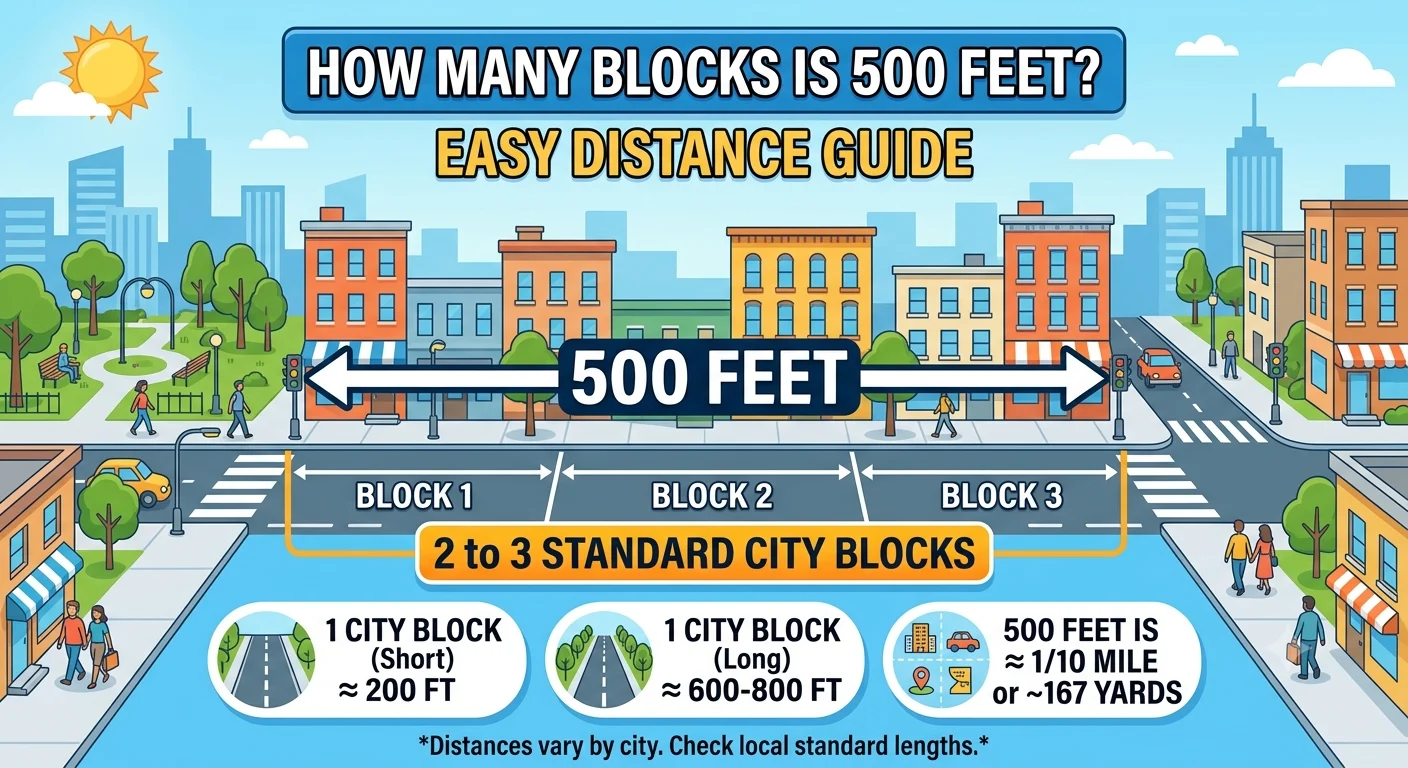
If you’re trying to estimate walking distance, navigate a city, or understand property measurements, you may wonder how many blocks is 500 feet. The answer depends on the city because blocks are not the same size everywhere. However, in many U.S. cities, 500 feet is approximately one city block.
This guide explains how to estimate 500 feet in blocks, why block sizes vary, and how to make accurate distance estimates in different situations.
What Does 500 Feet Mean?
A foot is a standard unit of length in the U.S. customary system.
- 1 foot = 12 inches
- 500 feet = 166.67 yards
- 500 feet = 152.4 meters
- 500 feet = approximately 0.095 miles
Although these conversions are exact, converting feet into city blocks requires an estimate because there is no universal block size.
How Many Blocks Is 500 Feet?
In many American cities:
| Average Block Length | 500 Feet Equals |
|---|---|
| 300 feet | 1.67 blocks |
| 330 feet | 1.52 blocks |
| 400 feet | 1.25 blocks |
| 500 feet | 1 block |
| 600 feet | 0.83 block |
| 660 feet | 0.76 block |
A common rule of thumb is:
500 feet is about one city block.
However, the exact number depends on where you are.
Why Do City Block Sizes Vary?
There is no nationwide standard for city blocks.
Several factors affect block length:
- City planning history
- Street layout
- Population density
- Terrain
- Urban redevelopment
Older cities often have shorter and irregular blocks, while newer planned cities may have much larger ones.
Examples from Different Cities
New York City
Manhattan is famous for its grid system.
Typical north-south blocks:
- Around 260 feet
Typical east-west blocks:
- Around 750–900 feet
That means:
- 500 feet equals almost 2 north-south blocks
- Or about half of one east-west block
Chicago
Many Chicago blocks are around 330 feet.
500 feet is approximately:
1.5 blocks
Seattle
Many downtown blocks measure around 240–300 feet.
500 feet equals roughly:
1.7 to 2 blocks
Phoenix
Some blocks are much larger, around 600 feet.
500 feet is less than one full block.
Quick Reference Chart
| Feet | Approximate Blocks (500-ft Blocks) |
|---|---|
| 100 | 0.2 |
| 200 | 0.4 |
| 300 | 0.6 |
| 400 | 0.8 |
| 500 | 1 |
| 600 | 1.2 |
| 700 | 1.4 |
| 800 | 1.6 |
| 900 | 1.8 |
| 1,000 | 2 |
How Long Does It Take to Walk 500 Feet?
The average person walks about 3 miles per hour.
Walking 500 feet usually takes:
- Approximately 2 minutes
If you’re walking slowly:
- Around 2.5 to 3 minutes
If you’re walking quickly:
- Around 1.5 minutes
Visualizing 500 Feet
If you’re having trouble picturing 500 feet, here are a few comparisons.
500 feet is roughly:
- One average city block
- Half the length of a 1,000-foot distance
- About one and two-thirds football fields without end zones
- Around 152 meters
- A two-minute walk
When Is Knowing 500 Feet Useful?
Understanding this distance helps with many everyday activities.
Examples include:
- Walking directions
- Real estate listings
- Parking regulations
- Construction planning
- Running and fitness
- Property boundaries
- Event planning
- Navigation without GPS
Estimating Blocks Without Measuring
Here are some practical tips.
Use Walking Time
If your walking speed is average:
- Two minutes ≈ 500 feet
Check Map Apps
Google Maps and Apple Maps display walking distances in feet before switching to miles.
Count Street Intersections
In cities with uniform grids, counting intersections often provides a close estimate.
Use Landmarks
Many parking lots, office buildings, and shopping centers have known dimensions that help estimate distance.
Feet vs Blocks Comparison
| Distance | Approximate Blocks |
|---|---|
| 250 feet | 0.5 block |
| 500 feet | 1 block |
| 750 feet | 1.5 blocks |
| 1,000 feet | 2 blocks |
| 1,500 feet | 3 blocks |
| 2,000 feet | 4 blocks |
Common Mistakes
Assuming Every Block Is the Same
This is the biggest misconception.
Block sizes differ from city to city and even neighborhood to neighborhood.
Confusing Walking Distance with Straight-Line Distance
A map may show 500 feet as a straight line, but roads and sidewalks often increase the actual walking distance.
Ignoring Local Street Layouts
Grid cities are easier to estimate than towns with winding roads.
Expert Tips
- Learn your city’s average block length if you walk often.
- Use map applications for precise measurements.
- Remember that one block is only an estimate.
- Convert feet to meters if traveling internationally.
- Walking time is often the easiest way to estimate short distances.
Practical Examples
Example 1
A restaurant is listed as 500 feet away.
You can expect:
- About a 2-minute walk.
- Roughly one city block in many downtown areas.
Example 2
A parking garage is 1,000 feet from your destination.
That equals approximately:
- Two average city blocks.
Example 3
A hotel advertises attractions within 500 feet.
Most guests can comfortably walk there in just a couple of minutes.
Frequently Asked Questions
Is 500 feet always one block?
No. It depends on the city’s block size. In many places, it is close to one block, but some cities have much shorter or longer blocks.
How many minutes is 500 feet?
Most people walk 500 feet in about 2 minutes.
Is 500 feet close enough to walk?
Yes. It’s a short walking distance for most people.
How many yards are in 500 feet?
500 feet equals 166.67 yards.
How many meters are 500 feet?
500 feet equals 152.4 meters.
Conclusion
If you’re wondering how many blocks is 500 feet, the simplest answer is about one city block in many U.S. cities. However, actual block sizes vary based on local street design, so the estimate can range from less than one block to nearly two blocks. Knowing this approximation makes it easier to understand walking directions, estimate travel time, and visualize short distances in everyday life. Whether you’re exploring a new city, reading a property listing, or planning a walk, using 500 feet as roughly one block is a practical and reliable rule of thumb.