

Choosing the right air conditioner size is one of the most important decisions when installing a cooling system. If you are wondering how many square feet per ton of AC is ideal, you are already on the right track to avoiding energy waste, poor cooling, and high electricity bills.
In simple terms, AC tonnage determines how much space an air conditioner can cool efficiently. If the size is wrong, your room may stay uncomfortable even if the AC is running all day. This guide explains everything in a clear, practical way so you can confidently choose the right AC for your space.
Understanding AC Ton and Cooling Capacity
Before learning how many square feet per ton of AC is ideal, it is important to understand what “ton” actually means in HVAC systems.
What does 1 ton of AC mean?
A “ton” in air conditioning does not refer to weight. It refers to cooling capacity.
1 ton of AC = the ability to remove 12,000 BTU (British Thermal Units) per hour from a room.
This measurement is based on the amount of heat required to melt one ton of ice in 24 hours.
BTU and how it connects to tonnage
BTU (British Thermal Unit) is the standard unit used to measure cooling power.
- 1 ton = 12,000 BTU/hour
- 1.5 ton = 18,000 BTU/hour
- 2 ton = 24,000 BTU/hour
Higher BTU means higher cooling capacity and larger coverage area.
How Many Square Feet Per Ton of AC (Standard Rule)
Now to the main question: how many square feet per ton of AC is considered standard?
General industry standard
On average:
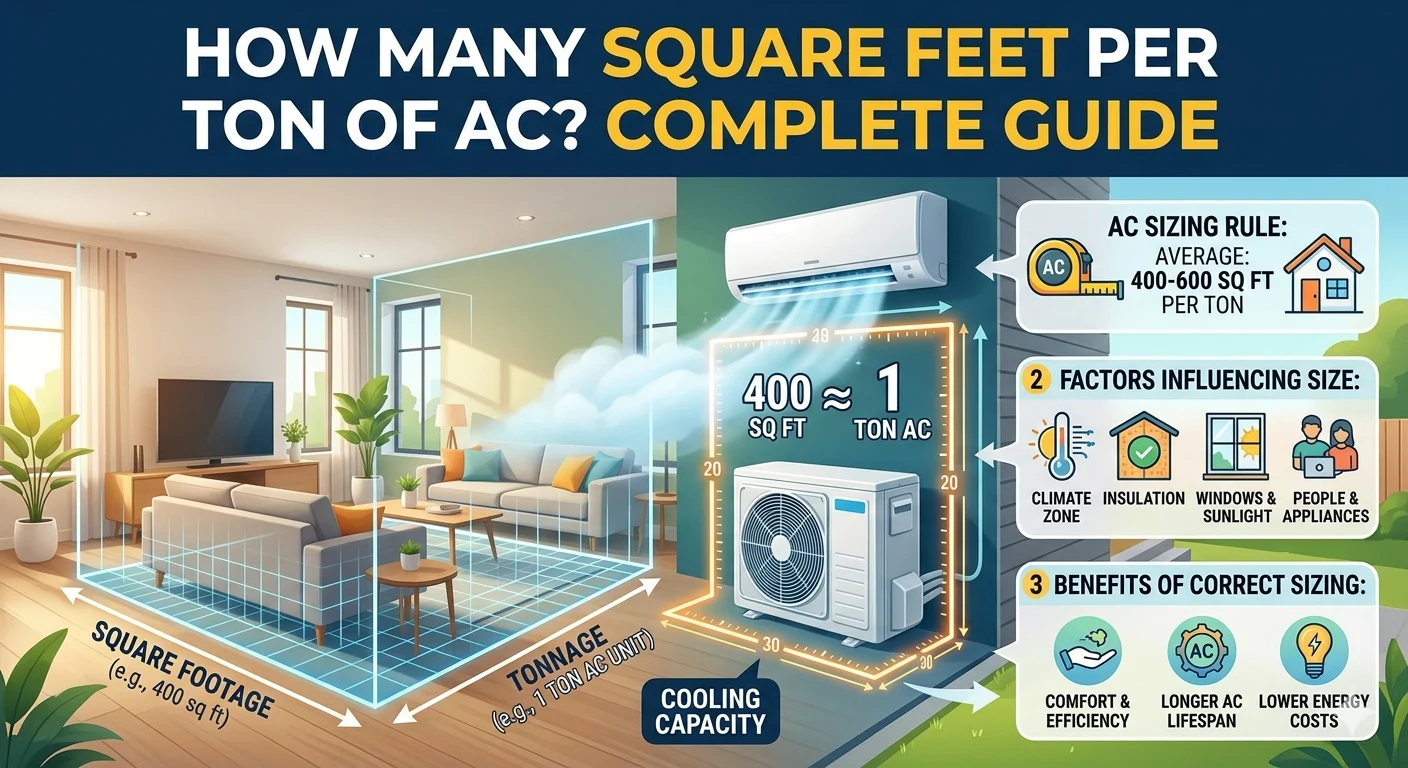
1 ton of AC cools approximately 400 to 600 square feet
This is the most widely used guideline in HVAC sizing.
Here is a simple breakdown:
- 1 ton AC → 400–600 sq ft
- 1.5 ton AC → 600–900 sq ft
- 2 ton AC → 900–1200 sq ft
Climate-based variations
Cooling performance changes based on climate:
- Hot climates → 1 ton per 400 sq ft
- Moderate climates → 1 ton per 500 sq ft
- Cooler climates → 1 ton per 600 sq ft
In hotter regions, more cooling power is required for the same space.
AC Size Chart by Room Size
This practical chart helps you match AC tonnage with room size.
1 ton AC coverage
Best for:
- Small bedrooms
- Study rooms
- Small offices
Coverage:
- 400–600 sq ft
1.5 ton AC coverage
Best for:
- Medium bedrooms
- Small living rooms
Coverage:
- 600–900 sq ft
2 ton AC coverage
Best for:
- Large living rooms
- Open halls
- Shops
Coverage:
- 900–1200 sq ft
Factors That Affect Cooling Efficiency
Even if you know how many square feet per ton of AC is recommended, real performance depends on several factors.
Room insulation
Poor insulation allows cool air to escape, reducing efficiency and increasing electricity use.
Sunlight exposure
Rooms with large windows or direct sunlight heat up faster and need more cooling power.
Ceiling height
Standard calculations assume 8–10 ft ceilings. Higher ceilings increase cooling requirements.
Appliances and people
Heat sources inside a room include:
- People
- TVs
- Computers
- Kitchen appliances
More heat means more cooling demand.
How to Calculate AC Size for Your Room
You can estimate AC size using a simple method.
Step-by-step method
- Measure room length and width
- Multiply to get square footage
- Divide by 500
Example
Room size = 20 ft × 15 ft = 300 sq ft
300 ÷ 500 = 0.6 ton
So, a 1 ton AC is recommended for proper cooling.
Common Mistakes When Choosing AC Size
Oversized AC problems
- Higher electricity bills
- Frequent on/off cycling
- Poor humidity control
Undersized AC problems
- Continuous running
- Poor cooling performance
- Faster wear and tear
Correct sizing is about balance, not maximum power.
Expert Tips for Choosing the Right AC
Focus on energy efficiency
Check:
- EER (Energy Efficiency Ratio)
- Inverter technology
Inverter ACs adjust cooling automatically and save electricity.
Inverter vs non-inverter AC
- Inverter AC: Energy-efficient, stable cooling
- Non-inverter AC: Lower cost but higher long-term electricity use
For most homes, inverter AC is the better choice.
Final Recommendation Based on Room Types
- Small bedroom → 1 ton AC
- Large bedroom → 1.5 ton AC
- Living room → 1.5–2 ton AC
- Office space → Based on occupancy
- Shops/commercial areas → 2 ton or more
Always consider heat load, not just square footage.
FAQs
1. How many square feet does a 1 ton AC cover?
A 1 ton AC typically covers 400 to 600 square feet depending on insulation and climate.
2. Is 1.5 ton AC enough for a living room?
Yes, it is suitable for medium-sized living rooms up to around 900 sq ft.
3. Can I use a bigger AC than required?
Yes, but it may increase electricity usage and reduce efficiency.
4. What happens if AC is too small?
It will run continuously and fail to cool the room properly.
5. How do I calculate AC tonnage for my room?
Divide your room’s square footage by 500 to estimate the required tonnage.
Conclusion
Understanding how many square feet per ton of AC helps you choose the right cooling system for your home or office. On average, 1 ton of AC covers 400–600 square feet, but actual performance depends on climate, insulation, and room conditions.
A properly sized AC improves comfort, reduces electricity bills, and increases system lifespan. Always calculate your room size carefully before making a purchase decision.