
If you are trying to understand how many feet is 80 meters, the quick answer is that 80 meters equals approximately 262.47 feet. This conversion is commonly needed in construction, education, travel, sports, and engineering where metric and imperial systems are both used.
But simply knowing the number is not enough. Understanding how the conversion works helps you apply it to any other value easily. In this guide, you will learn the exact formula, step-by-step calculation, real-life comparisons, and practical tips to convert meters into feet without confusion.
Understanding “How Many Feet Is 80 Meters”
The question how many feet is 80 meters is about converting units of length between two different measurement systems:
- Meters belong to the metric system
- Feet belong to the imperial system
Most countries use the metric system, but countries like the United States still rely heavily on feet and inches for everyday measurements. That’s why conversions like 80 meters to feet are so important in global communication.
Why this conversion matters
You will often see this conversion in:
- Construction drawings
- Land measurements
- Sports field dimensions
- Engineering projects
- Academic math and physics problems
- Travel and mapping data
When working internationally, switching between meters and feet becomes essential for clarity and accuracy.
Exact Answer: How Many Feet Is 80 Meters?
The exact conversion is:
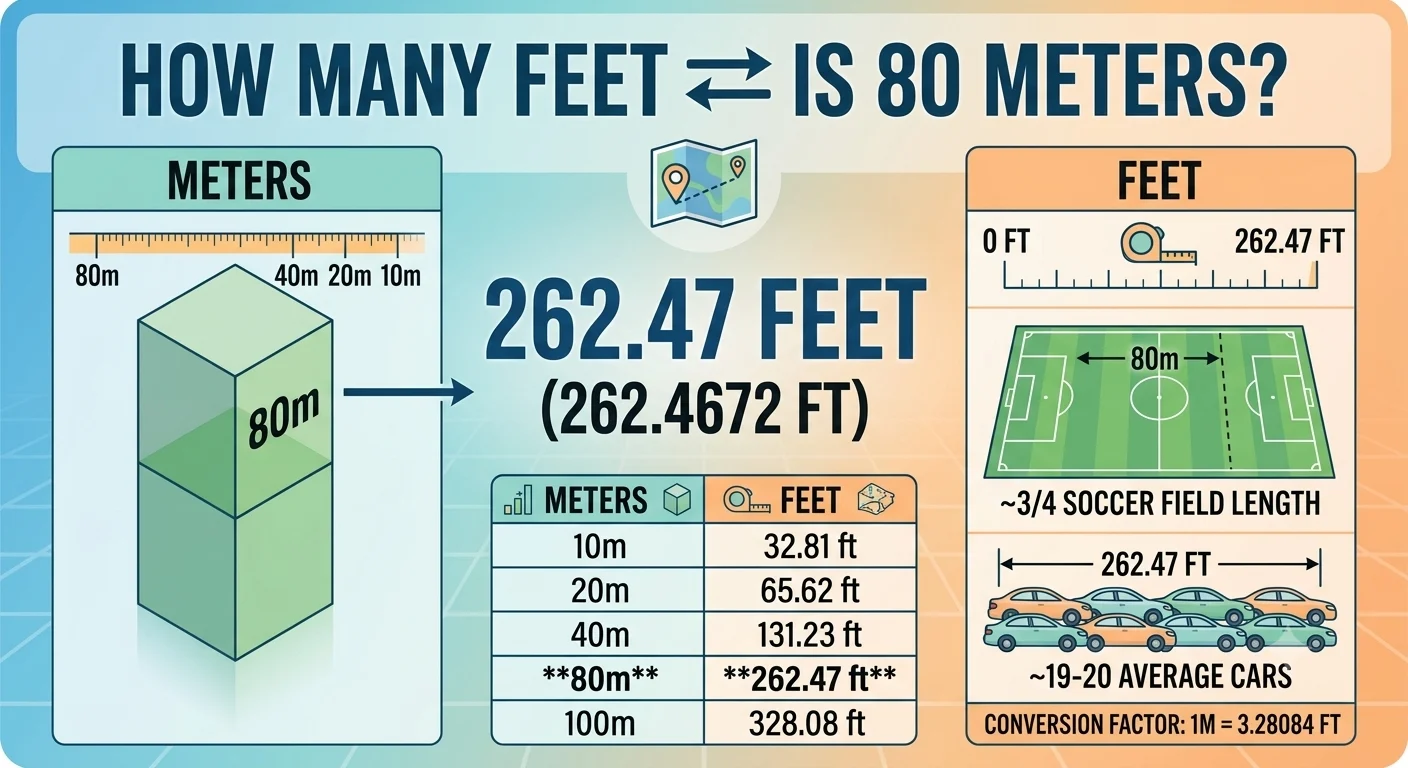
80 meters = 262.467 feet
Rounded for practical use:
80 meters ≈ 262.47 feet
This value is based on the standard conversion factor used worldwide.
Conversion formula
To convert meters into feet, use this formula:
1 meter = 3.28084 feet
So:
80 × 3.28084 = 262.4672 feet
This is the most accurate and widely accepted conversion method.
Step-by-step breakdown
Let’s make it even simpler:
- Start with 80 meters
- Multiply by 3.28084
- Result = 262.4672 feet
- Round it = 262.47 feet
This step-by-step method ensures accuracy and helps you understand how the value is derived instead of just memorizing it.
Quick Reference: Meters to Feet Conversion Table
Here is a useful chart to help you quickly estimate conversions without a calculator:
| Meters | Feet |
|---|---|
| 5 m | 16.40 ft |
| 10 m | 32.81 ft |
| 20 m | 65.62 ft |
| 50 m | 164.04 ft |
| 80 m | 262.47 ft |
| 100 m | 328.08 ft |
| 150 m | 492.13 ft |
This table helps you compare values quickly and understand scale differences.
Real-Life Understanding of 80 Meters in Feet
Numbers become more meaningful when we connect them to real-world objects and distances.
Sports field example
A standard football (soccer) field is around 100 to 110 meters long. That means:
- 80 meters is about 3/4 of a football field
- In feet, that equals 262.47 feet
This makes it easier to visualize the distance when watching or playing sports.
Building and construction context
In construction or architecture, 80 meters (262.47 feet) can represent:
- A long residential apartment block
- A large commercial warehouse section
- A parking structure length
- A medium bridge span in rural development
Engineers often switch between meters and feet depending on project location, so this conversion is frequently used.
Everyday comparison
To put it in simple terms:
- 80 meters is longer than a basketball court
- It is shorter than a football field
- It is roughly the length of 25 average cars lined up
These comparisons help visualize the distance more naturally.
How to Convert Meters to Feet Easily
Once you understand the basic rule, converting any number becomes simple.
Basic method
Multiply the number of meters by 3.28084.
Example:
- 80 × 3.28084 = 262.47 feet
- 30 × 3.28084 = 98.43 feet
- 60 × 3.28084 = 196.85 feet
Quick estimation method
If you don’t need perfect accuracy, use:
- 1 meter ≈ 3.3 feet
So:
- 80 meters ≈ 264 feet
This is slightly rounded but useful for quick mental calculations.
Digital tools method
You can also use:
- Google search (type: “80 meters to feet”)
- Mobile unit converter apps
- Scientific calculators
These tools give instant and accurate results without manual calculation.
Meters vs Feet: Key Differences
Understanding the systems helps avoid confusion.
Metric system (meters)
- Based on powers of 10
- Easy to calculate
- Used worldwide
- Standard in science and education
Imperial system (feet)
- Used mainly in the United States
- Includes feet, inches, yards
- Less decimal-friendly
- Common in construction and daily life in some countries
Because of these differences, conversions like 80 meters in feet are necessary.
Common Mistakes in Conversion
Many people make small but important mistakes when converting units.
1. Rounding too early
If you round numbers before completing the calculation, you reduce accuracy. Always calculate first, then round at the end.
2. Using incorrect conversion factor
Some people use:
- 3.2 instead of 3.28084
This may look small, but over larger distances like 80 meters, it creates noticeable errors.
3. Confusing feet with inches
Remember:
- 1 foot = 12 inches
So when dealing with feet, avoid mixing inches unless required.
4. Ignoring context
In engineering or construction, even small errors matter. In casual use, approximation is fine, but in technical fields, precision is essential.
80 Meters in Inches (Extra Insight)
Sometimes you may also need conversion into inches.
Since:
- 1 foot = 12 inches
Then:
- 262.47 feet × 12 = 3149.64 inches
So:
80 meters ≈ 3149.64 inches
This is useful in manufacturing, design, and engineering where smaller units are required.
Expert Tips for Accurate Conversion
Here are some practical tips to improve your accuracy:
Use full precision for professional work
Always use:
- 3.28084 instead of rounding
This ensures accuracy in engineering, surveying, and architecture.
Use approximation for daily use
For general understanding:
- 1 meter ≈ 3.3 feet
This is fast and easy for mental math.
Double-check large conversions
When working with values like 80 meters or higher:
- Recalculate once
- Verify using a digital tool
This reduces costly mistakes in real-world projects.
Why Knowing 80 Meters in Feet Is Useful
Understanding how many feet is 80 meters is helpful in many areas:
- International communication
- Construction planning
- Sports analysis
- Academic studies
- Travel and mapping
- Real estate measurement
It allows you to easily switch between measurement systems without confusion.
Frequently Asked Questions (FAQs)
1. How many feet is 80 meters exactly?
80 meters is exactly 262.467 feet using the standard conversion factor.
2. What is the formula to convert meters to feet?
Multiply meters by 3.28084.
3. Is 80 meters more than 250 feet?
Yes, 80 meters equals about 262.47 feet, which is greater than 250 feet.
4. How can I quickly estimate meters to feet?
Multiply meters by 3.3 for a quick approximation.
5. Why do different countries use different units?
Most countries use the metric system, while a few, like the US, use the imperial system due to historical standards.
Conclusion
Understanding how many feet is 80 meters helps you easily switch between metric and imperial measurement systems. The exact conversion shows that 80 meters equals approximately 262.47 feet, based on the standard formula where 1 meter equals 3.28084 feet.
Whether you are working in construction, studying math, or simply trying to understand distances, this conversion is practical and widely used. Once you know the formula, you can convert any meter value into feet quickly and accurately.
With this knowledge, measurements become simpler, clearer, and more useful in real-world situations.