
Understanding how many square feet in a acre of land is one of the most important basics in real estate, agriculture, and land investment. Whether you are buying a plot, selling farmland, or planning a construction project, knowing this conversion helps you avoid confusion and make accurate decisions.
Land is often measured in different units depending on the country. Some regions use acres, others use square feet, square meters, marla, kanal, or hectares. But among all these systems, square feet is one of the most commonly used units in property dealings, especially in South Asia and urban real estate markets.
This is why understanding the exact relationship between acres and square feet is essential for anyone dealing with land.
What Is an Acre of Land?
An acre is a traditional unit of land measurement used globally, especially in countries like the United States, United Kingdom, Pakistan, India, and several others. Unlike square feet, an acre does not represent a fixed shape. It can be a rectangle, square, or irregular shape—what matters is the total area.
Historically, the acre was based on the amount of land that could be plowed in one day by a pair of oxen. Over time, this agricultural measurement was standardized into a precise modern unit used in surveying and real estate.
Today, an acre is used in:
- Agricultural land measurement
- Real estate transactions
- Government land records
- Construction and planning projects
Even though modern tools are highly advanced, the acre remains a widely accepted standard unit.
How Many Square Feet in a Acre of Land?
The exact and globally accepted conversion is:
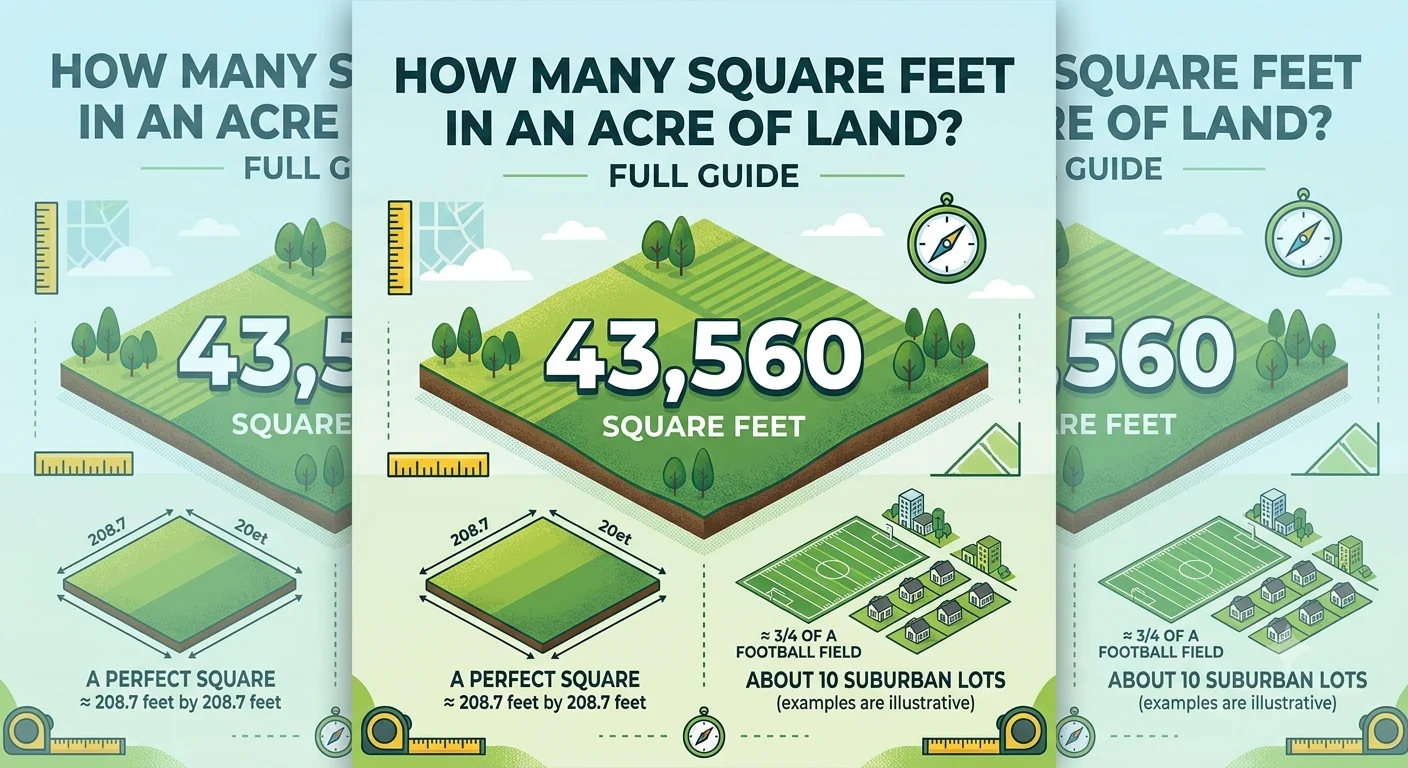
1 acre = 43,560 square feet
This is a fixed value used in all standard land measurement systems.
So when someone asks how many square feet in a acre of land, the answer will always remain the same: 43,560 square feet.
Basic conversion formula
To convert acres into square feet:
Acres × 43,560 = Square Feet
Example conversions
- 0.5 acre = 21,780 square feet
- 1 acre = 43,560 square feet
- 1.5 acres = 65,340 square feet
- 2 acres = 87,120 square feet
- 5 acres = 217,800 square feet
This simple formula is used in real estate calculations, land valuation, and construction planning.
Why the Acre Measurement Is Important
The importance of understanding how many square feet in a acre of land goes beyond academic knowledge. It directly affects financial decisions and property planning.
1. Real estate transparency
When buying or selling land, knowing the exact square footage helps:
- Verify property size
- Avoid fraud or misinformation
- Compare property prices fairly
2. Construction planning
Builders use square feet to:
- Design houses and buildings
- Calculate construction materials
- Plan space utilization
3. Agricultural usage
Farmers use acre measurements to:
- Estimate crop yield
- Plan irrigation systems
- Divide farmland efficiently
Without understanding this conversion, land management becomes confusing and error-prone.
Visualizing 1 Acre in Real Life
Numbers like 43,560 square feet can feel abstract. Let’s understand it through real-life comparisons.
Football field comparison
A standard football field (soccer field) is roughly 1.7 to 2 acres in size.
This means:
- 1 acre is slightly smaller than a full football field
- You could fit most of a football field inside 1 acre
Parking lot comparison
A large supermarket parking lot typically covers around 1 acre. That gives a practical sense of how large the area really is.
Residential layout example
In residential planning:
- A 1-acre plot can fit multiple houses
- Depending on design, around 6–10 medium-sized houses can be constructed
Acre to Other Land Measurement Units
Land measurement varies by region, so understanding conversions is very useful.
Acre to square yards
- 1 acre = 4,840 square yards
Square yards are often used in South Asian property systems.
Acre to hectares
- 1 acre = 0.4047 hectares
- 1 hectare = 107,639 square feet
A hectare is larger than an acre, commonly used in international agriculture.
Acre to marla and kanal (South Asia)
In Pakistan and India:
- 1 acre = 8 kanal
- 1 kanal = 20 marla
- 1 acre = 160 marla
This is especially important for local property buyers who deal with traditional units.
Conversion Table for Quick Understanding
| Acres | Square Feet |
|---|---|
| 0.25 acre | 10,890 sq ft |
| 0.5 acre | 21,780 sq ft |
| 1 acre | 43,560 sq ft |
| 2 acres | 87,120 sq ft |
| 5 acres | 217,800 sq ft |
| 10 acres | 435,600 sq ft |
This table helps quickly estimate land size without manual calculation.
Step-by-Step Real-Life Conversion Examples
Example 1: Small residential land
If you have 0.75 acre of land:
0.75 × 43,560 = 32,670 square feet
This is enough for:
- Multiple homes
- Small housing society block
- Large farmhouse
Example 2: Medium farmland
If you own 3 acres:
3 × 43,560 = 130,680 square feet
This can be used for:
- Crop farming
- Poultry farms
- Storage warehouses
Example 3: Large estate
For 10 acres:
10 × 43,560 = 435,600 square feet
This is suitable for:
- Large agricultural production
- Industrial development
- Housing schemes
Common Mistakes in Land Measurement
Many people make errors when dealing with land units, especially when converting acres to square feet.
1. Confusing acre with hectare
A common mistake is thinking they are similar, but:
- Acre = 43,560 sq ft
- Hectare = 107,639 sq ft
A hectare is more than double the size of an acre.
2. Mixing unit systems
People often mix:
- Square feet
- Square yards
- Marla or kanal
This leads to incorrect calculations and financial misunderstandings.
3. Rounding errors
Small rounding mistakes in land measurement can lead to:
- Incorrect pricing
- Legal disputes
- Planning issues
Real Estate Value Impact of Acres
Land value is usually calculated per square foot or per acre depending on the market.
For example:
- If 1 square foot costs 1,000 PKR
- Then 1 acre (43,560 sq ft) equals 43,560,000 PKR
Even a small mistake in conversion can lead to large financial differences.
This is why real estate professionals always double-check measurements before closing deals.
Agricultural Importance of Acre Measurement
In farming, understanding acre size is essential for productivity planning.
Crop yield estimation
Farmers calculate:
- Wheat yield per acre
- Rice production per acre
- Vegetable farming output
Irrigation planning
Water requirements depend on land size:
- Larger acre = more water usage
- Proper measurement ensures efficient irrigation
Land division
Farmers divide land into:
- Irrigation zones
- Crop sections
- Storage areas
Without accurate acre-to-square-feet conversion, planning becomes inefficient.
Expert Tips for Accurate Land Understanding
To avoid confusion when dealing with land:
- Always remember: 1 acre = 43,560 square feet
- Use calculators only after understanding the formula
- Cross-check land records before buying
- Learn local unit conversions like marla and kanal
- Compare land visually when possible
These simple habits can prevent costly mistakes.
Final Thoughts
Understanding how many square feet in a acre of land is essential for anyone involved in property, agriculture, or investment. One acre equals exactly 43,560 square feet, and this value is universally accepted across land measurement systems.
Whether you are planning to buy land, build a home, or invest in farmland, this knowledge gives you clarity and confidence. It helps you interpret property listings correctly, compare prices accurately, and make smarter financial decisions.
Land measurement may seem complex at first, but once you understand the relationship between acres and square feet, everything becomes simple and practical in real-world use.