

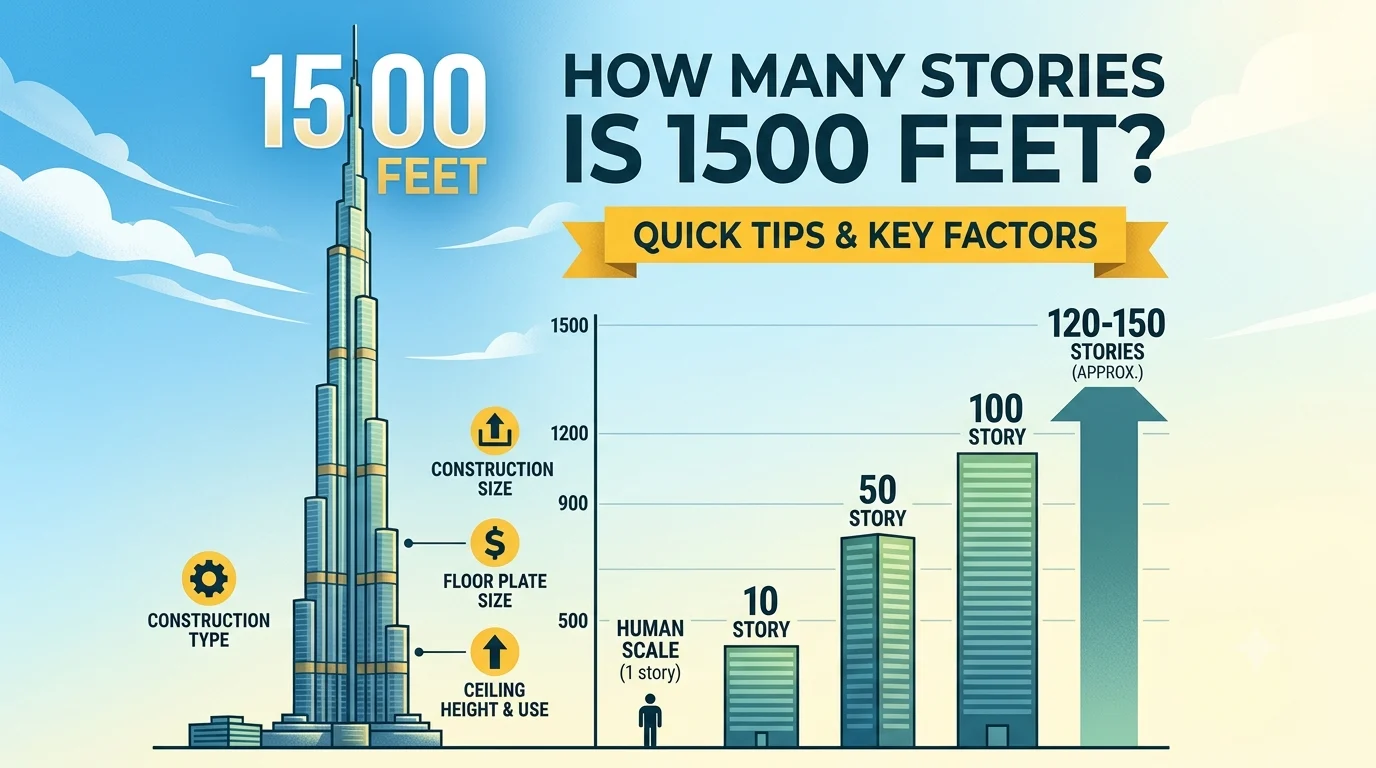
If you’ve ever wondered how many stories is 1500 feet, the answer depends on the type of building and the average height of each floor. While there is no single universal conversion, most buildings have floors that range from 10 to 15 feet tall.
Using standard building measurements, a 1500-foot-tall building is typically between 100 and 150 stories high, with many modern skyscrapers falling near the middle of that range.
Understanding how feet convert into stories is useful for comparing skyscrapers, planning construction projects, studying architecture, and satisfying curiosity about some of the world’s tallest buildings.
Quick Answer
A 1500-foot building is approximately:
| Average Height Per Story | Estimated Stories |
|---|---|
| 10 feet | 150 stories |
| 12 feet | 125 stories |
| 13 feet | 115 stories |
| 14 feet | 107 stories |
| 15 feet | 100 stories |
For most modern skyscrapers, 1500 feet equals roughly 100–125 stories.
Understanding Story Height
Before calculating the number of stories in a 1500-foot building, it’s important to understand what a story actually means.
A story (or floor) is the vertical space between one floor and the next. Different building types use different floor heights.
Average Residential Story Height
Residential buildings typically have:
- 8–10 foot ceilings
- Floor structure between levels
- Utility spaces
As a result, each residential story averages 10–12 feet per story.
A 1500-foot residential tower could therefore contain approximately:
- 125 stories at 12 feet each
- 150 stories at 10 feet each
Average Commercial Story Height
Office buildings generally require:
- Higher ceilings
- HVAC systems
- Electrical systems
- Raised flooring
Typical commercial story heights range from 12–15 feet per floor.
Using these dimensions:
- 1500 ÷ 12 = 125 stories
- 1500 ÷ 15 = 100 stories
Skyscraper Floor Heights
Super-tall skyscrapers often include:
- Observation decks
- Mechanical floors
- Luxury lobbies
- Structural support systems
These features increase average floor heights, meaning a 1500-foot skyscraper may have fewer stories than expected.
Many skyscrapers average 12–14 feet per floor, producing approximately 107–125 stories.
How to Calculate How Many Stories Is 1500 Feet
Calculating stories from height is straightforward.
Formula
Use this formula:
Number of Stories = Building Height ÷ Average Story Height
Examples
Example 1: Residential Building
Building height = 1500 feet
Average floor height = 10 feet
1500 ÷ 10 = 150
Result: 150 stories
Example 2: Office Tower
Building height = 1500 feet
Average floor height = 12 feet
1500 ÷ 12 = 125
Result: 125 stories
Example 3: Luxury Skyscraper
Building height = 1500 feet
Average floor height = 14 feet
1500 ÷ 14 ≈ 107
Result: About 107 stories
1500 Feet in Stories Conversion Chart
The chart below shows how story count changes based on floor height.
| Story Height | Stories in 1500 Feet |
|---|---|
| 9 feet | 167 |
| 10 feet | 150 |
| 11 feet | 136 |
| 12 feet | 125 |
| 13 feet | 115 |
| 14 feet | 107 |
| 15 feet | 100 |
| 16 feet | 94 |
| 18 feet | 83 |
This chart demonstrates why there is no exact answer to the question, “How many stories is 1500 feet?”
Factors That Affect Story Count
Several factors influence the number of floors in a building.
Building Type
Different structures have different requirements.
Residential Towers
- Lower ceilings
- More floors
Office Buildings
- Larger floor-to-floor distances
- Fewer floors
Hotels
- Moderate floor heights
Mixed-Use Towers
- Varying floor heights throughout the building
Ceiling Height
Higher ceilings create more spacious interiors but reduce the total number of stories.
For example:
- 10-foot floors = 150 stories
- 15-foot floors = 100 stories
That’s a difference of 50 floors.
Mechanical Floors
Tall skyscrapers contain mechanical levels that house:
- Elevators
- HVAC systems
- Water pumps
- Electrical equipment
These floors often occupy more vertical space than regular floors.
Architectural Design
Architectural elements can increase building height without adding usable floors.
Examples include:
- Decorative crowns
- Spires
- Observation structures
- Antennas
A building may be 1500 feet tall but have significantly fewer occupied floors.
Real-World Examples of 1500-Foot Buildings
Looking at famous skyscrapers helps put 1500 feet into perspective.
Famous Skyscrapers Near 1500 Feet
Many iconic towers around the world exceed or approach the 1500-foot mark.
Examples include:
| Building Type | Approximate Stories |
|---|---|
| Modern office skyscraper | 100–120 |
| Luxury residential tower | 110–130 |
| Mixed-use supertall tower | 100–125 |
Most buildings around 1500 feet tall contain approximately 100–125 occupied floors.
Height Comparisons
A 1500-foot building is:
- Nearly one-third of a mile tall
- About 457 meters high
- Taller than many city skylines
- Visible from long distances
Its height places it among the world’s elite skyscrapers.
How Tall Is 1500 Feet Compared to Everyday Objects?
Comparisons help visualize such a large height.
Football Fields
A standard football field is 300 feet long.
1500 feet equals:
5 football fields stacked vertically
Residential Homes
A typical two-story house is approximately 20 feet tall.
1500 ÷ 20 = 75
A 1500-foot tower is roughly as tall as:
75 two-story houses stacked on top of each other
City Blocks
Depending on location, 1500 feet can equal about:
4 to 5 city blocks
Trees
A mature tree often reaches 50 feet.
1500 ÷ 50 = 30
A 1500-foot building is about:
30 large trees stacked vertically
Benefits of Understanding Building Height Conversions
Knowing how to convert feet into stories has several practical uses.
Better Visualization
Most people understand floors better than raw height measurements.
Real Estate Analysis
Property professionals often compare buildings by story count.
Construction Planning
Builders and architects use floor-to-height calculations during project planning.
Educational Purposes
Students studying engineering, architecture, or mathematics frequently use these conversions.
Travel and Tourism
Visitors often compare famous skyscrapers by both height and number of stories.
Common Mistakes When Estimating Stories From Feet
Many people make inaccurate assumptions when converting building height.
Assuming Every Floor Is 10 Feet
Not all floors have identical heights.
Commercial and luxury buildings often use larger floor-to-floor distances.
Ignoring Mechanical Floors
Mechanical levels can significantly affect the final story count.
Forgetting Architectural Features
Spires and crowns add height but may not add usable floors.
Using Residential Standards for Skyscrapers
Super-tall buildings rarely follow standard residential floor heights.
Expecting an Exact Conversion
Building height conversions are estimates because floor heights vary widely.
Expert Tips for Estimating Stories Quickly
If you need a quick estimate:
- Divide by 10 for residential buildings.
- Divide by 12 for modern mixed-use towers.
- Divide by 14 for luxury skyscrapers.
- Divide by 15 for commercial office towers.
For most practical purposes:
1500 feet ÷ 12 = about 125 stories
This provides a reliable estimate in many situations.
Frequently Asked Questions
How many stories is 1500 feet exactly?
There is no exact answer because story heights vary. Most 1500-foot buildings range from 100 to 150 stories.
How many floors are in a 1500-foot skyscraper?
Most modern skyscrapers around 1500 feet tall have approximately 100–125 floors.
Is 1500 feet taller than a quarter mile?
Yes. A quarter mile equals 1320 feet, so 1500 feet is taller by 180 feet.
How many meters is 1500 feet?
1500 feet equals approximately 457.2 meters.
What average story height is used for skyscrapers?
Many skyscrapers use an average floor-to-floor height of 12–14 feet.
Conclusion
When asking how many stories is 1500 feet, the answer depends on the building’s design and average floor height. In general, a 1500-foot building contains between 100 and 150 stories, with about 125 stories being a common estimate for modern skyscrapers. By dividing the total height by the average floor-to-floor measurement, you can quickly estimate the number of stories in residential towers, office buildings, and supertall skyscrapers. Understanding these conversions makes it easier to compare famous buildings, evaluate construction projects, and visualize just how impressive a 1500-foot structure really is.