
Cornhole is one of the most popular backyard games played at gatherings, parties, and competitive events. It looks simple, but one question often confuses beginners: how many feet apart is cornhole?
The answer matters more than most people realize. The distance between the boards directly affects how easy or difficult the game feels, how fair the match is, and how consistent your practice becomes if you want to improve your skills.
In this guide, you will learn the official cornhole distance, how to set it up correctly, and how to adjust it for casual or competitive play.
What Is Cornhole and Why Distance Matters
Cornhole is a tossing game where players throw small fabric bags filled with corn or pellets toward a raised board with a hole near the top. The goal is to land the bag on the board for points or sink it into the hole for higher points.
While the game looks easy, accuracy depends heavily on distance control. That’s why the question how many feet apart is cornhole is so important.
If the boards are too close:
- The game becomes too easy
- Scoring becomes unrealistic
- Skill development slows down
If the boards are too far:
- Beginners get discouraged
- Throws become inconsistent
- The game loses fun for casual players
That’s why official measurements exist.
Official Answer: How Many Feet Apart Is Cornhole?
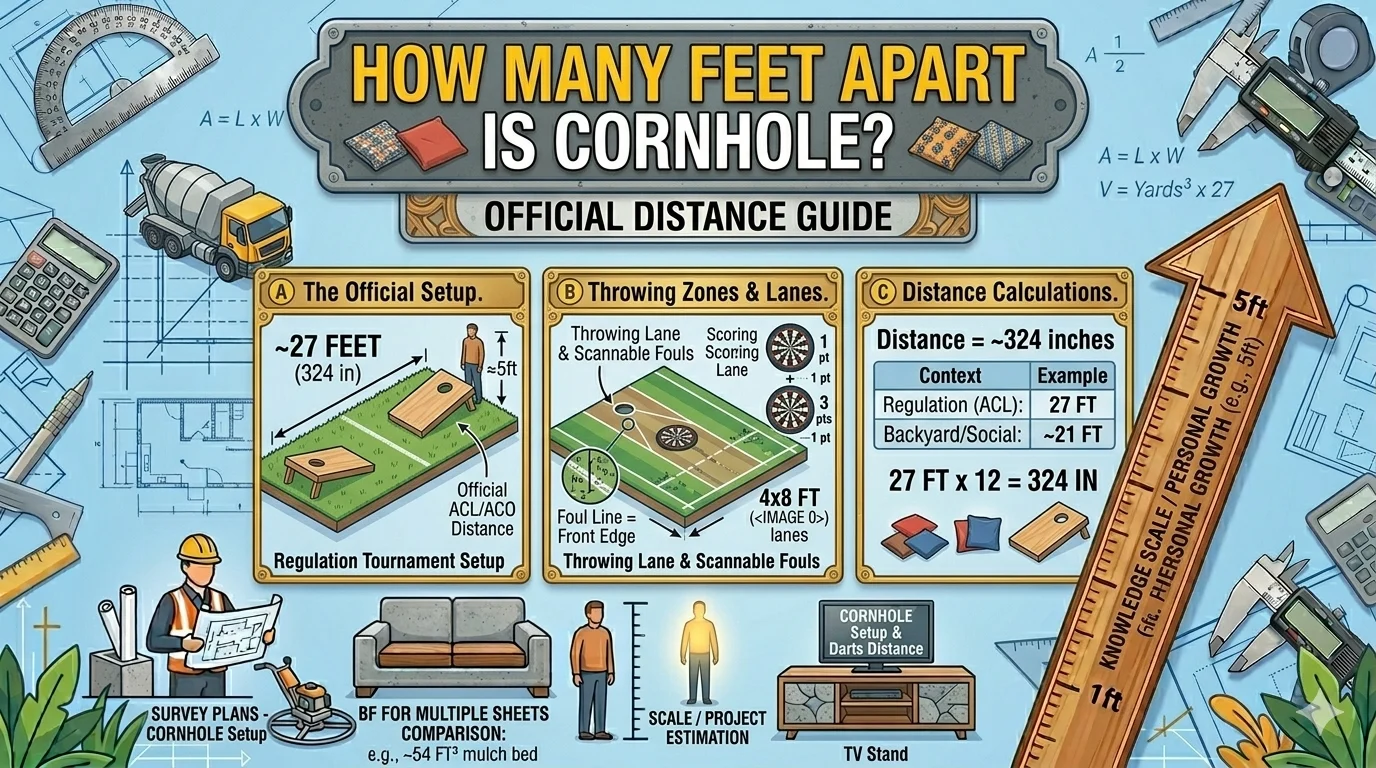
The standard regulation distance in cornhole is:
27 feet from front edge to front edge of the boards
This is the official measurement used in most tournaments and competitive games.
Important measurement detail:
- You measure from the front edge of one board to the front edge of the other
- Both boards must face each other directly
- Boards must remain parallel during play
This setup ensures fairness and consistency across all games.
Many beginners make the mistake of measuring from the center or back of the board, which changes the difficulty level and leads to incorrect setup.
Why 27 Feet Is the Standard Distance
The 27-foot distance is not random. It is carefully chosen to balance skill and fairness.
At this distance:
- Skilled players can aim with precision
- Beginners still have a chance to score
- Wind and force control matter
- Strategy becomes part of gameplay
It creates the perfect balance between challenge and fun.
Cornhole Distance for Different Players
Not everyone plays at tournament level. That’s why cornhole distance can be adjusted based on age and skill.
Here’s a simple breakdown:
- Professional / Tournament Play: 27 feet
- Standard Adult Backyard Play: 24–27 feet
- Beginners or Teens: 20–24 feet
- Kids: 15–20 feet
This flexibility is one of the reasons cornhole is so popular. You can adjust it without breaking the game.
Step-by-Step: How to Set Up Cornhole Correctly
Setting up cornhole properly is simple, but accuracy matters.
Step 1: Choose a flat surface
Pick a level area like:
- Grass lawn
- Driveway
- Indoor hall or gym
Avoid slopes or uneven ground because they affect how bags slide.
Step 2: Place the first board
Put one cornhole board firmly on the ground. Make sure it doesn’t wobble.
Step 3: Measure the distance
From the front edge of the first board, measure exactly 27 feet forward.
Use a measuring tape for accuracy.
Step 4: Place the second board
Position the second board at the measured point, facing directly toward the first board.
Step 5: Align both boards
Check that:
- Both boards are parallel
- Holes face each other
- Boards are not tilted sideways
Proper alignment ensures fair gameplay.
Cornhole Distance Chart (Quick Reference)
Here is a simple guide you can use anytime:
| Game Type | Distance | Difficulty |
|---|---|---|
| Tournament Play | 27 feet | Hard |
| Standard Adult Game | 24–27 feet | Medium |
| Family Backyard Game | 20–24 feet | Easy |
| Kids Game | 15–20 feet | Very Easy |
This chart helps you quickly adjust setup depending on who is playing.
Backyard Cornhole Setup (Flexible Rules)
In casual games, strict rules are often relaxed. Backyard cornhole is more about fun than competition.
That’s why many people adjust the distance based on:
- Age of players
- Space available
- Skill level
- Weather conditions
Common backyard setups include:
- 20 feet for beginners
- 22–24 feet for balanced play
- 27 feet for advanced practice
If you’re playing with family or kids, shortening the distance makes the game more enjoyable and keeps everyone engaged.
Common Mistakes When Setting Up Cornhole
Even though cornhole is simple, setup mistakes are very common.
1. Measuring from the wrong point
Many people measure from the center or back of the board instead of the front edge. This leads to incorrect distance.
2. Uneven ground
If the board is not level, bags may slide unfairly or behave unpredictably.
3. Wrong distance for skill level
Using full 27 feet for beginners can make the game frustrating.
4. Misaligned boards
Boards must face each other directly. Even slight angles affect throws.
5. Ignoring surface conditions
Wet grass or slippery concrete can change how bags land and slide.
Avoiding these mistakes improves the quality of every game.
Expert Tips for Better Cornhole Setup
If you want a smoother and more professional setup, follow these tips:
Always double-check measurements
Measure twice before starting play to avoid errors.
Mark your playing area
Use chalk or tape to mark board positions so setup is faster next time.
Practice at regulation distance
Even if you play casually, practicing at 27 feet improves your accuracy.
Adjust for wind
Outdoor wind can affect throws, especially at longer distances.
Use consistent bags
Uniform weight and texture of bags help improve performance.
Regulation vs Casual Cornhole Play
Understanding the difference helps you choose the right setup.
Regulation Play:
- Fixed 27 feet distance
- Strict rules
- Used in tournaments and competitions
- Focus on skill and precision
Casual Play:
- Flexible distance
- Relaxed rules
- Focus on fun and entertainment
- Adjustable difficulty
Both styles are valid depending on your goal.
Why Correct Distance Improves the Game
Using the correct spacing makes a big difference:
Better fairness
Both players have equal challenge.
Improved skill development
You learn proper aim and throwing strength.
More consistent gameplay
Every round feels balanced and predictable.
Easier transition to tournaments
You can switch to competitive play easily if you already practice at regulation distance.
More enjoyable experience
Balanced difficulty keeps the game fun for everyone.
Final Thoughts
So, how many feet apart is cornhole? The official answer is 27 feet from front edge to front edge. However, the best distance can vary depending on who is playing and the purpose of the game.
For competitive play, stick to 27 feet. For casual backyard fun, feel free to adjust between 20 and 24 feet for a more relaxed experience.
Once you understand and apply the correct distance, your cornhole setup becomes more accurate, fair, and enjoyable for everyone involved.